Research
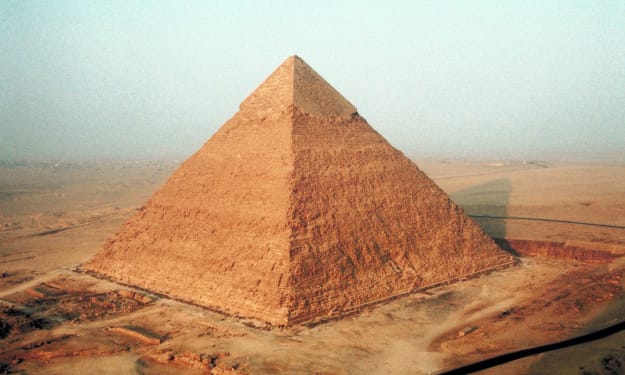
The Great Pyramid of Giza Has MORE Than Four Sides: The Hidden Truth Behind Egypt's Iconic Wonder. AI-Generated.
The Great Pyramid of Giza Has MORE Than Four Sides: The Hidden Truth Behind Egypt's Iconic Wonder The Great Pyramid of Giza, also known as the Pyramid of Khufu or Cheops, stands as one of the most remarkable architectural feats in human history. Constructed around 2560 BCE during Egypt’s Fourth Dynasty, this ancient wonder has intrigued scientists, historians, and travelers for centuries. While most people perceive the pyramid as a four-sided structure with a square base and four triangular faces, the truth is far more fascinating: The Great Pyramid of Giza actually has eight sides.
By Adnan Rasheed9 months ago in History
The Rise and Legacy of the Mughal Empire
The history of the Mughal Empire is one of grandeur, ambition, and complexity. Spanning over three centuries, this dynasty ruled much of South Asia, leaving behind a legacy that shaped the cultural, political, and architectural landscape of the Indian subcontinent. The Mughals, descendants of the great Central Asian conqueror Timur and the Mongol Empire, brought an era of prosperity, artistic brilliance, and remarkable political intrigue that reverberates in India’s heritage to this day.
By Haseeb Mujaddidi9 months ago in History
Iran and the Nuclear Weapons Controversy: A Geopolitical Flashpoint
Over the past two decades, Iran's nuclear program has been one of the most persistent and contentious issues in international politics. Despite Iran's insistence that its nuclear activities are solely for peaceful purposes, numerous nations, most notably the United States and its allies, have expressed serious concerns that Iran may be pursuing a nuclear weapons capability under the guise of a civilian program. In an effort to stop Iran from possessing a nuclear weapon in one of the world's most volatile regions, this issue has sparked years of diplomatic talks, sanctions, and tension in the region. Background: In the 1950s, Iran began its nuclear program with assistance from the United States as part of the "Atoms for Peace" initiative. Following the Islamic Revolution in 1979, both the program and international cooperation slowed down. By the end of the 1990s and the beginning of the 2000s, there was evidence that Iran was pursuing enrichment technology and other components that could be linked to the production of nuclear weapons.
By Sayem Khan9 months ago in History
The Lost City of 200,000 Years: Africa’s Forgotten Civilization
A Lost Chapter of Human History In the rolling hills of South Africa, far from the eyes of the world, lie thousands of circular stone structures that have puzzled scientists, historians, and seekers of truth for decades. These ruins stretch over hundreds of kilometers and form an intricate network of ancient walls, roads, and complex settlements. They whisper of a past that is far older than we ever imagined, a past that may rewrite the story of humanity.
By The Secret History Of The World9 months ago in History
Naupa and the Secrets of Hyperborea: Has a Lost Arctic Civilization Been Discovered?
Whispers from the Ice In the furthest reaches of our imagination lies a land not found on modern maps. A forgotten kingdom beyond the north wind. A realm veiled in snow, mystery, and silence, Hyperborea. Ancient Greek philosophers and mystics once spoke of it in hushed tones, describing a radiant civilization untouched by time, blessed by the gods, and protected beneath the dancing veil of aurora.
By The Secret History Of The World9 months ago in History
Celtic Halloween. AI-Generated.
In the west of Ireland, on the night of October 31st, a peculiar atmosphere descended upon the villages, as if the very air were charged with an unseen energy. The evening hung in the balance, caught between the fading warmth of summer and the biting chill of winter, a time when the natural world itself seemed to hold its breath.
By ADIR SEGAL9 months ago in History
Australian PM Anthony Albanese wins re-election
Anthony Albanese won a historic re-election on May 3, 2025. He became the first Australian Prime Minister to serve a full term and be re-elected since 2004. Sky News election analyst Tom Connell called the election for Labor at 8:19 p.m., and by 9 p.m., it was confirmed that Albanese would form a majority government. During his emotional victory speech at Canterbury-Hurlstone Park RSL, Albanese expressed deep gratitude and a strong sense of responsibility, calling it the greatest honor of his life to serve as Prime Minister. In addition, Senator Penny Wong addressed the gathering to express her gratitude to the volunteers and supporters for their faith in the Labor Party and Australia's future. Opposition Leader Peter Dutton conceded defeat and congratulated Albanese, commending his leadership and honoring his personal milestone as a moment that would make his late mother proud .
By Md Faruk Ali9 months ago in History
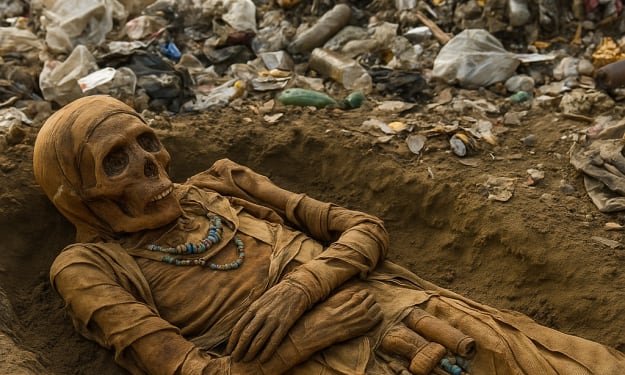
Archaeologists Found a Stunningly Preserved 5,000-Year-Old Mummy in a Garbage Dump. AI-Generated.
Archaeologists Found a Stunningly Preserved 5,000-Year-Old Mummy in a Garbage Dump In an extraordinary discovery that has stunned the archaeological world, a remarkably well-preserved 5,000-year-old mummy was unearthed—not in the heart of an ancient burial chamber, but in a modern garbage dump. This unexpected find has not only challenged conventional notions of where historical artifacts can be found but also opened new avenues for understanding ancient civilizations and their burial practices.
By Adnan Rasheed9 months ago in History
Modern Science and Its Impact on the Future. Content Warning. AI-Generated.
Modern science is one of the most powerful tools shaping the world today. It helps us understand the universe, solve real-world problems, and improve the quality of human life. From medicine and technology to environmental solutions and space exploration, science is playing a key role in building a better future.
By Sadik rocker9 months ago in History