Places
A Historical Account of Difference: A Comparative History of the Literary Cultures of Lat- in America
Abstract: In his article "A Historical Account of Difference: A Comparative History of the Literary Cultures of Latin America," Mario J. Valdés addresses the well-recognized limitations of literary history as historical research. Valdés outlines the theoretical thinking that has guided the editors of The Oxford Comparative History of Latin American Literary Cultures to plan, organize, and com- plete the first history of literary culture of Latin America. The project is comparative, recognizing the radical diversity of the continent while at the same time it is an open-ended history that in- forms but does not attempt to provide a totalizing account of more than five hundred years of cul- tural development among the heterogeneous entities that make up Latin America. Valdés begins by considering the paradox of literary history, he then suggests ways that literary history can be shaped by the work of Michel Foucault, and he proposes a framework for a hermeneutics of literary history. Valdés also considers the challenges that face the literary historian whose work now in- cludes cultural history. All of these considerations are then placed within the context of an effort to create a literary and cultural history of Latin America.
By Silas Blackwood8 months ago in History
2024 Election Fallout: Supreme Court Rules on Trump’s Immunity Case
Introduction In a historic decision that could reshape the future of U.S. presidential accountability, the Supreme Court ruled on former President Donald Trump’s immunity case in 2024. The case, Trump v. United States, centered on whether a former president enjoys absolute immunity from criminal prosecution for actions taken while in office. The ruling not only impacts Trump’s multiple legal battles but also sets a precedent for the limits of executive power. This article examines the Court’s decision, its legal and political implications, and the potential consequences for the 2024 election and beyond. Background: The Legal Battle Over Presidential Immunity
By Silas Blackwood8 months ago in History
World’s Oldest Pyramid Built 25,000 Years Ago Was Not Made by Humans Archaeologists Claim
World’s Oldest Pyramid Built 25,000 Years Ago Was Not Made by Humans Archaeologists Claim In a groundbreaking claim that challenges everything we thought we knew about ancient civilizations and the timeline of human history archaeologists have unearthed what they believe could be the world’s oldest pyramid predating Egypt’s iconic pyramids by over 20,000 years. But what’s truly shocking is not just its age but the belief that it was not constructed by human hands. The site located in the heart of Indonesia’s Java island and referred to as Gunung Padang has long been a source of mystery and legend. For years local folklore spoke of a sacred mountain with unexplained energies and ancient secrets. Now with extensive carbon dating ground penetrating radar and 3D imaging researchers have uncovered a massive structure hidden beneath what was once believed to be a natural hill. And their findings are rewriting the pages of prehistory.
By Adnan Rasheed8 months ago in History
Alexander the Great and the Indian Dragon: Legend, Mystery, or Forgotten History?
A Conqueror's Path Meets the Unknown Alexander the Great is one of history’s most legendary figures. Born in 356 BCE in Macedonia, his military campaigns that extended from Greece to Egypt, Persia, and as far as the borders of India. By the age of 30, he had conquered most of the known world. But it wasn’t just empires and armies he encountered along his path. According to a few ancient accounts, he may have come face-to-face with something far more mysterious, something that some describe as a dragon.
By The Secret History Of The World8 months ago in History
The Battle of Karansebes, 1788: The Austrian Army Accidentally Fighting Itself in the Chaos of War
Among the most bewildering and farcical episodes in military history, the Battle of Karansebes stands out as a stunning example of miscommunication, panic, and human error spiraling out of control. Fought during the Austro-Turkish War of 1787–1791, the event is infamous not for a valiant clash with the Ottoman enemy, but for a chaotic episode where an Austrian army ended up attacking itself. Taking place on the night of September 17–18, 1788, in what is now modern-day Romania, the so-called battle involved confusion, fear, and an abundance of alcohol - ultimately leading to hundreds of Austrian soldiers dead or wounded by friendly fire, long before the Ottomans even arrived.
By Kek Viktor8 months ago in History
🌷 The Tulip Mania Bubble in the Dutch Republic, 1636–1637: When Tulip Bulbs Became the World's Most Valuable Commodities Before the Crash
🏩 Part 1: A Blooming Republic - The Dutch Golden Age and the Rise of the Tulip In the early 17th century, the Dutch Republic stood at the pinnacle of European power and prosperity. This confederation of provinces, recently liberated from Spanish rule after decades of conflict, had rapidly evolved into a formidable maritime, financial, and cultural powerhouse. The Dutch Golden Age, as historians now call it, was marked by explosive growth in global trade, scientific exploration, art, and banking.
By Kek Viktor8 months ago in History
Have We Misunderstood Our Past? 12,000-Year-Old Calendar Found in Turkey Rewrites Human History
Have We Misunderstood Our Past? 12,000-Year-Old Calendar Found in Turkey Rewrites Human History Imagine standing in front of a towering stone carved by hands that lived 12,000 years ago. No cities no written language no smartphones just a community of early humans looking up at the sky and trying to understand their place in the universe. In southern Turkey near the city of Şanlıurfa lies Göbekli Tepe an ancient archaeological site that continues to puzzle and fascinate scientists. But now a recent discovery at this site may shake the very foundations of our understanding of history a calendar older than any known system of timekeeping in the world.
By Adnan Rasheed8 months ago in History
Whispers of the Lost River
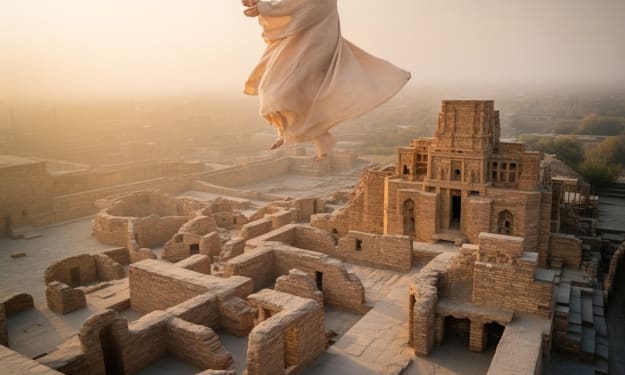
In the twilight of history, where time itself lingers like a mystic dervish spinning in silence, the Indus Valley Civilization once breathed with a rhythm as ancient as the stars. It was not merely a cluster of mud-brick cities etched along a river’s edge—it was a hymn sung in clay, stone, and spirit. Before Babylon dreamed of ziggurats or the Nile whispered secrets to the pyramids, the Indus had already woven a tapestry of life where the sacred and the mundane danced hand in hand.
By Kaleem Ullah 8 months ago in History