
Whispers of the Lost River
A Sufi-Inspired Journey into the Soul of the Indus Valley Civilization

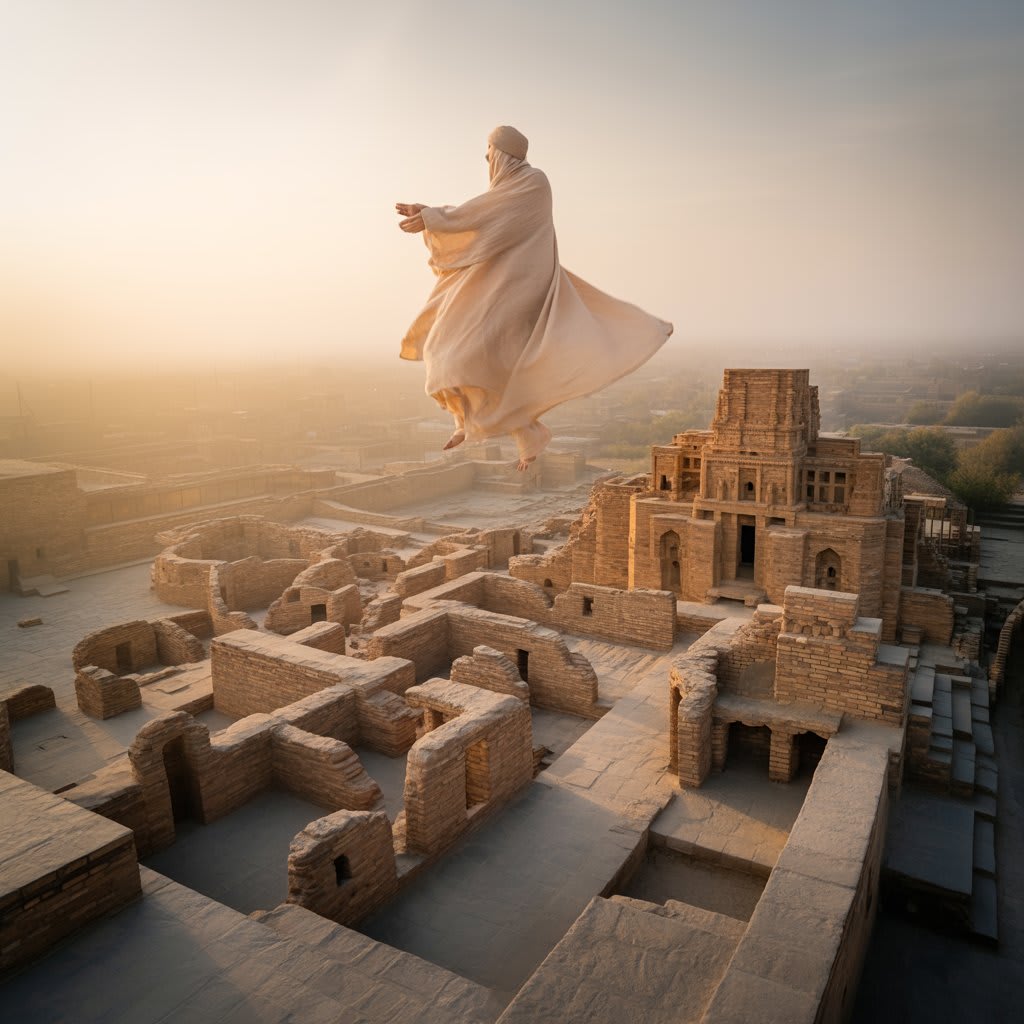
In the twilight of history, where time itself lingers like a mystic dervish spinning in silence, the Indus Valley Civilization once breathed with a rhythm as ancient as the stars. It was not merely a cluster of mud-brick cities etched along a river’s edge—it was a hymn sung in clay, stone, and spirit. Before Babylon dreamed of ziggurats or the Nile whispered secrets to the pyramids, the Indus had already woven a tapestry of life where the sacred and the mundane danced hand in hand.
It is said by Sufi sages that every soul is born from a divine sigh, a breath of beauty that carries the essence of truth. So too was this civilization—a sigh of the earth, born of water, fire, wind, and silence.
The River That Remembered
The Indus River, known in whispers as Sindhu, did not simply carve valleys; it carved destinies. It was the bearer of stories and the drinker of time. On its sacred banks bloomed cities like Harappa and Mohenjo-daro, where people moved in harmony, their lives choreographed like the turning of prayer beads.
Unlike the kingdoms of war that roared elsewhere, the Indus people were quiet architects of peace. Their cities were not built for conquest but for communion—with nature, with each other, and perhaps, with the divine.
Streets ran straight, as if in meditation. Homes, humble yet wise, bore no thrones, no grand palaces, no signs of kings. No temples scraped the sky. Instead, wells were dug deep—perhaps to drink from the same silence the mystics later sought. The Great Bath of Mohenjo-daro, still echoing with droplets unseen, hints not at mere hygiene but a ritual of purification. In its waters, one might imagine pilgrims washing off the dust of illusion.
A People of Gentle Strength
They left behind no tales of bloody conquest. No records of dynastic arrogance. Only seals pressed with animal motifs and undeciphered script—fragments of thought suspended like Sufi verses waiting to be understood by hearts rather than eyes.
What wisdom did they guard so quietly? What song hummed through their pottery and jewelry, their games and grain stores?
Perhaps their true temple was life itself. Perhaps they saw no boundary between the sacred and the everyday. A potter shaping clay was no less than a priest shaping spirit. A farmer coaxing wheat from soil was a poet whispering couplets into the ears of the earth.
Trade routes blossomed like gardens, connecting them not only to lands far beyond—Mesopotamia, Central Asia, the Arabian Gulf—but to the idea of shared humanity. They traded beads and lapis lazuli, yes—but perhaps, too, they traded silence and understanding. Perhaps in every transaction was a gesture of trust, a recognition of divine presence in the other.
Mystery as the Message
It is the silence of the Indus that speaks most. Their language, etched in delicate script upon terracotta seals, remains unread. But maybe, just maybe, they never meant it to be read with the eyes. Maybe their script was for the heart—a mantra not to be translated but to be felt.
In this silence, the Sufi finds kinship.
Rumi once said, “Silence is the language of God, all else is poor translation.” The Indus people, then, may have been early disciples of this ineffable tongue. What they left behind is not a riddle to be solved, but a presence to be experienced.
Their disappearance, too, is not a tragedy but a transcendence. Civilizations often die with a scream; the Indus vanished like a breath returning to the Beloved. No great wars, no plagues carved on walls. Just a slow ebbing, like the river that gave them life retreating to some higher realm.
The Soul’s Architecture
Walk through the ruins of Mohenjo-daro, and you may still hear it—the quiet dignity of baked brick, the geometry of spirit made manifest. Every courtyard, every granary, every drain whispers that life is sacred when lived with balance.
Their cities mirrored a philosophy later echoed by Sufi thought: that heaven is not above but within; that order and beauty arise from inner clarity.
Could it be that the Indus people were the first mystics of the subcontinent? That their unbroken harmony with nature, their measured life, and their graceful exit from history were all part of a deeper truth?
Sufis speak of fana—the annihilation of the ego, the merging into the divine. What if the Indus did not fall but simply melted into time, leaving behind no kings or battles, only stillness? What if their ruins are not reminders of loss, but doorways to that truth?
Legacy of Light
Today, in Pakistan’s Sindh and Punjab, or India's Gujarat and Haryana, children still play near those sacred mounds. Farmers till the same soil. The river still flows, though thinner now, as if mourning or remembering.
Sufi shrines dot the landscape now—at Sehwan, Multan, and beyond. Pilgrims gather, spinning in trance, seeking the same truth the Indus may have once lived: that God is in the grain of the brick, in the flow of the river, in the breath of the wind.
Archaeologists study the material remains, but perhaps the Indus Valley’s real inheritance lies not in what is seen but what is felt. It is in the patience of the potter, the silence between words, the space between heartbeats.
As you hold a shard of their pottery or gaze at their seals in a museum, close your eyes. Listen. You may just hear the song they left behind.
Not a song of war or power.
But a lullaby of balance.
A whisper of harmony.
A sigh of the eternal.
“We came whirling out of nothingness, scattering stars like dust... The stars made a circle, and in the middle we dance.”
— Rumi
And perhaps, long before Rumi, it was the Indus that danced first.
About the Creator
Kaleem Ullah
Hi everyone well come to my profile enjoy your day with in best story.
Keep reading
More stories from Kaleem Ullah and writers in History and other communities.
The Question of the Silent Chair
The golden light of evening slowly crept across the faded walls of a small, quiet room. In one dimly lit corner stood an old wooden chair — silent, weathered, and heavy with the weight of untold stories. And there, on that very chair, Ahmed sat every evening. His arms folded tightly, his brows furrowed, and his eyes fixed on the ground as if searching for answers buried deep beneath the floor.
By Kaleem Ullah 10 months ago in Motivation
Ashoka: The Emperor Who Turned Conquest into Compassion
History remembers many conquerors, emperors, and rulers who built vast empires through military strength and strategic brilliance. Names such as Alexander the Great, Julius Caesar, and Augustus often dominate the narrative of ancient political power. Yet among these figures stands a ruler whose legacy is unique not because of conquest alone, but because of a profound moral transformation that reshaped the very meaning of governance.
By Arjun. S. Gaikwad6 days ago in History



Comments
There are no comments for this story
Be the first to respond and start the conversation.