Narratives
Unbelievable! Man Survives 3 Days in Ocean's Depths
Unbelievable! Man Survives 3 Days in Ocean's Depths The vast mysterious depths of the ocean have long been a source of awe fear and fascination for humankind. Countless stories have emerged over the years about individuals lost at sea some surviving against all odds while others vanish without a trace. However the recent case of a man who survived for three days in the ocean’s depths is nothing short of miraculous. His tale is not just one of endurance but a testament to the incredible resilience of the human spirit. It all began when the man whose name has not been disclosed for privacy reasons embarked on what was supposed to be an ordinary maritime journey. A seasoned sailor he had spent years navigating the seas and was well aware of the unpredictable nature of the ocean. On this particular voyage however fate had a different plan for him. The vessel he was traveling on encountered a sudden and violent storm with towering waves crashing down relentlessly. Despite his best efforts to steer through the chaos the boat succumbed to the overwhelming force of nature plunging into the ocean’s depths. Most would assume that such an accident would be fatal as the deep sea is an unforgiving place with extreme conditions including crushing pressure darkness and a lack of oxygen. Yet what happened next defied all logic. Instead of drowning or succumbing to the inhospitable environment the man found himself in a pocket of air trapped within the wreckage of the boat. It was a scenario few could ever imagine let alone survive.
By Adnan Rasheed11 months ago in History
"From Heroines to Equals: The Unfinished Journey of Women in Kosovo"
In honor of International Women’s Day, I want to share some reflections on the evolving role of women in Kosovo—a journey marked by sacrifice, resilience, and the slow but steady push for equality.
By Zana Sokoli11 months ago in History
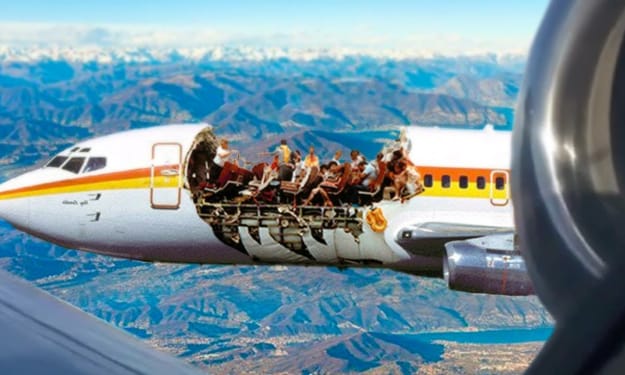
This Airplane lost its roof at 24000 fits what happened next?
This Airplane lost its roof at 24000 fits what happened next? On a seemingly routine flight passengers and crew aboard an aircraft at 24,000 feet experienced a nightmare scenario part of the plane’s roof suddenly tore away exposing them to the open sky. What followed was a dramatic struggle for survival a test of human resilience and an investigation into the causes of such a catastrophic event. The moment the roof separated from the fuselage an explosive decompression occurred. The air inside the cabin which was pressurized to mimic conditions at a much lower altitude rushed out violently. Anything that was not securely fastened loose objects, papers even lightweight belongings was immediately sucked out into the sky. The deafening roar of wind replaced all other sounds making communication nearly impossible. For those on board the experience was both terrifying and disorienting. Passengers and crew who were not wearing seatbelts felt an immense force pulling at them. Some who were unlucky enough to be near the area of structural failure were partially ejected held back only by their seatbelts or the sheer luck of their position. The temperature inside the aircraft plummeted instantly dropping to well below freezing as the cabin lost its ability to regulate heat. Breathing became difficult because the rapid decompression caused a significant reduction in oxygen levels.
By Adnan Rasheed11 months ago in History
Caral-Supe
Nestled in the depths of the Peruvian desert, where the sun relentlessly beats down and the winds carry whispers of the past, resides the birthplace of the Americas' earliest civilization. Long before the Inca Empire ascended to prominence and even prior to the Olmecs of Mesoamerica sculpting their monumental heads, the Caral-Supe civilization thrived along the dry coastline of present-day northern Peru. This mysterious culture, which dates back to 3700 BCE, predates the construction of the pyramids at Giza and serves as a remarkable example of human creativity and endurance. Its narrative is characterized by collaboration, innovation, and an extraordinary lack of violence—a notable exception in the history of ancient societies.
By A História11 months ago in History
The Beatles, Dodger Stadium, 1966
The following is an excerpt of a much longer short story. It’s 95% true. It's autobiographical. I actually lived this moment. We were a car full of stupid 16 year old kids that just didn’t want to miss this concert. We did a 60 minute drive in Los Angeles rush hour traffic in about 20 minutes. But we got there and I lived to tell about it. We were there. The Beatles second to last live concert they ever gave in the USA.
By Larry hart11 months ago in History
One Wrong Turn That Sparked World War
One Wrong Turn That Sparked World War World War I one of the deadliest conflicts in human history was ignited by a series of complex political economic and military factors. However at the heart of it all was a single event an assassination that in many ways can be seen as the result of one wrong turn. The fateful decision that led Archduke Franz Ferdinand’s car down the wrong street on June 28, 1914 changed the course of history setting off a chain reaction that led to global warfare. This incident though seemingly insignificant in the grand scheme of things played a pivotal role in the outbreak of World War I. The political landscape of early 20th century Europe was marked by tensions alliances and nationalist movements. Austria Hungary a vast empire struggling with internal ethnic divisions found itself facing a growing wave of Slavic nationalism particularly from Serbia. The Austro Hungarian Empire viewed Serbia as a threat suspecting that it was encouraging separatist movements within its borders. Meanwhile Serbia emboldened by its recent victories in the Balkan Wars sought to expand its influence particularly over territories where Slavic populations resided. This growing animosity created a volatile situation one that needed only a spark to erupt into full scale war.
By Adnan Rasheed11 months ago in History
Hitler's Last 10 Days
Hitler's Last 10 Days The last ten days of Adolf Hitler’s life are among the most significant and dramatic moments in history. By April 1945 World War II was nearing its end and Nazi Germany was on the verge of complete collapse. Soviet forces were closing in on Berlin and Hitler had chosen to remain in the capital refusing to flee. He had taken refuge in the Führerbunker an underground shelter beneath the Reich Chancellery where he was surrounded by his closest advisors guards and staff. Outside Berlin was crumbling under relentless bombardment but inside the bunker Hitler was trapped in a world where delusion and reality had blurred. April 20, 1945 marked Hitler’s 56th birthday but it was far from a celebration. High ranking Nazi officials like Joseph Goebbels and other loyalists formally congratulated him, but the atmosphere was grim. As he stepped out of the bunker he met with a group of young soldiers many just sixteen or seventeen who had been hastily recruited to defend Berlin. He shook their hands knowing well that they were untrained and stood little chance against the advancing Soviet army. Yet he remained fixated on his belief that Germany could still turn the war around. In the following days as Soviet forces pushed deeper into Berlin Hitler’s psychological state deteriorated rapidly. He held frequent meetings with his generals demanding updates but every report was bleak. By April 22 during a heated conference he erupted in rage accusing his commanders of betraying him and failing to follow his orders. It was at this moment that he first openly admitted that Germany had lost the war. His generals realizing the futility of resistance knew that staying in Berlin meant certain death. However no one dared to contradict him.
By Adnan Rasheed11 months ago in History
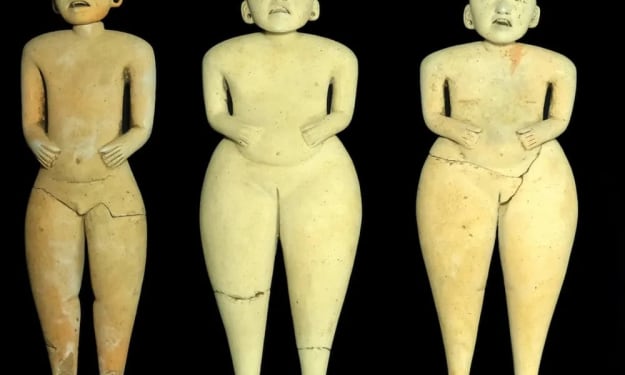
Archaeologists Unearth Ancient Clay Puppets With Open Mouths and Detachable Heads That Resemble Modern Toy Dolls
Archaeologists Unearth Ancient Clay Puppets With Open Mouths and Detachable Heads That Resemble Modern Toy Dolls. The recent discovery of ancient clay puppets in El Salvador has opened a fascinating window into the lives and culture of a Mesoamerican society that thrived over two millennia ago. Unearthed by archaeologists Jan Szymański and Gabriela Prejs from the University of Warsaw these figurines were found atop a ruined pyramid at the San Isidro site. Dating back approximately 2,400 years these artifacts known as Bolinas figurines, are rare and have been found at other Central American sites. Their intricate design including open mouths and detachable heads suggests they may have played a role in rituals storytelling or entertainment. This discovery not only adds to the understanding of Mesoamerican societies but also raises intriguing questions about their social structures artistic expressions and technological capabilities. The Bolinas figurines are remarkable in their craftsmanship. They are not simply static representations of human figures instead they possess movable parts making them unique among the artistic relics of ancient civilizations. Each puppet like figure features a hollow body an open mouth and a detachable head allowing for movement and possibly even manipulation akin to modern toy dolls or marionettes. The level of detail suggests that they were created with a specific purpose in mind possibly for ceremonial or theatrical use.
By Adnan Rasheed11 months ago in History
Epic Battles
In a time when legends were born on the battlefield and destiny was forged by the clash of steel, one battle stood as a turning point in the fate of empires. This is the story of the Battle of Aetherion, a confrontation that would echo through the corridors of history, where warriors fought not only for territory but for honor, freedom, and the future of their people.
By OWOYELE JEREMIAH11 months ago in History
The Goddess Kamakshi: A Source of Unconditional Love and Protection for Her Devotees
Introduction: The Compassionate Heart of Kamakshi Amman At the heart of Kanchipuram, one of the most revered cities in Tamil Nadu, stands the Kamakshi Amman Temple, dedicated to Sri Kamakshi Ambal, the goddess of unconditional love and protection. Kamakshi, known as the embodiment of the divine feminine energy (Shakti), holds a unique place in the hearts of her devotees. Her essence represents compassion, grace, and care, guiding all those who seek her blessings towards spiritual peace and protection.
By Sri Kamakshi Ambal Temple11 months ago in History