Lessons
Timeless Glory: Colosseum’s Enduring Legacy
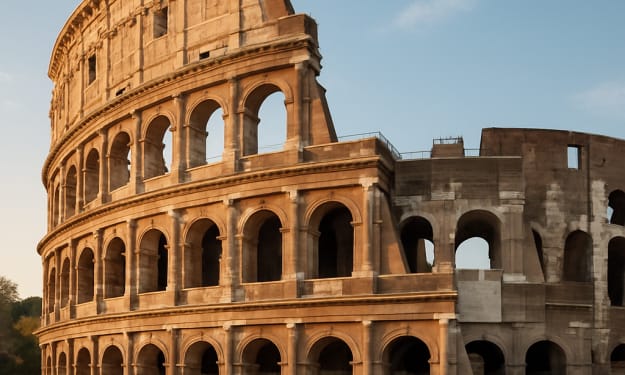
Rising majestically in the heart of Rome, the Colosseum stands as one of the most iconic and enduring symbols of the Roman Empire. Known in ancient times as the Flavian Amphitheatre, this monumental structure was commissioned around 70–72 AD by Emperor Vespasian of the Flavian dynasty and completed by his son Titus in 80 AD. Built to demonstrate the might of the new regime, the Colosseum served not just as a center for entertainment but also as a powerful tool for political propaganda, showcasing the glory, wealth, and engineering genius of the empire.
By Mukhtiar Ahmad8 months ago in History
Timeless Majesty of Giza Pyramids
Rising from the golden sands of the Giza Plateau, just outside modern-day Cairo, the Pyramids of Giza are among the most iconic and enduring symbols of ancient Egypt. These colossal monuments—the Great Pyramid of Khufu, the Pyramid of Khafre, and the Pyramid of Menkaure—were constructed during Egypt’s Fourth Dynasty, over 4,500 years ago. They are not only architectural marvels but also bear powerful testimony to the grandeur, innovation, and spiritual depth of ancient Egyptian civilization.
By Mukhtiar Ahmad8 months ago in History
"I Spent a Week Living Like a 19th Century Aristocrat — Here’s What Modern Life Has Completely Forgotten"
My best friend, a history nerd with a flair for dramatics, challenged me to live an entire week like a 19th-century aristocrat. No electricity. No phones. No Uber Eats. Just corsets, candlelight, and carriages—or at least, their closest modern-day equivalents. I laughed. How hard could it be? A week of tea, long baths, and lounging around in lace sounded like a luxury spa retreat. Right?
By Nizam khan8 months ago in History
Why the Past 10 Years of American Life Have Been Uniquely Stupid
The past decade in America has been marked by a peculiar kind of chaos—one that feels both unprecedented and self-inflicted. From political dysfunction to social media-fueled outrage, from the erosion of public trust to the glorification of ignorance, the 2010s and early 2020s have often seemed like an experiment in mass irrationality. But why has American life felt so uniquely stupid in recent years? The answer lies in a combination of technological disruption, political polarization, economic anxiety, and cultural decay. These forces have converged to create an era where bad ideas spread faster than good ones, where institutions crumble under the weight of distrust, and where public discourse often feels like a race to the bottom.
By Silas Blackwood8 months ago in History
Timeless Beauty of India's Taj Mahal
The Taj Mahal: A Monument of Eternal Love and Timeless Legacy The Taj Mahal, one of the most iconic and revered architectural wonders of the world, stands in Agra, India, as a symbol of love, loss, and artistic brilliance. Commissioned in 1632 by the Mughal emperor Shah Jahan, this breathtaking white marble mausoleum was built in memory of his beloved wife Mumtaz Mahal, who died during childbirth. Over the centuries, the Taj Mahal has come to represent not only the grandeur of Mughal architecture but also the deep personal love story that inspired its creation.
By Mukhtiar Ahmad8 months ago in History
The female horror film audience : viewing pleasures and fan practices. Part: 03
front a) mixed sex groups (usually) b) couples (often) c) female groups (sometimes) d) male groups (rare) middle a) couples b) groups (mixed sex?) rear a) couples b) female pairs or groups c) lone males (old)5 d) lone males (young) Even assuming that women make up only a small proportion of the mixed sex groups (these may well be dominated by males), anywhere between 25 and 50 per cent of Twitchell's audience could well be female. Clover's breakdown of the audience (p. 6) offers a slightly different picture: At theatre screenings ... the constituencies typically breakdown, in order of size, as follows: young men, frequently in groups but also solo; male-female couples of various ages (though mostly young); solo 'rogue males' (older men of ominous appearance andlor reactions); and adolescent girls in groups. Clover did not collect any data or make any personal observations of the cinema audience, instead relying on data reported by Austin (1983). She did, however, conduct a small scale survey of video rentals (p. 6-7), but these were from a very small sample of video stores and should not be taken as statistically significant. Clover collected rental figures for two rape-revenge films from three rental outlets in the San Francisco area for four weeks. Results showed that between 80 and 90 per cent of renters were male and renters of both sexes were mostly in their early twenties. However, these figures are unlikely to give any indication of who viewed the film once it had left the store. The mixed-sex group is notably absent from Clover's cinema audience. She also maintains that young men in single sex groups make up most of the audience, whereas Twitchell rarely or never saw such groups. Clover ranks all female groups as the lowest proportion of the audience, yet Twitchell's observations seem to contradict this. It may be that Clover and Twitchell are reporting on audiences from different geographical or class backgrounds, or different generic or historic audiences; it may also be possible that, while the adolescent male remains the majority viewer of the 80s slasher film, Clover.
By Silas Blackwood8 months ago in History
TikTok Banned? Congress Passes Bill Forcing Sale or Shutdown
Introduction In a landmark decision, the U.S. Congress has passed a bill that could force the sale or complete shutdown of TikTok, the wildly popular social media platform owned by China-based ByteDance. The move comes after years of bipartisan concerns over national security risks, data privacy, and potential Chinese government influence over the app. The bill, signed into law by President Joe Biden as part of a larger foreign aid package, gives ByteDance up to nine months to divest TikTok’s U.S. operations or face an outright ban. This decision has sparked intense debate, with supporters arguing it’s necessary to protect Americans’ data, while critics claim it infringes on free speech and sets a dangerous precedent for government intervention in tech. In this article, we’ll explore: The reasons behind the TikTok ban The legal and political process leading to the bill’s passage TikTok’s response and potential legal challenges The implications for users, creators, and the social media landscape What happens next in the battle over TikTok’s future Why Is TikTok Facing a Ban? 1. National Security Concerns The primary argument against TikTok stems from fears that the Chinese government could access sensitive U.S. user data or manipulate content for propaganda purposes. U.S. officials have long warned that under China’s 2017 National Intelligence Law, companies like ByteDance could be compelled to share data with Beijing. While TikTok denies these allegations, reports have suggested that ByteDance employees in China accessed U.S. user data, raising red flags among intelligence agencies. The FBI and Department of Justice (DOJ) have repeatedly warned that TikTok poses espionage and influence operation risks. 2. Data Privacy Issues TikTok collects vast amounts of user data, including: Location information Device identifiers Browsing history Biometric data (like faceprints) Although TikTok claims U.S. user data is stored in Texas (via Oracle Cloud servers), skeptics argue that Chinese laws could still force ByteDance to hand over this information. 3. Influence Over U.S. Public Opinion Lawmakers worry that TikTok’s algorithm could be weaponized to spread misinformation or suppress certain political content. During the 2024 election cycle, concerns grew that the platform could be used to sway young voters—a key demographic that heavily uses TikTok. 4. Previous Attempts to Ban TikTok This isn’t the first time the U.S. has tried to restrict TikTok: 2020: The Trump administration attempted to ban TikTok unless it was sold to a U.S. company (Microsoft or Oracle were potential buyers). Courts blocked the move. 2022: The RESTRICT Act was introduced, proposing broad powers to ban foreign-owned apps. 2023: Several states and federal agencies banned TikTok on government devices. The new law is the most aggressive action yet, forcing ByteDance to sell TikTok within 270 days (with a possible 90-day extension) or face removal from U.S. app stores. How Did the TikTok Ban Bill Pass? Bipartisan Support in Congress The bill gained rare bipartisan backing, with both Republicans and Democrats agreeing on national security risks. Key moments in its passage: April 2024: The House passed the bill 352-65 as part of a foreign aid package. April 23, 2024: The Senate approved it 79-18. April 24, 2024: President Biden signed it into law. Why Now? Several factors accelerated the bill’s passage: Geopolitical tensions with China (Taiwan, trade wars, spy balloon incident). Election-year pressure to act on tech security. Lobbying from Meta (Facebook/Instagram) and Google, which stand to gain if TikTok is removed. TikTok’s Lobbying Efforts TikTok spent millions fighting the bill, including: Running ads urging users to call Congress. Mobilizing influencers to oppose the ban. Arguing that a ban would hurt small businesses and creators. Despite these efforts, national security concerns outweighed lobbying pressure. TikTok’s Response & Legal Challenges TikTok’s Public Statements TikTok’s CEO, Shou Zi Chew, called the law "unconstitutional" and vowed to fight it in court. The company argues: A ban violates First Amendment rights (free speech). There’s no evidence TikTok shared U.S. data with China. A forced sale is technically difficult due to TikTok’s AI-driven algorithm. Will TikTok Sue? Legal experts expect TikTok to file a lawsuit, possibly arguing: First Amendment Violation – Restricting a platform used by 170M Americans could be seen as censorship. Due Process Concerns – The law targets TikTok specifically, which may be deemed unfair. Practical Challenges – Finding a buyer willing to pay billions (TikTok’s U.S. operations are valued at $50B+) won’t be easy. Potential Buyers If ByteDance is forced to sell, possible buyers include: Tech giants (Microsoft, Oracle, Google) – But antitrust issues may arise. Private equity firms or investors – Could struggle to raise funds. A consortium of U.S. investors – Similar to how Shell and Exxon jointly own ventures. However, China may block the sale of TikTok’s algorithm, making a deal nearly impossible. What Happens Next? Key Scenarios 1. TikTok Is Sold to a U.S. Company (Most Likely?) ByteDance finds a buyer within 9-12 months. The app continues operating under new ownership. U.S. user data is further secured. 2. TikTok Is Banned in the U.S. (If No Sale Happens) App stores (Apple, Google) remove TikTok. Internet service providers may block access. VPN usage surges as users try to bypass the ban. 3. Legal Battles Delay the Ban (Likely Short-Term Outcome) Courts issue an injunction, pausing the ban. The case drags on for years (like the Trump-era ban attempts). 4. China Retaliates (Geopolitical Fallout) Beijing could ban U.S. apps (Instagram, WhatsApp) in China. Further trade restrictions on U.S. tech firms. Impact on Users, Creators, and Businesses For TikTok Users (170 Million in the U.S.) If banned, users migrate to Instagram Reels, YouTube Shorts, or new apps. Loss of a major platform for entertainment and news. For Content Creators & Influencers Many creators built careers on TikTok—now they must pivot. Brands that relied on TikTok marketing shift budgets elsewhere. For Competitors (Meta, YouTube, Snapchat) Instagram Reels and YouTube Shorts gain millions of users overnight. New apps may emerge to fill the void. Conclusion: Will TikTok Survive in the U.S.? The TikTok ban law marks a historic moment in U.S.-China tech relations. While national security concerns drove the decision, the battle is far from over. TikTok will likely challenge the law in court, and ByteDance may resist selling. If a ban happens, the social media landscape will shift dramatically, benefiting rivals like Meta and Google. However, if TikTok is sold to a U.S. entity, it may continue operating under stricter data rules. One thing is clear: The fight over TikTok is not just about an app—it’s about data sovereignty, free speech, and the future of global tech dominance. What do you think? Should TikTok be banned, or is this government overreach? Let us know in the comments!
By Silas Blackwood8 months ago in History