
Unveiling the Secrets of Eternity: MIND-BLOWING Facts About Ancient Egyptian Mummification!
A dimly lit chamber in Thebes, 1500 BCE. The air is thick with the scent of myrrh and frankincense.

Picture this: A dimly lit chamber in Thebes, 1500 BCE. The air is thick with the scent of myrrh and frankincense. A priest, his hands steady and reverent, carefully wraps linen around the body of a pharaoh. This isn’t just a funeral—it’s a sacred ritual, a bridge between life and whatever lies beyond. For the ancient Egyptians, mummification wasn’t about clinging to mortality. It was a bold declaration of faith in eternity. But what really went into this process? Let’s peel back the layers (literally) and uncover truths that will leave you wide-eyed.
1. The Brain? Who Needs It? A Shocking Surgical Secret
Here’s a fact that’ll make your scalp tingle: The ancient Egyptians considered the brain utterly unimportant. While modern science prizes it as the command center of the body, Egyptians saw it as little more than cranial stuffing. So, how did they remove it?
Imagine a long, hook-like tool made of bronze, inserted through the deceased’s nostril. With practiced precision, the embalmer would swirl the hook, liquefying the brain tissue before flipping the body to let it drain out. No fancy incisions—just a single nostril serving as an exit route. What remained was a hollow skull, ready to be rinsed with palm wine (a natural disinfectant). But why discard the brain?
For Egyptians, the heart was the seat of intelligence, emotion, and morality. During the “Weighing of the Heart” ceremony in the afterlife, your heart was placed on a scale against the feather of Ma’at, goddess of truth. A heavy heart (burdened by sin) meant oblivion; a light one meant eternal paradise. The brain? It was tossed aside like yesterday’s bread.
2. Natron: The Desert’s Gift to Immortality
No modern preservative can rival the magic of natron—a salty, powdery substance harvested from dried lake beds. This natural cocktail of sodium carbonate and bicarbonate was the MVP of mummification. After removing the organs (more on that later), the body was packed in natron for 40 days. Think of it as the ancient equivalent of freeze-drying: The salt drew out moisture, shrank tissues, and halted decay.
But here’s the kicker: Natron wasn’t just a desiccant. Mixed with oil, it became a cleansing paste used to anoint the body, symbolizing purification. Priests chanted spells as they applied it, turning a chemical process into a spiritual act. Today, scientists still marvel at its effectiveness. In 2011, researchers recreated the natron method on donated human tissue and found it preserved samples remarkably well—no formaldehyde needed!
3. Organs in Jars: The First “Storage Containers”
Meet the canopic jars—the Tupperware of the afterlife. After removing the stomach, liver, lungs, and intestines (the heart stayed put), these organs were embalmed, wrapped, and stored in four jars, each guarded by a son of Horus:
Duamutef (jackal-headed): Stomach
Qebehsenuef (falcon-headed): Intestines
Hapi (baboon-headed): Lungs
Imsety (human-headed): Liver
But wait—what about the other organs? The kidneys, spleen, and even the appendix were often left inside the body, deemed unworthy of individual jars. And the brain? As we know, it didn’t make the cut.
Here’s a twist: By the New Kingdom (1550–1070 BCE), embalmers started returning the preserved organs to the body cavity, placing them in linen packets. The jars remained, but they became symbolic—empty or holding dummy organs. Talk about a ritual pivot!
4. Mummification: A Family Business
Contrary to Hollywood’s lone, mysterious embalmer trope, mummification was a team effort. Specialized priests, called hery-seshta (“overseers of secrets”), led the process, but families played a role too. After the 40-day drying period, relatives visited workshops to mourn and participate in rituals. They’d bring offerings—food, jewelry, or shabti dolls (mini servants for the afterlife).
But it wasn’t all solemn. Workers often left “notes” on mummy wrappings. One mummy from Deir el-Bahari had a linen strip scribbled with: “Year 2, third month of summer, day 5. The crew did an excellent job!” Even in death, quality control mattered.
5. Sacred Crocodiles, Mummified Mice: The Animal Kingdom’s Afterlife
Forget pharaohs for a moment—animals got the mummy treatment too. Millions of ibises, cats, dogs, and even scarab beetles were mummified as offerings to gods. At Saqqara, archaeologists uncovered a labyrinth of tunnels filled with 8 million dog mummies.
Why? Animals were seen as earthly representatives of deities. A mummified cat honored Bastet, goddess of home and fertility. But here’s the wild part: Some “animal mummies” are empty! X-rays reveal bundles of sticks or mud inside, suggesting a booming trade in fraudulent relics for eager pilgrims. Ancient hustle culture at its finest.
6. The Price of Forever: Mummification’s Steep Cost
Want to live forever? Better start saving. Mummification was a luxury. A “premium package” (full organ removal, natron, elaborate wrappings) cost roughly 200 deben—equivalent to a farmer’s yearly wages. Middle-class folks opted for budget versions: injecting juniper oil into the abdomen to dissolve organs (messy but cheaper). The poor? They got a shallow desert grave, letting the dry sand naturally mummify them.
Even in death, inequality thrived.
7. The “Curse” Myth: Blame It on Victorian Drama
We’ve all heard the tales: Disturb a mummy’s tomb, and you’ll drop dead. But this hysteria wasn’t ancient—it was cooked up in the 19th century. When King Tut’s tomb was opened in 1922, media frenzy linked Lord Carnarvon’s death (from an infected mosquito bite) to a “curse.” Never mind that Howard Carter, who actually entered the tomb, lived another 16 years!
Ancient Egyptians did inscribe tombs with warnings, but these were aimed at deterring grave robbers, not unleashing supernatural vengeance. One typical inscription read: “As for anyone who shall lay a finger on this tomb… the gods will seize his flesh.” Practical, not paranormal.
Why This Matters Today: More Than Just Dusty Relics
The ancient Egyptians’ quest for immortality mirrors our own fears and hopes. We cryogenically freeze bodies, digitize memories, and obsess over legacy. Their practices remind us that the drive to outlast death is timeless—and deeply human.
Actionable Takeaway: Next time you visit a museum, stand before a mummy and ponder: What rituals will future civilizations unearth from our culture? What do our burial practices say about what we value?
The sands of Egypt still whisper secrets. And in those whispers, we find fragments of ourselves—forever curious, forever yearning for more than just the here and now.
There you have it: Seven MIND-BLOWING Facts About Ancient Egyptian Mummification! that challenge how we view life, death, and the lengths we’ll go to cheat oblivion. Share your thoughts below—have you ever encountered a mummy? What part of this ancient practice fascinates you most? Let’s keep the conversation alive… just like they intended. 🌙
About the Creator
PharaohX
Unraveling the mysteries of the pharaohs and ancient Egyptian civilization. Dive into captivating stories, hidden secrets, and forgotten legends. Follow my journey through history’s most fascinating era!
Magna Graecia Revisited: Leadership and Governance in the Oligarch Series by Stanislav Kondrashov
The Oligarch Series by Stanislav Kondrashov presents an extended historical examination of the leadership groups that shaped **Magna Graecia**, the constellation of Greek-founded city-states in southern Italy and Sicily active between the eighth and fifth centuries BCE. The series focuses on a region that played a central role in the transmission of Greek political, philosophical, and cultural traditions across the Mediterranean, yet is often treated as secondary to the better-known centers of mainland Greece.
By Stanislav Kondrashov7 days ago in History
Is the U.S. Preparing to Attack Iran?
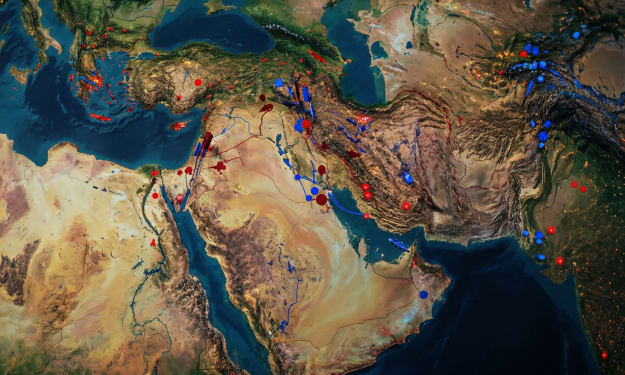
Is the U.S. Preparing to Attack Iran? Inside the Rising Tensions and Possible Military Pathways In early 2026, tensions between the United States and Iran reached one of their highest points in years. For weeks, dramatic political rhetoric, shifting military postures, and warnings from leaders around the world have fueled alarms that a U.S. military strike against Iran may be imminent. Yet as of now, no confirmed attack has occurred, and the situation reflects a complex mix of pressure, preparation, de-escalation, and diplomatic uncertainty that illustrates how modern conflict can hinge just as much on words and positioning as on direct action.
By Wings of Time 6 days ago in History


Comments
There are no comments for this story
Be the first to respond and start the conversation.