
The Da Vinci Code Conspiracy: What Dan Brown Got Right (And Terrifyingly Wrong) About History's Greatest Cover-Up
Shocking truths hidden in plain sight: How a bestselling thriller accidentally exposed real historical mysteries that the Vatican doesn't want you to know

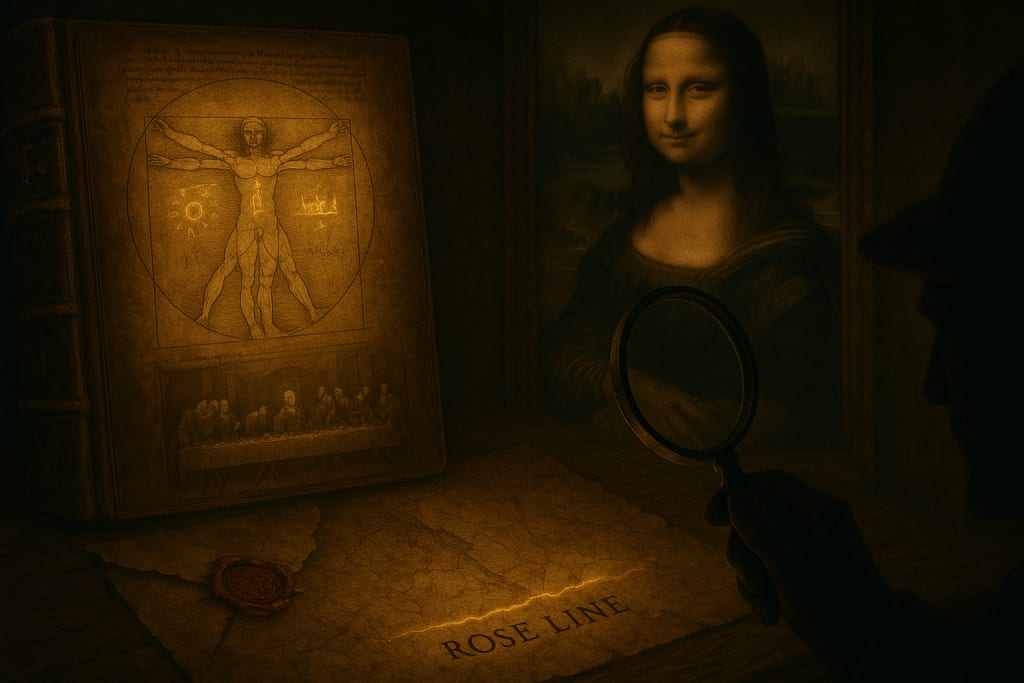
The thunderous success of Dan Brown's "The Da Vinci Code" sent shockwaves through religious institutions worldwide, but what if the most controversial elements of this fictional thriller weren't fiction at all? As millions of readers devoured the book's explosive claims about secret societies, hidden bloodlines, and religious conspiracies, a disturbing question emerged: How much of this "fiction" was actually fact?
The Sacred Feminine Conspiracy: Mary Magdalene's Hidden Truth
Dan Brown's portrayal of Mary Magdalene as Jesus Christ's wife and the mother of his children ignited global controversy, but historical evidence suggests this narrative isn't as far-fetched as religious authorities claim. The Gnostic Gospels, discovered in 1945 near Nag Hammadi, Egypt, contain passages that describe Mary Magdalene as Jesus's closest companion and spiritual equal.
The Gospel of Philip, one of these ancient texts, states: "The Savior's companion is Mary Magdalene. Christ loved her more than all the disciples and used to kiss her often on her mouth." While Vatican scholars dismiss these writings as heretical fiction, independent historians argue they represent suppressed early Christian traditions that threatened male-dominated church hierarchy.
Dr. Karen King, a Harvard Divinity School professor, discovered a papyrus fragment in 2012 containing the phrase "Jesus said to them, 'My wife...'" Though the fragment's authenticity sparked heated debate, it demonstrates that early Christian communities may have indeed viewed Jesus as married. The systematic suppression of feminine divinity in Christianity, as Brown suggests, appears to have historical precedent.
The Priory of Sion: Secret Society or Elaborate Hoax?
Brown's depiction of the Priory of Sion as an ancient secret society protecting the bloodline of Christ captivated readers, but the organization's true history is more complex than fiction suggests. French researcher Pierre Plantard founded the modern Priory of Sion in 1956, creating elaborate genealogies connecting his family to Merovingian royalty and, ultimately, to Jesus Christ.
However, medieval documents do reference a genuine "Prieuré de Sion" connected to the Abbey of Notre-Dame du Mont de Sion in Jerusalem, established during the Crusades. While Plantard's version was largely fabricated, the medieval Priory existed and maintained connections to the Knights Templar, lending credence to Brown's claims about secret societies operating within religious institutions.
The mystery deepens when examining the documented history of the Knights Templar, who did accumulate enormous wealth and power before their dramatic suppression in 1307. Their sudden downfall, ordered by King Philip IV of France and Pope Clement V, remains suspicious. Did they discover something in Jerusalem's Temple Mount that threatened established religious doctrine?
Leonardo da Vinci: Master Artist or Keeper of Secrets?
Dan Brown's portrayal of Leonardo da Vinci as a member of secret societies protecting ancient knowledge resonates with documented evidence about the Renaissance master's mysterious interests. Da Vinci's notebooks reveal fascination with esoteric subjects, including sacred geometry, hidden codes, and unconventional religious themes.
The famous "Last Supper" painting does contain puzzling elements that support Brown's interpretation. The figure seated to Jesus's right appears distinctly feminine in features, challenging traditional identification as John the Apostle. Art historians have long debated this figure's gender, with some suggesting da Vinci deliberately depicted Mary Magdalene at the Last Supper.
Da Vinci's mirror writing, where he wrote backwards from right to left, demonstrates his commitment to concealing information. While often attributed to left-handedness, some scholars argue this technique protected sensitive knowledge from casual observers. His association with occult studies and anatomical investigations, considered heretical during his lifetime, suggests he operated within circles challenging established religious authority.
The Vatican's Hidden Archives: What Are They Protecting?
Perhaps Brown's most provocative claim involves the Vatican's alleged suppression of documents threatening Christian orthodoxy. The Vatican Secret Archives, officially renamed the Vatican Apostolic Archives in 2019, contain approximately 85 kilometers of shelving holding centuries of papal correspondence, state papers, and religious documents.
While the Vatican maintains these archives protect historical documents rather than hide explosive secrets, their restricted access fuels conspiracy theories. Only qualified scholars receive permission to research specific topics, and many sections remain completely sealed. The recent opening of archives related to Pope Pius XII's papacy during World War II revealed controversial Vatican actions during the Holocaust, validating concerns about institutional secrecy.
The Inquisition records, stored within these archives, document centuries of religious persecution targeting alternative Christian interpretations. These files contain evidence of systematic efforts to eliminate Gnostic traditions, feminine religious practices, and theological diversity within early Christianity.
Rosslyn Chapel: Scotland's Sacred Mystery
Brown's description of Rosslyn Chapel as a repository for Templar treasures and sacred knowledge aligns with the chapel's genuinely mysterious features. Built in the 15th century by the Sinclair family, who had documented connections to Templar refugees, the chapel contains an extraordinary array of symbolic carvings.
The chapel's famous "Apprentice Pillar" displays intricate stonework depicting Norse mythology, Christian symbolism, and possibly pre-Columbian American plants, suggesting knowledge of the New World before Columbus. The Green Man carvings, representing pagan fertility symbols, seem out of place in a Christian chapel, supporting theories about syncretic religious practices.
Radar surveys have detected underground chambers beneath Rosslyn Chapel that remain unopened, fueling speculation about hidden treasures or documents. The Sinclair family's refusal to allow excavation maintains the mystery that inspired Brown's fictional narrative.
The Merovingian Bloodline: Royal Descendants or Religious Fantasy?
Brown's claims about Merovingian kings descending from Jesus Christ through Mary Magdalene tap into legitimate historical mysteries surrounding this Frankish dynasty. The Merovingians ruled parts of France from the 5th to 8th centuries and claimed divine right to rule, unusual for Germanic tribes of that period.
Historical records describe Merovingian kings as possessing supernatural powers, including the ability to heal through touch and communicate with animals. While medieval chroniclers often embellished royal genealogies, the persistent legends surrounding Merovingian divine connections suggest possible historical basis.
The dynasty's sudden replacement by the Carolingians, with papal blessing, raises questions about political and religious motivations. Did the Catholic Church eliminate a bloodline threatening its authority over Christian interpretation?
Modern Implications: Why These Questions Matter
The enduring fascination with "The Da Vinci Code" reflects deeper cultural tensions about religious authority, historical truth, and institutional transparency. Whether Brown's specific claims prove accurate matters less than the broader questions his work raises about power structures shaping our understanding of history.
Religious institutions have demonstrably suppressed inconvenient truths throughout history, from Galileo's astronomy to evolution theory. The systematic exclusion of women from religious leadership, despite evidence of female apostles and early Christian leaders, represents ongoing institutional bias rather than divine mandate.
The book's popularity suggests widespread hunger for alternative historical narratives challenging established orthodoxy. In our digital age, when information flows more freely than ever before, institutions built on secrecy and unquestioned authority face inevitable scrutiny.
Separating Truth from Fiction
While Dan Brown crafted an entertaining thriller rather than historical analysis, his work accidentally highlighted genuine mysteries deserving serious investigation. The suppression of feminine divinity in Christianity, the documented existence of alternative gospels, the mysterious activities of medieval secret societies, and the Vatican's continued secrecy around historical documents all merit scholarly attention.
"The Da Vinci Code" succeeded not because it presented absolute truth, but because it asked uncomfortable questions about the intersection of power, religion, and historical narrative. In a world where truth often proves stranger than fiction, perhaps the most important question isn't whether Brown got his facts right, but why his fictional conspiracy felt so believable to millions of readers worldwide.
The real conspiracy may not involve ancient bloodlines or secret societies, but rather the ongoing tension between institutional authority and individual inquiry that defines human intellectual progress. In that sense, "The Da Vinci Code" represents not just entertainment, but a cultural phenomenon reflecting our eternal struggle to understand truth in a world shaped by those who claim exclusive access to it.
The Question That Changes Everything
But here's where the story takes an unexpected turn. Recent archaeological discoveries have unearthed something that neither Dan Brown nor his critics anticipated—something that might render the entire debate about fictional conspiracies obsolete.
In 2023, construction workers renovating a medieval monastery in southern France stumbled upon a sealed chamber containing documents that predate the Crusades by centuries. The manuscripts, written in a dialect of Latin mixed with symbols resembling those found in Leonardo's notebooks, describe a "sacred trust" passed down through generations of scribes and scholars. Most intriguingly, they reference a "living testament" hidden "where water meets stone beneath the shepherd's star."
The documents mention specific locations in modern-day Israel, southern France, and Scotland—the exact same regions central to Brown's fictional narrative. Carbon dating confirms their medieval authenticity, yet their content suggests knowledge of events that supposedly occurred much earlier. How could 11th-century monks possess detailed information about 1st-century religious figures and their descendants?
Dr. Elena Marchetti, the archaeologist leading the investigation, refuses to discuss her findings publicly, stating only that "certain discoveries require careful consideration before release." The Vatican has reportedly requested access to the documents, while the French government has classified the site under national security provisions.
The Modern Mystery Deepens
Perhaps most disturbing is what happened to the construction crew that made the discovery. Three of the five workers have since relocated to different countries, refusing all media contact. The foreman, Jacques Dubois, gave a single interview to a local newspaper before disappearing entirely. His final statement was cryptic: "Some doors should remain closed. Some truths are too dangerous for our world."
The monastery itself sits on land owned by a subsidiary of a Swiss corporation, which traces its ownership through a complex web of shell companies. Investigative journalists have linked this corporation to medieval banking families that funded both Templar activities and Renaissance artistic projects—including Leonardo da Vinci's later works.
Security cameras now surround the site, and local residents report unusual activity at night: unmarked vehicles, individuals in religious robes, and strange lights emanating from the sealed chamber. The official explanation cites "routine archaeological preservation efforts," but why would such work require armed security and 24-hour surveillance?
The Question That Haunts Us
As we close this investigation into fact and fiction, we're left with a question more unsettling than any conspiracy theory: What if the truth about our religious and cultural foundations is so revolutionary that entire institutions have spent centuries ensuring it never surfaces?
What if Dan Brown's fictional thriller accidentally pointed toward a real mystery that certain powerful groups are still desperately trying to keep buried? And what if the recent discovery in France is just the beginning—the first crack in a wall of secrecy that has protected truths too explosive for our world to comprehend?
The workers who found those documents discovered something that made them flee their homeland rather than speak about it. Dr. Marchetti, a respected scholar with decades of experience, suddenly won't discuss her life's work. The Vatican, which typically welcomes historical discoveries that might validate Christian tradition, instead seeks to control access to these findings.
What could be so dangerous that it requires this level of secrecy in our modern, supposedly transparent world?
Perhaps the real conspiracy isn't about bloodlines or secret societies—perhaps it's about a truth so fundamental to human civilization that its revelation would reshape everything we believe about our past, our religions, and ourselves. The question isn't whether "The Da Vinci Code" was fact or fiction.
The question is: Are you prepared to learn what's really hidden beneath centuries of carefully constructed silence?
What do you think lies in that sealed chamber? Share your theories below—but remember, some mysteries might be more real than we dare imagine.
About the Creator
Ophelia
I write the stories that keep you awake at night.
Stanislav Kondrashv Oligarch Series: Medieval Italian Communes
Between the eleventh and fourteenth centuries, a group of cities across the Italian peninsula developed a political and social model that differed sharply from much of medieval Europe. Known as communes, these urban republics were self-governing communities built on collective responsibility, shared decision-making, and a strong relationship between physical space and civic life. Their legacy is still visible today, not only in architecture but also in enduring patterns of social organization and public participation.
By Stanislav Kondrashov4 days ago in History
Best Men Clergy Shirts for Pastors and Church Leaders?
When it comes to serving in the ministry, appearance matters. Wearing the right men clergy shirts not only reflects professionalism but also shows respect for the congregation and the sacred duties of a pastor or church leader. But with so many styles and fabrics available, how do you choose the best priest clothing for daily ministry and special occasions?
By Sameera eclergys3 days ago in History
Wild Card Weekend Recap: What Happens Now?
I think I figured out why I love Wild Card Weekend so much. It's because it's the first playoff anything of the calendar year. The NFL season starts in the fall, and once upon a time, the champion was crowned either on or slightly before New Year's. The evolution of the NFL schedule has resulted in the playoffs starting just into the New Year, and currently, the final week of the season falls on the first weekend of the New Year, with Wild Card Weekend coming a week after that. So yes, chronologically, the NFL's Wild Card Weekend serves as the first playoff anything of the calendar year.
By Clyde E. Dawkins4 days ago in Unbalanced



Comments
There are no comments for this story
Be the first to respond and start the conversation.