Lessons
🌟 Battle of Badr: The First Great Clash Between Truth and Falsehood
✨ Prologue: Silence in the Desert, Storms in the Hearts It was the 17th of Ramadan, 2 AH. A silent, scorching afternoon covered the city of Madinah. But behind this silence, hearts were ablaze with the fire of faith. The Prophet Muhammad ﷺ, along with 313 loyal, brave, and devoted companions, set out for a battle that would soon become one of the most monumental confrontations in human history — the Battle of Badr.
By Anees Khan8 months ago in History
⛏️Venetian Glass Beads found in Alaska - Amazing archeological findings
Venetian glassmaking reached its zenith during the late Middle Ages and Renaissance, with the city of Venice becoming the epicenter of fine glass production. The island of Murano, in particular, became renowned worldwide for its advanced techniques, including cristallo (crystal-clear glass), millefiori (multicolored patterns), and elaborate formings.
By Kek Viktor8 months ago in History
"The Landlord's Game". Kiowa Indians invented it. A woman patented it...Men became Billionaires.
I found this tidbit of information in the movie "Heretic', which I just started watching on the Prime Network. The controversy surrounds a game first attributed to the Kiowa Indians, said invented by Elizabeth Magi...then reinvented by Charles Darrow.
By Antoni De'Leon8 months ago in History
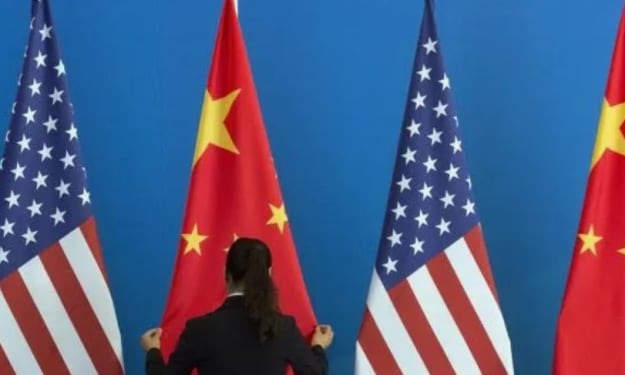
Donald Trump says US-China trade talks to be held in London on June 9
On June 9, the United States and China will hold a new round of high-level trade talks in London, according to Donald Trump. The former president made the surprising announcement in a post on social media in which he expressed optimism regarding the discussions. Trump asserts that the U.S. To resume negotiations aimed at resolving ongoing trade tensions, Treasury Secretary Scott Bessent, Commerce Secretary Howard Lutnick, and Trade Representative Jamieson Greer will meet with their Chinese counterparts, led by Vice Premier He Lifeng. After a period of renewed hostilities marked by new tariffs, export restrictions, and diplomatic strain, this meeting represents a significant step in efforts to stabilize economic relations between the world's two largest economies. Analysts view the decision to hold the meeting in London as symbolic, suggesting an effort to include Europe's perspective in the dialogue and providing a neutral setting for discussions. China and the United States of America are still locked in a complicated economic dispute over everything from semiconductor exports to education visas to cybersecurity. Some of the tariffs that both sides imposed were temporarily eased by the Geneva Agreement, which was reached earlier this year. However, tensions have persisted, with each side asserting that the other has broken the agreements made within that framework. The United States' export controls on cutting-edge semiconductor technologies are anticipated to be one of the most pressing topics under discussion in London. Chinese access to AI chips and related technologies developed in the United States has been restricted by both the Trump administration and the Biden administration. Beijing has been enraged by these actions, which Beijing claims are discriminatory and disrupt global supply chains. These actions are meant to safeguard national security and innovation in the United States. China responded by imposing stricter licensing requirements for the export of rare earth minerals, which are essential components of electronic devices and electric automobiles. U.S. officials see the regulations as an attempt to weaponize supply chain dependencies, despite Beijing's insistence that they are for the protection of national resources. Washington has demanded that China's application of these rules be more transparent and predictable. The recent U.S. visa restrictions that target Chinese graduate students in sensitive fields like robotics, aerospace, and quantum computing are another source of contention. Beijing has vehemently rebuked the move, claiming that it is politically motivated and detrimental to academic exchange. As part of any larger trade agreement, it is anticipated that the Chinese delegation will demand the removal of these restrictions. Domestic pressure is exerted on both governments to achieve measurable outcomes. Farmers and manufacturers in the United States are pleading with the government to reduce tariffs that have hampered exports and increased costs. As a result of having less access to Western investment and technologies, Chinese businesses are experiencing difficulties. The economic stakes are high, and if nothing is done, new retaliatory measures could be taken. The news of the talks in London has spooked the markets. While some investors appreciated the chance to talk, others are still skeptical of any long-term advances. Negotiations in the past have frequently ended without significant progress, and trust between the two countries remains low. The decision to hold the meeting in London also reflects larger geopolitical considerations. A chance to demonstrate diplomatic outreach is provided by holding talks in the United Kingdom, given that Washington and Beijing are competing for influence in Europe. Additionally, it demonstrates a willingness to cooperate with Western allies as stakeholders in the stability of global trade. In order to determine whether the two sides can make significant progress on the main issues, observers will closely monitor the situation. The key questions include whether the United States will loosen restrictions on exports, whether China will commit to fairer trade in rare earths, and whether both sides will be able to stop future crises involving students, intellectual property, and digital trade. The June 9 meeting may decide whether a more long-term agreement is possible or whether economic friction between the United States and China will grow. The deadline to extend the temporary tariff truce is fast approaching. Officials hope that direct engagement at the highest levels can pave the way for de-escalation while expectations are measured. London is the next stage in a global economic drama that is being watched by the entire world. Its outcome could have long-term effects on trade, innovation, and diplomacy.
By GLOBAL NEWS8 months ago in History
Khalid ibn al-Walid (The Greatest Commander)
Throughout the pages of military history, few commanders have carved a path of victory as consistently and decisively as Khalid ibn al-Walid. Known as “The Sword of Allah,” Khalid’s name is synonymous with invincibility, and his leadership redefined the early Islamic conquests. His undefeated record in over a hundred battles remains a testament to his extraordinary skill, vision, and mastery of the art of war.
By Mehtab Ahmad8 months ago in History
Skara Brae: A Well-Preserved Neolithic Village in Scotland
Nestled on the rugged, windswept coast of Orkney, an archipelago off the northern coast of Scotland, lies Skara Brae, a prehistoric village that provides a rare and extraordinary glimpse into human life approximately 4,500 years ago. Recognized as one of the most complete and well-preserved Neolithic settlements in Europe, Skara Brae has fascinated archaeologists, historians, and visitors alike for centuries.
By Kek Viktor8 months ago in History
Monowi America’s Only Town with a Population of One
In the vast expanse of the American Midwest, where small towns have been steadily shrinking over the past century due to economic shifts, urbanization, and demographic changes, one town stands out as uniquely singular: Monowi, Nebraska. As of today, Monowi holds the distinction of being the only incorporated municipality in the entire United States with a population of just one person. This remarkable community has captured the imagination worldwide, symbolizing resilience, nostalgia, and the quiet persistence of small-town America. Its story revolves around one woman—Elsie Eiler—who embodies the spirit of Monowi, acting as its mayor, librarian, bartender, and sole resident.
By Kek Viktor8 months ago in History
🪖When the allies dropped "dummies" from airplanes - the fake paratroopers
During World War II, intelligence and deception became critical components of military strategy. Both Allies and Axis powers employed sophisticated psychological warfare, using false information, fake equipment, and simulated troop movements to mislead opponents, gain advantageous positions, and minimize casualties. Among the most innovative and visually striking tactics was the deployment of dummy paratroopers—inflatable and dummy figures designed to simulate airborne troop drops.
By Kek Viktor8 months ago in History
🛁🫧When President Taft Got Stuck in a Bathtub
William Howard Taft, the 27th President of the United States (1909–1913), is remembered not only for his political accomplishments but also for his distinctive physical stature and personality. Standing about 5 feet 11 inches and weighing over 300 pounds, Taft was an imposing figure in American presidential history. His size, combined with his humor and self-awareness, made him a beloved and memorable figure. The story of Taft getting stuck in a bathtub at the White House is among the most enduring anecdotes about his presidency. It has become part of both presidential lore and American humor, symbolizing his remarkable physique and the challenges it sometimes posed.
By Kek Viktor8 months ago in History
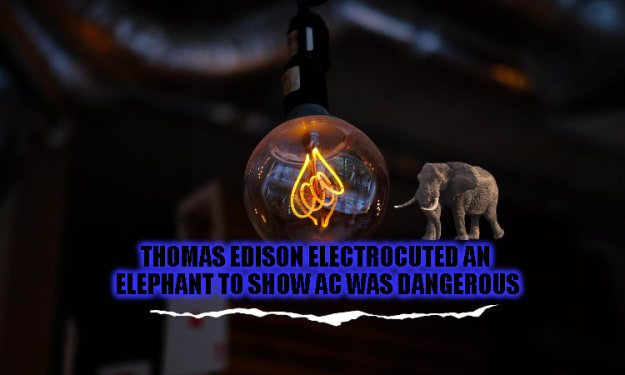
⚡Thomas Edison electrocuted an elephant to show AC was dangerous
⚡The War of the Currents and Electric Power Technologies In the late 19th and early 20th centuries, the world was on the cusp of a revolution—moving from gas lighting and direct current (DC) power systems to alternating current (AC). Thomas Edison, a pioneering inventor and businessman, was a fierce advocate of direct current electricity, which he had developed and promoted extensively through his Edison Electric Light Company. However, Nikola Tesla and George Westinghouse championed AC power, which proved to be more efficient for long-distance transmission and ultimately became the dominant technology for electrical systems worldwide. The rivalry, known as the "War of the Currents," was fierce, involving propaganda, legal battles, and public demonstrations.
By Kek Viktor8 months ago in History