Fiction
Napoleon Bonaparte
They called him short. Corsican. Outsider. But history would call him something else—Emperor. Napoleon Bonaparte Born on August 15, 1769, in the rocky, wind-swept island of Corsica, Napoleon Bonaparte came into the world just a year after France wrestled the island from the Republic of Genoa. The Bonaparte family, of minor Italian nobility, suddenly found themselves living under a new flag, in a land divided by loyalty and resentment. For young Napoleon, the French language would never feel native, and his thick Corsican accent would never quite fade. But his mind? His ambition? They would rewrite Europe.
By The Manatwal Khan8 months ago in History
John Dee: The Original 007?
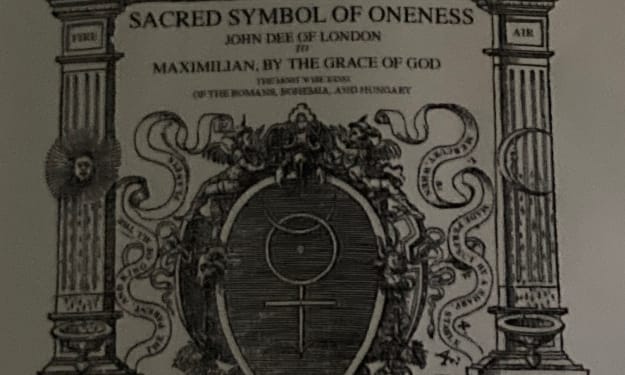
Thomas Grey, royal scribe to John Dee, Her Majesty’s astronomer, inhaled a faint scent of beeswax honey. The yellowish candle flickered in its brass holder, flame wavering, casting shadows on the chamber's stone wall and across the manuscript. Thomas yawned, blinking against the candlelight, wary now as the symbols he transcribed shifted from meaningless to something more calculated.
By Pamela Williams8 months ago in History
June 4, 1989 – Tiananmen Square Protests Memories. AI-Generated.
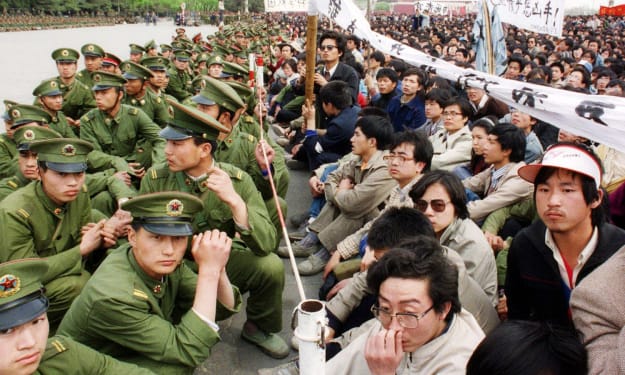
Tiananmen square Beijing 1989 the Chinese government sends tanks into the square shooting at unarmed civilians and students an abrupt end to political reforms that once brought people so much hope and today the protest movement remains a taboo in China this statue was called to the goddess of democracy she represented what the Tiananmen students were dreaming of democracy and liberty but the movement for democracy was met with a bloody crackdown why what happened let's start from the death of Huyao bang Huyao bang was the general secretary of the communist party of china. On 15th April 1989 he died Huyabang was seen as a liberal he was loved by the people college students pour onto the streets to mourn his passing soon mourners become protesters they turn Tiananmen square the country's symbol of sovereignty into a hub of dissent and protest they want a crackdown on corruption they want freedom of press they call for an awakening to reform and progress in china. The 1980s the old communist states are beginning to open up Mikhail Gorbachev the last communist leader of the soviet union is pushing for market reform in Russia china is walking out of the devastating shadow of the cultural revolution Deng Xiaoping the real leader of the communist party behind the scenes had launched the open door policy which introduced market economy to china it brought prosperity as well as moral liberty in this relatively free atmosphere. People begin to talk about political reform now china lack of democracy lack of freedom especially freedom of press do you think you get an accurate picture of the world from the news or do you think you get propaganda yeah some part propaganda this agitates the conservatives within the core of the communist party. 22nd April Huyabang's funeral is held tens of thousands of students gather outside three of them kneel at the entrance begging to have a dialogue with the premier Li Peng their plea falls on deaf ears with the consent of the most senior leaders in the communist party its official mouthpiece the people's daily publishes an editorial vowing to take a clear-cut stand against disturbances in the cultural revolution the term labeled anyone against the government as a danger to society that needed to be purged within hours campus wars are lined with handwritten posters condemning the editorial and its wording those who were protesting in Tiananmen square were about to leave now they are reignited and enraged college students set up the Beijing students autonomous federation. They demand dialogue with the government and a withdrawal of the April 26 editorial the government does not give in as standoff begins the April 26 editorial becomes the defining moment of the protest movement eventually it will lead to a military crackdown and determine the fate of thousands of young people in china we do not want to challenge with our government we just want to ask our government to talk with delegation i think what they really wanted was a channel to participate in making decisions in government or to participate in politics uh many of the people on the square were communist party members they were not there to overthrow the government 4th may more than 100 000 college students march across Beijing to mark the anniversary of another protest that happened in 1919 against world war one's treaty of Versailles which handed a German colony in China over to the Japanese. The students are joined by Beijing residents workers and civil servants from national agencies Zhao Zhiyang the communist party chief calls the protest patriotic and some of the students take comfort in this and return to campus the moment of quiet will be short-lived students like Wang Dan Chiling and work Kaisi strive to keep the protest going 13th may a few hundred students who had been camping in Tiananmen square since the beginning begin a hunger strike the protests. Continued five days into the hunger strike some students begin to faint men and women across Beijing one after another rush food and drink to them people go onto the street this time to show their support for the starving students mid-may a month in and things begin to get complicated 18th may premier Li Pung finally agrees to meet the students at the great hall of the people student leader and hunger striker work Heisi comes in in a hospital gown he interrupts the premier school the students have certain requirements which must be met otherwise they won't leave the square tensions rise the talks fall apart. The communist party chief who had comforted the students weeks earlier comes to the square and asks the student to stop their hunger strike his plea doesn't work 20th may the students ignore a newly imposed curfew in Beijing for the next few days Tiananmen square becomes an Island of liberty, freedom of speech rules it will not last 9 50 p.m third June Beijing's municipal government tells people to stay away from Tiananmen square for their own safety what the public doesn't know is that hundreds of thousands of soldiers are assembled on the outskirts of Beijing they are waiting for the order to charge to enforce eviction two hundred thousand soldiers move into the square from different directions. They shoot at students and residents along their way noise of gunfire is heard throughout the night. Early morning 4th June soldiers move into Tiananmen square they dragged down the statue of the goddess of democracy which had come to represent the protest movement they seal the fate of its failure. No one knows the death toll even today estimates run from several hundred to over ten thousand some argue that by shooting at civilians the communist party lost its legitimacy to rule and with it an opportunity for political modernisation, others believe the crackdown brought stability to china a price it had to pay to secure economic progress and to maintain the status quo thirty years on it is still impossible to openly mark the anniversary in mainland China vigils are held every year in Hong Kong attended by tens of thousands but people are still seeking the truth and the effort to hold those accountable for the bloody crackdown.
By taylor lindani8 months ago in History
June 2, 1953 – Queen Elizabeth II’s Coronation Memories. AI-Generated.
on one of the coldest June days of the century after 16 months of planning and watched by millions of people throughout the world Her Majesty the queen set out to be crowned. One of the world's oldest ceremonies was to Mark the dawn of a new Elizabethan age now in what has become the longest reign of any British monarch the queen talks for the first time about that day we're not taking part in something you don't actually see it Her Majesty reveals her intimate knowledge of the crown jewels he handed that that way that I put it on when he hands it and I put it on straight so there are some disadvantages to crowns but otherwise they're quite important things no British monarch has ever talked about their coronation on camera until now with unprecedented access to the Royal collection. This program unlocks the story of the crown jewels the crown jewels matter they are conductors for a feeling that we have about our country and and that is something that's that comes alive when they're actually used we meet those who witnessed the events of that day everybody thought the queen had arrived so everybody stood up 8 000 people stood up when from underneath the organ Loft came four cleaners with carpet sweepers in a Britain recovering from war and austerity nothing could be allowed to go wrong under there we had a file of smelling sauce finally after 65 years we tell the inside story of the crown jewels. The Queen's coronation I mean I've seen one one coronation and been the recipient and the other which is pretty remarkable, today the two crowns used in the Queen's coronation have just left their heavily guarded home in the Tower of London for an unprecedented assignment at Buckingham Palace for the first time since her coronation Her Majesty. The queen has agreed to talk about the ceremony that marked the start of her Reign 65 years ago with coronation expert Aleister Bruce she is about to reacquaint herself firstly with the crown she has only ever worn once at the moment of coronation since Edward's Crown was made in 1661 for the coronation of Charles II only be handled by the Queen the Archbishop of Canterbury and the crown Jeweler. Today it's been summoned from its Fortress home to Her Majesty's throne room encrusted with 440 precious and semi-precious stones and with a frame of solid gold it weighs five pounds but is it still as heavy yes it is it weighs a ton it's very solid isn't it um I don't suppose you've seen it much no I haven't since thank goodness and it's impossible to tell which is front and back I suppose it's identical I think the crowning with Saint Edward's Crown is the centerpiece of the coronation it's the ceremony that marks the moment when the new Sovereign is formally recognized in front of God and their people and it goes back more than a thousand years the ritual of the coronation has been being performed pretty much exactly along the same lines other than being translated into English and Latin since um since the the Anglo-Saxon period and that is an extraordinary thing the order of service was written down more than 600 years ago in a medieval manuscript it outlines the five stages of the coronation they move from the recognition where the Monarch shows they aren't an imposter byronose and an anointing to the crowning and finally the Lords of the land pay their homage to the monarch and Central to each stage are the crown jewels in the collection there are 140 items containing more than 23 000 precious stones most are used in the coronation and are known as the regalia we have this incredible continuity in this country in the form of the coronation other countries still have a monarchy but very very few have a medieval fat none has a medieval coronation in the way that we do and that we have a collection of regalia that is used for that um is is is astonishing the concept of the crown dates back at least 2 000 years originally a simple band a Halo of light it represents the Sovereign as head of the nation then there are the other sacred items in the collection that throughout the ceremony symbolize different aspects of the Monarch's powers. The orb is an expression of religious and moral Authority receptor embodies power the ampulla and Spoon represent the most holy part of the ceremony when the Monarch is Anointed with the coronation oil and the sovereign's ring known by some as the wedding ring of England symbolizes the lifetime commitment of the monarch. It is an amazing thing to see these objects which in a way very familiar to people from afar but to see them up close like this actually that proximity is extraordinary because you can really appreciate what astonishing objects they are for many the role of the crown jewels has been largely forgotten of 65 years without a coronation they're not just objects of tremendous Beauty and and and skill and craftsmanship and so on they are an expression of the way in which authority has worked in this country the the relationship between the Sovereign and the subject. There is a kind of an expression of all of our history in that in that relationship in those objects the most important items used in the coronation are the monarchs two crowns the queen has only worn Saint Edward's Gold Crown once she is much more with this the diamond encrusted Imperial State Crown she wore it at the end of her coronation and for most State openings of parliament since you see it's it's much smaller isn't it I mean it was it was the same height you know it would be it would have been up to about there when my father wore it I mean it was huge then yes very un unwieldy it's difficult to always remember that diamonds are Stones I said it very heavy yes fortunately my father and I have about the same sort of shaped head but once you put it on it stays I mean it just remains itself you have to keep your head very still yes and you can't look down to read the speech you have to take the speech up because if you did your neck would break would it fall off so there are some disadvantages to crimes but but otherwise they're quite important things can I ask if the crown could be brought a little bit closer to the queen this is what I do when I wear it can I look at this end yes certainly I like the black princess Ruby this Crown contains the story of a thousand years of the history of the British Monarchy the Ruby actually a semi-precious Stone mined in Afghanistan is said to have been worn by Henry V in 1415 at the Battle of Agincourt he is supposed to have placed a feather in the hole drilled into the Ruby it's fun to see I think with it with the idea that his plume was was put into the stone for his on his helmet bit rash but that was the sort of thing they did I suppose and there's it four pearls hang underneath the Arches two of them were said to have belonged to Mary Queen of Scots and were bought by her rival Elizabeth the first after Mary's execution they were meant to be Queen Elizabeth's earrings um but they're not very happy now no they don't look very happy now like to be sort of living creatures. They've just been out hanging out here for years it's all said so they don't look very happy I quite dead well I'm afraid so I mean the trouble is that pearls are are sort of live things and and they need they need warming the Queen's relationship with the regalia began in 1937 that her father King George VI coronation Her Majesty is about to look at footage of what happened when her father was crowned the coronation didn't quite go to plan the Archbishop of Canterbury who conducts the service thought he'd cunningly marked the front of Saint Edward's crown with a piece of cotton but at the vital moment he couldn't find it now this is when they'd lost the little piece of thread that they organizers are placed through the front Arch the king written his diary I never did know whether it was put on the right way or not I don't think the King was best pleased. Father was determined that his daughter's coronation would run more smoothly I remember my father making me write down what I remembered about his coronation it was very valuable everyone who never seen it the Queen's own account written in a child's exercise book contains remarkable insights. I thought it all very very wonderful and I expect the Abbey did too The Arches and beams at the top were covered with a sort of haze of Wonder as Papa was crowned at least I thought so the events left a lasting impression on the queen you remember that one almost better than yours because I wasn't doing anything I'm just sitting there from that moment on Guided by her father the queen Was preparing for her own coronation no one was more aware of the importance of the crown jewels to the coronation and to the nation than the Queen's father in the second world war when Britain faced the threat of Nazi invasion the King was intimately involved in plans to keep the jewels out of Hitler's hands to protect them they were taken from the tower only a handful of people knew where they were hidden until now recently uncovered private correspondence reveals that the crown jewels were actually hidden under Windsor Castle. Librarian Oliver urkutelvin who discovered the letters is showing Aleister Bruce their specially built secret hiding place 60 feet below the castle. It was accessed by a medieval tunnel known as a sally port secret passage with a concealed entrance that was used in times of Siege, oh my goodness look down there you better lead us down yes absolutely Castle, one imagines that you know the King was determined to make sure that right down here the Nazis would never find the crown jewels so here are the chambers built to hold the rules it is far bigger than I thought and so literally all the symbols the regalia of this nation that go back centuries held here of all the things that were to be kept close by and guarded most securely had a lot of something significant to the Royal palaces and fortresses it is those actual jewels and I think that is uh that's a measure really the importance which he attached to the jewels the correspondence also reveals that some key items were prized from their settings and placed in a Biscuit tin it meant they could easily have been Spirited Away to an even more secure location had the Nazis closed in on Windsor Castle for her majesty the queen it's an intriguing and unknown story you think they were at Windsor they were definitely the librarian guides the principal stains out of the crown jewels and put them into a wrap them up put them into a jar and put them in a bath Oliver tin hmm and hit them brilliant absolutely brilliant did you remember where he put them because he might have died in the middle I think the King was told man the queen like the crown jewels spent the war at Windsor but she was never aware of the treasure beneath her feet when we would turn nothing when we were only children then but but I mean we didn't know anything that was well I mean all the pictures disappeared and all the everything disappeared and someone was never told anything it was it was you know a secret I suppose the road to the Queen's own coronation began on February the 6th 1952. 25 year old princess Elizabeth was on Royal duties in Kenya standing in for her father George VI the king suffering from lung cancer was too ill to travel princess filmed these images of the famous Treetop Safari Lodge they were taken at a moment when the princess's life was about to change forever. Hours later on the morning of the 6th of February the king died at Sandringham in his sleep at that moment in Africa the princess became Queen losing a parent for anyone is tough particularly if like the princess you're as close as she was to her father but knowing that everything has changed now she's not the Queen the head of state it's very lonely place to be the queen flew home for the lying in state of her beloved father the Imperial State Crown the scepter and the orb were taken from the tower to lie on the king's coffin in Westminster Hall. After a period of mourning the date for the coronation was set Tuesday the 2nd of June 1953 there were 16 months to get everything ready preparations were overseen by a coronation committee chaired by the Duke of Edinburgh in charge was the formidable Bernard Duke of Norfolk he had masterminded George VI coronation since 1386 the Dukes of Norfolk have had a role in organizing great state occasions even though the 1953 everyone in that possession will either Drive in a carriage ride a horse or walk and there will not be any mechanization at all. To coronation for a new Elizabethan age in a country still suffering from the ravages of War was still in place the country was still physically very visibly damaged by the impact of War this was an opportunity to celebrate both the future and the past that the accession of a a young woman as Sovereign provided a wonderful opportunity to do that to sort of feel like it was a fresh start the very long period of time that it took between the death of George VI and the coronation of the queen was used to design something that would have a Hollywood movie glamor to it as well as all the ancient tradition to it the plan included organizing food and accommodation for 30 000 troops from across the Commonwealth and building 27 miles of seating along the processional route it put the whole country to work to achieve the greatest coronation show ever used to make a great coronation carpet at a factory in Glasgow when it is completed the carpet will measure 188 feet long by a 17 feet wide home to every coronation since that of King Harold in 1066 is Westminster Abbey it's witnessed the crowning of 39 kings and queens John Hall is the dean of Westminster it is the dean's responsibility to ensure the Abbey becomes the perfect stage for the coronation for six months they closed the alley they laid a railway track down the center of the Abbey bringing in tons and tons of wood and iron foreign takes place is called the theater. A specially raised platform at the Central Crossing of the Abbey the rest of the Abbey had to be transformed into a stadium for thousands of guests I think there were 400 people in the choir and they were they were all up there and there was an orchestra on the Cross Creek 2 200 people can sit on the on the floor of the Abbey 8 000 people were in here in 1953 they took a long time actually to get the whole thing ready but all these impressive preparations were no guarantee that the Queen's coronation would run smoothly in the past they'd gone notoriously wrong I think Queen Victoria's coronation here was absolutely amazing because they hadn't got much of a clue how to handle it and she writes very clearly about how chaotic the whole thing is how long it lasts it goes on forever and she and she goes into into the uh Saint Edwards Chapel behind the high altar earlier than she should and she finds the whole place a litter of bottles and sandwiches and is rather disgusted by this afterwards the Archbishop of Canterbury wondered if they should have had a full rehearsal. In May 1953 with a month to go building work within the Abbey was complete outside London was being transformed with giant stands for The Spectators temporary accommodation in World War II air raid shelters and attempted City in Kensington Gardens. As the day approached the rehearsals to deliver the perfect coronation reached fever pitch the queen practiced at Buckingham Palace and attended several rehearsals at The Abbey in secret the Press offered workmen 50 pounds to find out what had happened, lady Anne Glen Connor then aged 19 was chosen by the queen as one of her six Maids of Honor we had to be Daughters of Earl's Marcus's or dukes and it had sort of nice figures and that sort of thing in post-war Britain they provided much needed glamor in those days there weren't any sort of girl bands back there and I always perhaps was simply say we were all like the Spice Girls because suddenly we were in all the newspapers the Press followed us well this is my box I got my own Asian dressing a huge box it's very very fragile my address the maids of honors costumes were designed by Norman Hartnell the designer of the Queen's coronation dress it's all a beautifully more embroidered pearls and gold and I think they're zircons. There are leaves Little Golden Leaves there and it was all hand embroidered and we just felt like princesses actually because I was but we all brought up in the war when there were um rationing and clothes coupons and we never had an amazing rest like this the rehearsals were so secret even the dresses were kept Under Wraps the last rehearsal they said you wear your dress is but they didn't say completely top secret and you got to wear a coat so anyway I just had a white shawl and as we came out there was a wind blowing it blew my shawl back. The Queen said there was I exposed head to toe this wonderful dress and so embarrassing on the front of a newspaper head done saying she didn't know it was a secret so I felt I thought well I'm going to be struck off I'm going to get telephone call by the Duke of Norfolk saying sorry you know we're going to have I have to find somebody else but anyway it didn't happen for the final dress rehearsal four days before the coronation all the key participants other than the queen were brought together for the first time the ring Master Bernard Duke of Norfolk was in his element that brings back lots of memories there are my second from the right uh by the train the Duke of Norfolk was absolutely fantastic he had done the coronation of the late King so he knew exactly every detail about exactly what we were to wear uh what the jewelry the height of our shoes Duke Bernard was an absolute stickler for discipline when a bishop took an unauthorized holiday the Duke sent a police car to drag him back I think it must have been pretty scary to be at a rehearsal with Bernard Norfolk he knew minute by minute where every single person should be and when you see the plans it is literally a ballet things move everything moves precisely and when Randolph Churchill who was the son of Winston Churchill thought it looked like a bit of an untidy ballet very quickly Bernard's representative came over and said I think you need to remember there's room in the tower still. The dress rehearsal Bernard's wife The Duchess of Norfolk stood in for the queen there is the crown Duchess of Norfolk is being crowned all seems so much all real we realized what it was going to look like, on the eve of the Carnation two million people descended on the Rainy capital, 6500 extra trains and 6 000 coaches had been laid on to get them there I went The Umbrellas on went the raincoats and under the shelter of blankets and newspapers they stuck it out as people settled down for the night Crown Jaws were brought to the Abbey James Wilkinson was a 12 year old choir boy at the coronation and has subsequently written about the event this is the most historic room, this is the Jerusalem chamber and this is where the night before the coronation the regalia is set out and now it comes with 12 Yeoman Waters of the tar and it's set out on this table and they were all armed with revolvers and they each had 12 rounds of ammunition uh what would have happened if they'd had to discharge it, I don't know it would have left a few holes around this very significant room I would have thought that these days they would have probably had slightly more sophisticated ways of of making sure that the crown jewels are untouched amongst the most valuable items guarded that night were two gems from one of the most famous diamonds ever discovered the cullinan number one sits in the scepter and is the largest colorless cut diamond in the world its smaller sister the cullinan number two is mounted in the Imperial State Crown in total nine diamonds were fashioned from the legendary cullinan it was discovered in 1905 and astonishingly sent to Britain in the post. In 1908 The Cutting of this Priceless rough diamond was entrusted to Antwerp Jeweler Joseph Asher he was reputedly the best Diamond Cutter in the world I always wish I'd been there when they smashed it into pieces these are the chips that were left and there are two other two or three other bits too he he hit it with this whatever you had a diamond was to get the right thing and he spent hours looking at it you know and then he fainted when he'd done it but I don't know whether that's just a story it had a brown floor in it he hit it and and all the bits fell out and the brown bit disappeared these we've never seen each other since they were smashed really that is as Dawn broke on June the 2nd 1953 the scene was set for The Greatest Show on Earth Parliament Square quarter to six this morning many had never been out so early before yet here they were rapidly filling every Vantage for him more than 8 000 specially invited guests rushed to their places in the Abbey before the doors closed at 8 European royalty mingled with shakes Sultans and maharajas thousands of aristocrats in their Urban pick their way through the puddles. Many had hidden strong drink and sandwiches in their coronets to get them through the day among the 8 000 was the choir of 400 voices today James Wilkinson is meeting three of his fellow choristers from The Abbey Choir School at the time Richard Watts William Wallace and David Brown were aged between 9 and 13. Well it's a very long time since I was here my goodness me but it hasn't changed very much what a superview you get yeah and we're so close to where we were I mean you David was standing just there on the corner absolutely right on that corner there we were just lined up on the front two rows and it was extremely cramped if you remember yeah by 11 AM. The Abbey was ready for the arrival of the queen and the penultimate procession was the procession of the Queen Mother and Princess Margaret everybody got terribly excited because the next one was the queen and then there was a sort of bustle at the West End and everybody thought the queen had arrived so everybody stood up 8 000 people stood up when from underneath the organ Loft came four cleaners with carpet sweepers and started to sweep the carpet to restore it to its pristine station everybody got laughed and and sat down again at Buckingham Palace the queen is viewing film of her coronation cameras filmed throughout the day and even though the queen commissioned some of the footage it's the first time she has ever reviewed the event a very long day we're not taking part in something we don't actually see it no I don't suppose you've seen these films very often man I don't suppose I've ever seen it as the Queen's Carriage left the palace Courtyard her children remained at home now there are your children watching and Prince Charles says that you rehearsed wearing the crown before the event in fact he says at bath times it's rather sweet because only Prince Charles actually witnessed it hasn't that Princess Anne stayed back here and he only came for 10 minutes away what did the two children do for most of the day can you remember man no idea it wasn't there no it wasn't there I have no idea what they did but there are a lot of other people in the in the palace as well. I think lots of children the queen set out for Westminster Abbey in the gold State coach it weighs nearly four tons horrible it's not meant for terribly installed I mean it's just not it's only sprung on leather so it rocks around a lot it's not really comfortable were you in it for a long time Halfway Around London really we must have gone about four or five miles we can only go to walking pace yeah the horses couldn't possibly go any faster right it's so heavy really but you look really high up there so I presume it is very high I mean look at the size of the man yeah said. As the carriage approached the Abbey lady Anne's first task was to greet the queen there he is that's the gold and the lovely golden coach it has me about me looking through the window well this is a queen Coming well there's a Duke of Norfolk there's me on the left um taking up my bit of a tree like though I am going past it was so exciting to seeing her I mean she looked absolutely beautiful you know um we hadn't seen her in her dress and she had the tiniest waist and the most wonderful complexion and I it's just beautiful absolutely beautiful and of course the November looked pretty dishy too but he was a little bit fussy I think he wanted it all to go perfectly so he was sort of telling us no you know now I'm going to do this and I'll do that sort of thing after a moment's pausing the annex it was time. She hadn't said anything people said did you say something when she arrived and we said no nothing and we were all waiting and it was you know we were all like this and uh she just turned around and she said ready girls we've no idea you know an off we went the 8 000 guests were packed to the rafters to see a 27 year old crowned queen thank you they were they were so high up they messed up in the I mean we were in the bottom and everything that was happening you know they were all sitting at the top it was so full but that it all the takes away the height of it and here we are coming up I'm on the right there, as a queen but of course at that point she hasn't got any of her regalia answer we we felt she should have had some flowers or something that wasn't correct. The Queen's coronation dress was embroidered in silk with pearls and gold and silver bullion thread well I remember one where a moment when I was going against the tile of the carpet and I couldn't move at all really yes they hadn't thought of that in the organ Loft choir boy David Brown was one of three soloists there were just four bars intro and I came in and there were three of us who were going to do this solo and I think looking back to have three boys on standby as it were to do the solo you never know what's likely to happen in a situation like that nerves weren't the only difficulty for the choir they were so spread out they needed three conductors some will require were stuck further back or even somewhere they couldn't see anything that was being. I think they needed to sort of relay a system of conducting yes the tradition dates back to the year 973.
By taylor lindani8 months ago in History
June 15, 1215 – The Magna Carta Signed Memories. AI-Generated.
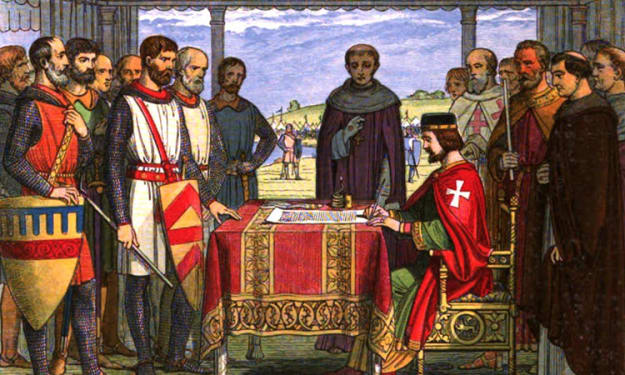
11.99 in king richard the lionheart is dead Richard left no heirs and so his dominions all of this was to be inherited by either his brother John who Richard her chosen or by his nephew Arthur of brittany arthur began a rebellion but nothing came of it and john managed to get the french king to accept his territorial claims after becoming King John had his first marriage annulled and instead married Isabella of angel' M. In 1202 fighting resumed between the kings of England and France because by this point they were both getting pretty good at it John attempted to mount a defense of his lands but due to financial constraint and the fact that he often insulted his nobility his ability to do so was lacking. In 1204 philippe augustus had conquered both Normandy and Anjou whereas Brittany had broken away from Anne ship in orbit on its own thus within five years of John coming to the throne only Aquitaine remained of his inheritance naturally many of the remaining Nobles in England were very unhappy that they had just lost some of their Continental lands the peasantry of England also found themselves upset when John levied extremely heavy taxes to pay for an attempted reconquest. In 1205 John was dishonored and disliked by his Nobles but at least he still had good relations with the church right nope the main issue between John and the church occurred during the election of the Archbishop of Canterbury in 1205 John wanted a friend and a lot of his to become the new archbishop whereas the clerics at Canterbury Cathedral did not the Pope Innocent the third was appealed to in his answer was that they were in fact both wrong. The Pope instead consecrated a man called Stephen Langton John was furious about this and so banned lankton from entering England and seized Canterbury's assets and revenues many clergymen saw this as a step too far and when they complained to John he essentially declared them traitors and seized their property as well the Pope attempted to convince the king to agree to Langdon's appointment but the king still refused. In 1208 the Pope ordered that church services in England were to be halted which they were for six years in 1209 the Pope went further and excommunicated John as well. 12:09 was an eventful year for John and England's is before his excommunication he invaded Scotland fearing that its King King William the lion was planning on forging an alliance with France the invasion went well and William agree to pay John and would stop claiming Northumbria. There was one success at least this year also saw the establishment of another Center of Education at Cambridge thus the two major centers of learning in England had been founded both of which would dominate English intellectual and political life for centuries to come. In 1210 the barons of Ireland revolted and John crossed the sea and crushed them shortly of course it was brony rebellion which would ultimately define John's brain and so unsurprisingly this would not be the last it's important to note the bearings have a justification to revolt against John because he had been excommunicated technically lords owed no allegiance to their superiors who lived outside of the boundaries of the Christian faith in practice the reasons for revolts weren't so theological. In 1212 John forged a series of alliances against King Philippe to prepare for an invasion of France the most notable ally being the Count of Flanders Philippe made the first move and attacked Flanders and was himself preparing to invade England John's barons weren't very supportive and only due to a pre-emptive English attack didn't invasion not occur by this time John had realised that he needed his barons onside who would the convenient excuse of excommunication to refuse his service. In 1213 he and Pope Innocent came to an agreement the king would repay the church for everything he took and importantly it was decided that John held England as a papal fief what this meant is that technically England belonged to the Pope and John simply ruled over it as the Pope is appointed keeper the next year John had secured more alliances in his war with France the most notable being the Holy Roman Emperor Otto the fourth the decisive battle was in July the 27th. The Battle of the boovie which was a decisive French victory this battle forever ruined John's chances of recovering his northern French territories as well as earning him the nickname John Lackland Jude mostly to his lack of land Phillipe Augustus was now the undisputed ruler of these territories marking an important turning point in the rise of France John's problems went from bad to worse upon his return to England. In 1215 John Snow was revolted against him plunging England into chaos the rebellious Nobu's approach was not to replace the king but to force reforms the rebels were led by Robert Fitzwater who he made 1215 March what the rebels had made the army of God into London John knew this wasn't going to end well. Whilst Archbishop Langton to organize peace talks what happened at these talks is one of the most famous and important events in English history the signing of the Magna Carta at Runnymede which is here Magna Carta which is Latin for Great Charter sought to restrict John's powers over the dispensing of justice which John had up until that point mostly used to make money it's also importantly stated that if John was to abandon his promises within Magna Carta his barons could use force against him John did sign the Magna Carta but make no mistake. He had no intention of abiding by it and quickly asked the Pope who was technically John's Lord to annul the agreement which the Pope did John's parents were not too happy about this and so on the Baron's knew that John would never accept their demands and so they invited a new claimant to the throne whom they could rally behind this man was Louie the son and heir of the French King Philippe Augustus Louie arrived in England in May 1216. Within a few months had taken all of this territory little more happened to her John died in October of the same year and for many of the rebellious barons the reason for the war had died with the King John had a young son Henry who many of the rebellious barons flocked to the reason for this was that Henry at this point was only nine years old. This was much less of a threat to noble interest than Louis could be Henry was crowned King Henry the third at Gloucester but he was too young to govern and so the respected nobleman William Marshall acted as his Regent being Regent meant that Marshall would act with the Kings Authority until the king was old enough to do so himself Marshalls first act would be to reissue Magna Carta in Henry's name to assure the other Nobles that their rights would be upheld Louis was of course not going to give up his claim to England. The war carried on the war was not going in Henry's favor until 1217 when Willy Marshall marched on Lincoln in an all-or-nothing battle the Battle of Lincoln saw many of Louie's French nobleman killed Robert fitzwater was captured and afterwards the town was thoroughly looted as a result. Menino was defected from Louis to Henry and after a few more battles Henry's throne was secured and Louis renounced his claim Henry's early reign was not without its problems many nobles had pledged their loyalty but weren't so keen on actually providing it some had built castles illegally during the rebellion and refused to abandon and demolished them to reassure Henry's Authority. The Pope allowed him to be coronated again this time in London and most of his Lords pledged allegiance and a pain of excommunication some still refuse to pledge their loyalty and so at the help of his just akia hubert de burgh henry crushed them in 1224 louis now King Louie the eighth for France invaded Henry's French territories and quickly seized part two of most of Gascony the nobles agreed to help fund an army to reinforce Gascony on the condition the Magna Carta was reissued again which it was in 1225 this time Magna Carta was issued willingly by a king who agreed to be bound by the laws and the advice of his know was a significant stepping stone in the history of the English monarchy. In 1226 Louie the eighth for France died and the throne passed to his son whose name you'll never guess unless you also guess Louis this new king was only 12 and so his position was weak many of the nobles in Normandy Anjou and Britain he asked for Henry to invade and reclaim his inheritance. In 1227 the Regency ended and Henry began his personal rule three years later he landed in Paris me with the large English army he would remain in France until 1234 and would leave having achieved nothing a great cost when Henry left for France he had placed Hubert de baron charge Hubert was not particularly popular in the faction which opposed him rally behind a man who pitted the rush. In 1231 after his return to England Peter wrote to Henry claiming that Hubert was corrupt and so Henry had Hubert arrested and Peter was made to stickier Peter almost immediately began seizing his opponents land which angered a certain Richard Marshall the son of William who complained that the king was neglecting his promises from Magna Carta naturally there would only be one outcome of this disagreement civil war in the end Henry agreed to remove Peter and wood from then onwards rule on his own Henry was so keen for peace because he was worried that during the Civil War Louis would invade and conquer Brittany which he did anyway so Henry believed that his predecessors mostly his father had allowed royal authority and dignity to be eroded and he sought to restore it. In 1236 Henry married Eleanor of Provence in order to forge an alliance in the South of France three years later Eleanor gave birth to a son Edward named after Edward the Confessor who Henry revered is the paragon of English kingship so Henry made sure to look after his wife's family and eventually they were invited over and some of them are giving important positions an example being Ellen his uncle Boniface he was made Archbishop of Canterbury all of this preferential treatment for people who weren't the English nobility was upsetting for the English nobility since they felt these rewards were theirs by rights needless to say Henry was well on his way to annoying his barons again so in 1241 Henry stepfather rebelled against the French King and called for Henry to land with an army to assist which Henry did eventually. Henry slow response meant that the rebellion collapsed and during the campaign there Henry's army was soundly defeated at the Battle of tiberg as a result of this Henry's French relatives by marriage ended up leaving France and coming to England in 1247 these relatives were granted numerous lands which further annoyed the English nobility by 1258 Henry was extremely unpopular he had financially ruined the kingdom the most notable event occurring. In 1252 when the Pope offered Henry Sicily providing he paid off the Pope's debt which he agreed to without consulting his Lords furthermore Henry also travelled to Paris where he agreed to renounce his claims to his lost territories the anger of his noble was culminated in rebellion again led by Simon de Montfort the rebels demanded Henry abandon his personal rule and allow the nobles to control the government and Institute reforms these reforms are summed up in the provisions of ox which limited the powers at the king in the major Nobles but most importantly set up an elected group of barons who would run the kingdom these form of government broke down after Henry had asked for the Pope's help in denouncing it. In 1263 the second barons war broke out long story short the war waged for four years Henry and his son Edward were captured at the Battle of Lewes Edward eventually escaped and later won a victory at the Battle of Evesham which saw de Montfort killed by 1267 the Barons had surrendered and the war was over leaving a now unwell Henry to rebuild Prince Edward was given great to say over the running of the kingdom until he went on a crusade. In 1270 Henry died in 1272 when Edward was declared king and upon his return to England he was crowned king yet with the first Edward however is better known either as Edward Longshanks or more famously as malleus Scott Horan the hammer of the Scots.
By taylor lindani8 months ago in History
Ukraine says at least 40 Russian warplanes hit in massive drone strikes
**Ukraine asserts that over 40 Russian warplanes were hit by massive drone strikes** Ukraine has claimed responsibility for a massive drone strike that allegedly damaged or destroyed more than 40 Russian warplanes across several key airbases, escalating its military campaign dramatically. Officials in Ukraine say that the attack, which took place in the early morning hours of June 1, 2025, was one of the largest and most successful drone operations since the war with Russia began. The operation, codenamed "Spider Web," targeted several Russian airfields, including Olenya in Murmansk Oblast, Diaghilevo in Ryazan Oblast, Belaya in Irkutsk Oblast, and Ivanovo Severny in Ivanovo Oblast, according to Ukraine's Security Service (SBU). Strategic bombers like the Tu-95 and Tu-22M3 as well as the A-50 airborne early warning aircraft are known to be housed at these bases. Ukrainian sources shared footage that showed several aircraft clearly engulfed in flames as thick black smoke rose from some of the affected bases. While Russia has acknowledged that drone attacks have occurred in specific locations, the country has yet to provide an official count of the damage. Access restrictions and ongoing military activity limit independent verification. The fact that this operation was the result of more than a year of planning and development has been emphasized by the Ukrainian government. In order to circumvent radar detection and air defenses, the reportedly used drones were launched from concealed mobile platforms inside Russian territory. Considering the disparity in long-range missile capabilities between the two nations, this strategy represents a significant shift in Ukraine's military tactics. According to Ukrainian officials, the operation involved the simultaneous deployment of more than 70 drones. demonstrating Kyiv's growing reliance on domestically produced weapons, many of these were indigenously developed systems. This, according to analysts, is a direct response to Ukraine's urgent need to expand its strategic reach and restrictions on Western weapons deliveries. Russia used more than 470 drones and a number of missiles to launch its own massive assault on Ukrainian territory in response to the drone attack. A Ukrainian military training facility was hit by one of these missiles, killing at least 12 soldiers and injuring more than 60 others. The tit-for-tat strikes are a significant step up in drone warfare, a strategy that is increasingly defining this contemporary conflict. The drone operation is viewed as a strategic and symbolic success by the Ukrainian government. Ukraine intends to challenge the concept of safe havens far from the front lines and hinder Russia's ability to launch aerial attacks against Ukrainian infrastructure by striking deeply into Russian territory. In the near future, Russia's capacity for coordinated missile strikes and aerial intelligence gathering may be diminished by damaging strategic bombers and surveillance aircraft. In contrast, the strikes by drones occur just a few days prior to the planned international peace talks in Istanbul. The international community is keeping a close eye on the negotiations because Ukraine has confirmed its participation. The timing of such a well-publicized attack raises concerns regarding its potential to influence diplomatic discussions or international perceptions of Ukraine's military resolve. Experts warn that while the attack demonstrates Ukraine's inventiveness and tenacity, it may also elicit harsh Russian retaliation. Nevertheless, the operation highlights a significant shift in contemporary warfare, in which battlefield dynamics are increasingly altered by drones and asymmetric strategies. The skies over Ukraine and Russia may become even more tense as both nations invest in unmanned aerial capabilities. Long-range drone strike technologies could continue to advance, not just in Ukraine but around the world, if the operation in Ukraine is successful. Drone warfare may now be the central battleground in a war that has already reshaped the geopolitical landscape of Eastern Europe with no end in sight and both sides indicating firm military resolve.
By GLOBAL NEWS8 months ago in History
Alexander the Great and the Indian Subcontinent
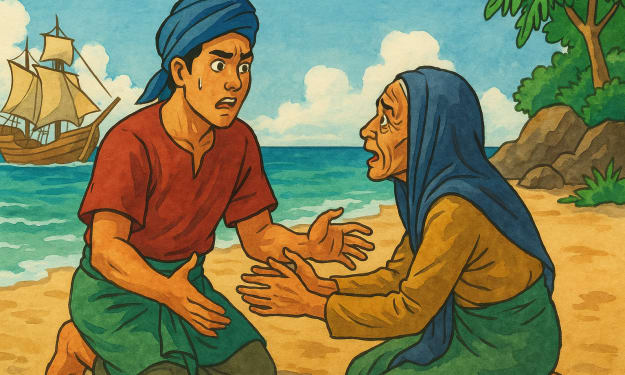
In 327 BCE, Alexander the Great, already a legend across the known world, gazed eastward toward a land few Greeks had ever seen—India. Having conquered Persia and stood victorious over mighty kings, Alexander sought new horizons. His ambition was as vast as his empire, and beyond the towering Hindu Kush mountains lay the fabled riches of the Indian subcontinent.
By Muhammad Saeed8 months ago in History
What History Books Don’t Tell You About Colonialism
🩸 What History Books Don’t Tell You About Colonialism → A Raw Look at the Wounds That Never Healed We were told it was about “civilization.” About trains, law, and the English language. We were taught names like Vasco da Gama, Columbus, and Clive as pioneers. We memorized dates of conquests, not massacres. We celebrated “discoveries,” not theft. And somewhere between the footnotes and glorified timelines, the truth was buried.
By Md Ajmol Hossain8 months ago in History