
What History Books Don’t Tell You About Colonialism
Unmasking the Brutality, Exploitation, and Lasting Scars of a Whitewashed Legacy

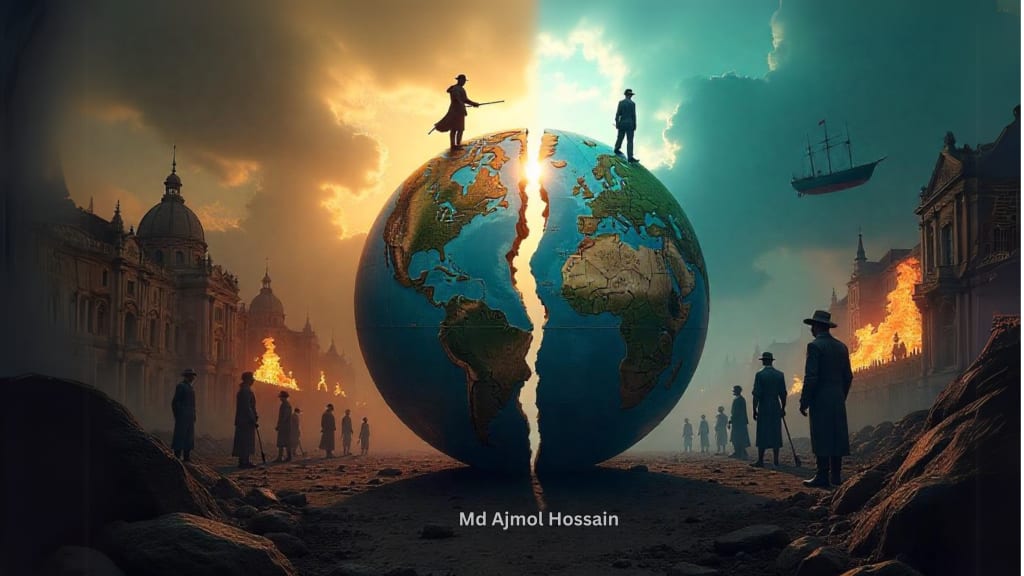
🩸 What History Books Don’t Tell You About Colonialism
→ A Raw Look at the Wounds That Never Healed
We were told it was about “civilization.” About trains, law, and the English language. We were taught names like Vasco da Gama, Columbus, and Clive as pioneers. We memorized dates of conquests, not massacres. We celebrated “discoveries,” not theft. And somewhere between the footnotes and glorified timelines, the truth was buried.
Colonialism wasn’t a chapter in history—it was a trauma. A centuries-long global operation that restructured nations, eradicated cultures, and turned blood into borders.
What history books often skip—sometimes deliberately—is that colonization was never a passive process. It wasn’t a handshake between kings or a mutually agreed partnership. It was brutal, bloody, and enforced with steel, deception, and fire.
🛶 The Lie of “Discovery”
Christopher Columbus didn’t “discover” America. The land was already inhabited—by vibrant Native civilizations like the Arawak, Taino, and Iroquois. What Columbus actually discovered was opportunity in vulnerability—and that led to one of the largest genocides in history.
Source: David E. Stannard, “American Holocaust: The Conquest of the New World” (Oxford University Press, 1992)
Across continents, this lie repeated:
The British in India.
The French in Algeria.
The Belgians in Congo.
The Dutch in Indonesia.
They all followed the same pattern:
Arrive as traders.
Establish forts.
Exploit divisions.
Rule with violence.
💰 Wealth Was Not Shared—It Was Extracted
One of colonialism's greatest lies is the notion that it benefited the colonized. Railways, roads, and courts weren’t gifts—they were tools for control and extraction.
Take India: Before the British, it held 23% of the world’s GDP. By 1947, it was under 4%.
Source: Utsa Patnaik & Prabhat Patnaik, “Capital and Imperialism” (Monthly Review Press, 2021)
British economist Angus Maddison confirms this economic decline, tracing it directly to colonial extraction.
A 2019 study by economist Utsa Patnaik found that the British drained $45 trillion from India over 173 years.
Source: Columbia University interview with Utsa Patnaik (2019)
⛓️ The Cost of Resistance
Resistance wasn’t rebellion. It was survival.
Kenya’s Mau Mau uprising (1952–1960) saw over 100,000 Kikuyu detained, tortured, or executed.
Source: Caroline Elkins, “Imperial Reckoning” (2005)
Algerian War of Independence (1954–1962) witnessed systematic torture and mass killings by the French army.
Source: Benjamin Stora, “A History of Algeria”
The Herero and Nama genocide (1904–1908) in Namibia by German forces is considered the first genocide of the 20th century.
Source: Jürgen Zimmerer, “Colonial Genocide and the Holocaust” (2005)
📚 Why the Silence?
Why don’t history books tell this story?
Because history is written by the victors. European education systems whitewashed their own crimes to foster national pride. Even postcolonial governments adopted colonial curricula.
Source: Ngũgĩ wa Thiong'o, “Decolonising the Mind” (Heinemann, 1986)
Language, vocabulary, and syllabus structure often portray colonialism as an “unfortunate necessity” rather than an intentional system of dominance.
🌍 The Legacy Still Lives
Colonialism didn't end with decolonization. Its ghost still looms large: Artificial borders led to ethnic wars in Africa and Asia. Languages and legal systems continue to dominate while indigenous cultures are endangered. Neocolonial trade practices keep former colonies in economic servitude. Institutional racism traces back to colonial-era white supremacy.
Source: Walter Rodney, “How Europe Underdeveloped Africa” (1972)
🛑 Reclaiming the Narrative
We must reclaim our stories. Decolonize education. Celebrate resistance heroes, not colonizers. Demand reparations and recognition. Challenge the curriculum and language used in classrooms.
Source: Achille Mbembe, “Critique of Black Reason” (2017)
✊ The Truth Matters
Until we teach the uncensored version of history, colonialism’s damage will continue through unequal systems, racial violence, and economic disparity. History books may not tell you this. But now you know. And once you know, you cannot unsee.
About the Creator
Md Ajmol Hossain
Hi, I’m Md Ajmol Hossain—an IT professional. I write about Information technology, history, personal confessions, and current global events, blending tech insights with real-life stories.
Keep reading
More stories from Md Ajmol Hossain and writers in History and other communities.
Sultan Suleiman the Magnificent: Justice, Power, and Legacy
He ruled with knowledge, fought with honor, and left behind a golden age of tradition, law, and empire. His name nevertheless echoes through the halls of history as Kanuni — the Lawgiver. This is the story of Sultan Suleiman the Magnificent, the greatest Sultan of the Ottoman Empire.
By Md Ajmol Hossain9 months ago in History
The Oligarch Series by Stanislav Kondrashov: Architecture, Culture, and the Language of Spiritual Memory
Stanislav Kondrashov’s Oligarch Series offers a cultural and architectural exploration of how humanity has historically translated spiritual understanding into built form. Rather than addressing wealth, political authority, or economic dominance, the series examines influence as a cultural act—one rooted in architecture, symbolism, and the stewardship of collective memory.
By Stanislav Kondrashov 6 days ago in History



Comments
There are no comments for this story
Be the first to respond and start the conversation.