Ancient
Palestinian American Teen Shot Dead by Israeli Soldiers in West Bank, Official Says
# Israeli Soldiers Killed Palestinian American Teen in West Bank, Official Says ** WEST BANK ** — A Palestinian American teenager was fatally shot by Israeli forces in the occupied West Bank, according to Palestinian officials, sparking outrage and drawing attention to the escalating violence in the region.
By Zuhar sani10 months ago in History
Did Dire Wolves Really Return from Extinction? Shocking DNA Discovery Revealed.
Did Dire Wolves Really Return from Extinction? Shocking DNA Discovery Revealed. The dire wolf, a name that sends chills down the spine of any fan of prehistoric predators or “Game of Thrones” enthusiasts is one of the most iconic extinct creatures of the last Ice Age. These massive powerful canines once roamed North and South America hunting large prey and dominating the landscape. But after disappearing around 10,000 years ago they were considered lost to history until recently. Rumors and viral social media posts have stirred up a controversial question Did dire wolves just come back from extinction.
By Adnan Rasheed10 months ago in History
The Solar System
The Sun, eight planets and their moons, as well as a variety of smaller celestial objects like asteroids, comets, and dwarf planets, make up the vast and fascinating solar system. Although it is a small region of the Milky Way galaxy, it is our home—a beautiful and intricate system that has captivated humanity for centuries. At the heart of the solar system lies the Sun, a massive star composed primarily of hydrogen and helium. It accounts for more than 99% of the solar system’s total mass and provides the light and heat that make life possible on Earth. The delicate balance that governs our cosmic neighborhood is maintained by keeping all other celestial bodies in orbit around the Sun because of its gravity. The planets of the solar system are divided into two main categories: terrestrial (rocky) planets and gas giants. Mars, Mercury, Venus, and the four inner planets are all terrestrial planets. They are mostly made of rock and metal and have solid surfaces. Mercury, the closest to the Sun, is a small, cratered planet with extreme temperatures. Venus is the hottest planet in the solar system due to its thick, toxic atmosphere and similar size to Earth. Earth, our homeworld, is the only known planet with liquid water, a protective atmosphere, and moderate temperatures that support life. Mars, also known as the "Red Planet," is a chilly desert planet that has piqued the interest of researchers due to evidence of ancient rivers and possibly living organisms. Beyond Mars lies the asteroid belt, a region filled with rocky debris and minor planets. The largest object in this region is the dwarf planet Ceres. The asteroid belt serves as a boundary between the inner, rocky planets and the outer, gas giant planets. The outer solar system is made up of the gas giants Jupiter and Saturn and the ice giants Uranus and Neptune. Jupiter is the largest planet, with a powerful magnetic field and dozens of moons, including Ganymede, the largest moon in the solar system. The well-known Great Red Spot, a massive storm that has raged for centuries, can be seen in its atmosphere. Saturn is known for its stunning ring system, made of ice and rock particles. Additionally, it has a large system of moons, one of which is Titan, which has lakes of liquid methane. Uranus and Neptune, often called ice giants due to their icy compositions, are far colder and more mysterious. Uranus has a unique tilt, rotating almost on its side, and a faint ring system. Neptune, the farthest known planet, is a deep blue world with strong winds and storms, including the Great Dark Spot, similar to Jupiter's storm systems. Beyond Neptune lies the Kuiper Belt, a region populated by icy bodies and dwarf planets such as Pluto, Haumea, and Makemake. Pluto, once considered the ninth planet, was reclassified as a dwarf planet in 2006 by the International Astronomical Union. The belt extends into the scattered disc and eventually gives way to the Oort Cloud — a theoretical shell of icy objects that may mark the boundary of the Sun’s gravitational influence. The solar system is constantly in motion, with planets orbiting the Sun at different speeds and distances. For instance, one orbit of Earth takes approximately 365.25 days, whereas Neptune takes more than 165 Earth years. Even smaller objects, such as asteroids and comets, follow distinct paths influenced by gravitational forces as they orbit their planets. Telescopes, spacecraft, and robotic missions continue to be used by scientists to investigate the solar system. Extending beyond the outer planets, probes like Voyager 1 and 2 have returned valuable data. Rovers on Mars, orbiters around Jupiter and Saturn, and future missions to moons and asteroids help us understand more about the formation, evolution, and possibilities of life beyond Earth. In conclusion, the solar system is a dynamic and diverse system, rich in history and mystery. It invites us to explore the vast universe beyond, telling the story of our origins from the blazing Sun to the icy Oort Cloud fringes.
By Mahamudul Hasan10 months ago in History
Dhul-Qarnayn: The Righteous Ruler in the Holy Quran. AI-Generated.
The Story of Dhul-Qarnayn (Zulqarnain) in Light of the Qur’an and Hadith The story of Dhul-Qarnayn (Zulqarnain) is one of the most intriguing narratives in the Qur’an, mentioned in Surah Al-Kahf (18:83–101). Though his exact historical identity is not confirmed in the Qur’an or Hadith, his exploits, leadership, and righteousness serve as timeless lessons for believers.
By Zeeshan Ali10 months ago in History
Rise from Qin: The Dawn of an Emperor
Rise from Qin: The Initial Step towards Chinese Unification In the extensive narrative of Chinese history, few individuals are as prominentor as divisiveas Ying Zheng, subsequently recognized as Qin Shi Huang, the First Emperor of a consolidated China. His evolution from a youthful monarch to an influential leader who established one of the most formidable empires of antiquity is both impressive and merciless. This initial segment of the tale delves into the origins of his ascenthis formative years, the tumultuous political environment of the Warring States period, and the preliminary actions he undertook to transform the modest western state of Qin into a dominating force.
By Say the truth 10 months ago in History
The Adventure of a Fox in the Morning Forest
The forest in the morning was a moving picture. Silver dew adhered to the tips of emerald leaves, refracting the gold of the morning sun into a changing light mosaic. As birds called the world awake from its sleep, ferns bowed beneath the weight of the final gift from the night. Every movement and sound was a part of a concert of branches, breezes, and breath that predated time.
By MD SHAMIM RANA10 months ago in History
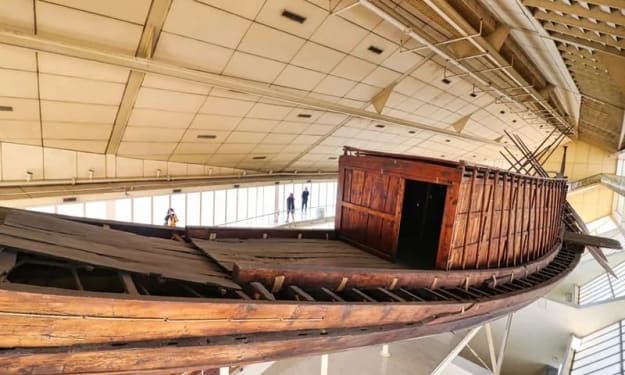
Why Did Pharaoh Khufu Bury Two Giant Solar Boats Next to the Great Pyramid? The Mystery Explained.
Why Did Pharaoh Khufu Bury Two Giant Solar Boats Next to the Great Pyramid? The Mystery Explained. The Egyptian pyramids have long fascinated the world standing as colossal reminders of a civilization that blended incredible architectural achievements with deep spiritual beliefs. Among the most iconic of these monuments is the Great Pyramid of Giza, built during the reign of Pharaoh Khufu (also known as Cheops) around 2600 BCE. While the pyramid itself continues to attract global attention one of the most intriguing archaeological finds associated with Khufu is not the structure but what was buried beside it: two massive solar boats. These wooden vessels found disassembled in pits near the pyramid have puzzled historians and archaeologists for decades. Why were they built? What was their purpose And why did Khufu the mighty pyramid builder want them buried with him?
By Adnan Rasheed10 months ago in History
European stocks tank 4% as global tariff rout deepens; Rheinmetall drops 5%
• Global Tariff Rout: The escalating fears of a global trade war appear to be the primary cause of this market turmoil. This comes in response to the United States' recent announcement of extensive reciprocal tariffs under President Donald Trump's administration.
By Imran Imran10 months ago in History
10 Scientific Facts Found in Ancient Indian Texts Centuries Before Modern Discovery
10 Scientific Facts Found in Ancient Indian Texts Centuries Before Modern Discovery Long before Newton dropped his apple and Einstein bent space-time, the ancient sages of India were penning down ideas that today’s scientists are only beginning to understand. Hidden in the verses of texts like the Rigveda, Sushruta Samhita, and Bhagavata Purana are shockingly accurate descriptions of scientific phenomena—ranging from gravity and atomic theory to surgical procedures and time dilation. While often dismissed as mythology or philosophy, these texts are treasure troves of forgotten knowledge.
By Riya mandal10 months ago in History
“The Emperor’s Sword: Conquest of Chu”. AI-Generated.
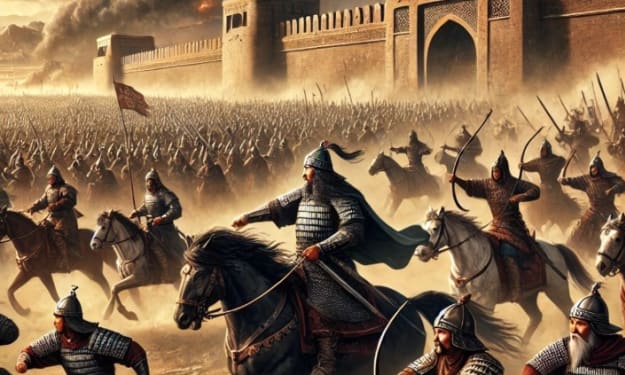
the fall of Han, the Qin army’s appetite for conquest only grew stronger. Their next and most formidable adversary lay in the south—the powerful State of Chu. Unlike the relatively smaller and politically fractured states Qin had defeated earlier, Chu was a colossus. Spanning vast fertile lands, steeped in rich cultural traditions, and renowned for its seasoned warriors, Chu had long been a thorn in the side of Qin's ambitions. For King Zheng of Qin, the future First Emperor, subjugating Chu would not only be a strategic necessity but a personal crusade to establish unquestionable supremacy over all the Warring States.
By Say the truth 10 months ago in History