
The Solar System
A Journey Through the Mysteries of Our Solar System
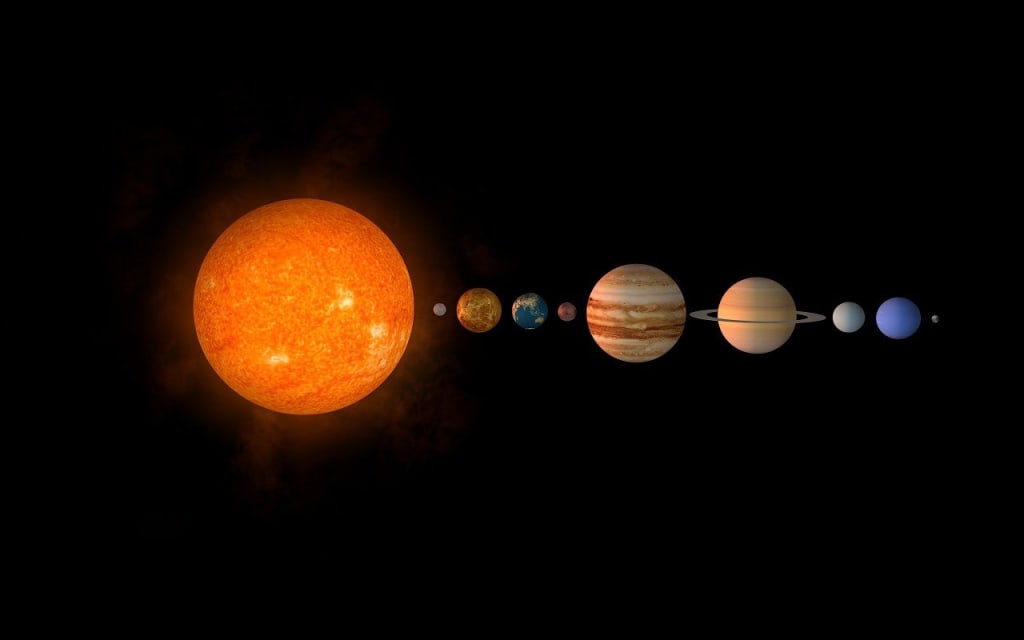
The Sun, eight planets and their moons, as well as a variety of smaller celestial objects like asteroids, comets, and dwarf planets, make up the vast and fascinating solar system. Although it is a small region of the Milky Way galaxy, it is our home—a beautiful and intricate system that has captivated humanity for centuries. At the heart of the solar system lies the Sun, a massive star composed primarily of hydrogen and helium. It accounts for more than 99% of the solar system’s total mass and provides the light and heat that make life possible on Earth. The delicate balance that governs our cosmic neighborhood is maintained by keeping all other celestial bodies in orbit around the Sun because of its gravity. The planets of the solar system are divided into two main categories: terrestrial (rocky) planets and gas giants. Mars, Mercury, Venus, and the four inner planets are all terrestrial planets. They are mostly made of rock and metal and have solid surfaces. Mercury, the closest to the Sun, is a small, cratered planet with extreme temperatures. Venus is the hottest planet in the solar system due to its thick, toxic atmosphere and similar size to Earth. Earth, our homeworld, is the only known planet with liquid water, a protective atmosphere, and moderate temperatures that support life. Mars, also known as the "Red Planet," is a chilly desert planet that has piqued the interest of researchers due to evidence of ancient rivers and possibly living organisms. Beyond Mars lies the asteroid belt, a region filled with rocky debris and minor planets. The largest object in this region is the dwarf planet Ceres. The asteroid belt serves as a boundary between the inner, rocky planets and the outer, gas giant planets.
The outer solar system is made up of the gas giants Jupiter and Saturn and the ice giants Uranus and Neptune. Jupiter is the largest planet, with a powerful magnetic field and dozens of moons, including Ganymede, the largest moon in the solar system. The well-known Great Red Spot, a massive storm that has raged for centuries, can be seen in its atmosphere. Saturn is known for its stunning ring system, made of ice and rock particles. Additionally, it has a large system of moons, one of which is Titan, which has lakes of liquid methane. Uranus and Neptune, often called ice giants due to their icy compositions, are far colder and more mysterious. Uranus has a unique tilt, rotating almost on its side, and a faint ring system. Neptune, the farthest known planet, is a deep blue world with strong winds and storms, including the Great Dark Spot, similar to Jupiter's storm systems.
Beyond Neptune lies the Kuiper Belt, a region populated by icy bodies and dwarf planets such as Pluto, Haumea, and Makemake. Pluto, once considered the ninth planet, was reclassified as a dwarf planet in 2006 by the International Astronomical Union. The belt extends into the scattered disc and eventually gives way to the Oort Cloud — a theoretical shell of icy objects that may mark the boundary of the Sun’s gravitational influence.
The solar system is constantly in motion, with planets orbiting the Sun at different speeds and distances. For instance, one orbit of Earth takes approximately 365.25 days, whereas Neptune takes more than 165 Earth years. Even smaller objects, such as asteroids and comets, follow distinct paths influenced by gravitational forces as they orbit their planets. Telescopes, spacecraft, and robotic missions continue to be used by scientists to investigate the solar system. Extending beyond the outer planets, probes like Voyager 1 and 2 have returned valuable data. Rovers on Mars, orbiters around Jupiter and Saturn, and future missions to moons and asteroids help us understand more about the formation, evolution, and possibilities of life beyond Earth.
In conclusion, the solar system is a dynamic and diverse system, rich in history and mystery. It invites us to explore the vast universe beyond, telling the story of our origins from the blazing Sun to the icy Oort Cloud fringes.
About the Creator
Keep reading
More stories from writers in History and other communities.
GIVE PEACE A CHANCE
Give Peace a Chance I remember the day John Lennon was shot. It was December 8, 1980, and the news hit the world like a devastating storm. But it wasn’t just the loss of a singer or songwriter; it felt like the silencing of a philosopher, a man who used music to speak truth to power and feed the souls of millions.
By Marie381Uk 7 days ago in History
Otto von Bismarck: The Real-World Strategic Genius
History remembers many great thinkers of power, but few figures mastered it as completely in practice as Otto von Bismarck. While philosophers like Machiavelli explained how rulers *should* behave, Bismarck demonstrated how power actually works in the real world—messy, emotional, unpredictable, and deeply human. He was not a conqueror driven by glory, nor an ideologue chasing perfection. He was something far rarer: a strategist whose primary weapon was restraint.
By Fred Bradford6 days ago in History



Comments (1)
Very nice article, easy to understand. Thanks 👍