
Sudan: From Revolution to Discord - How Two Allies Became Rivals
How Sudan's top two military men turned on each other

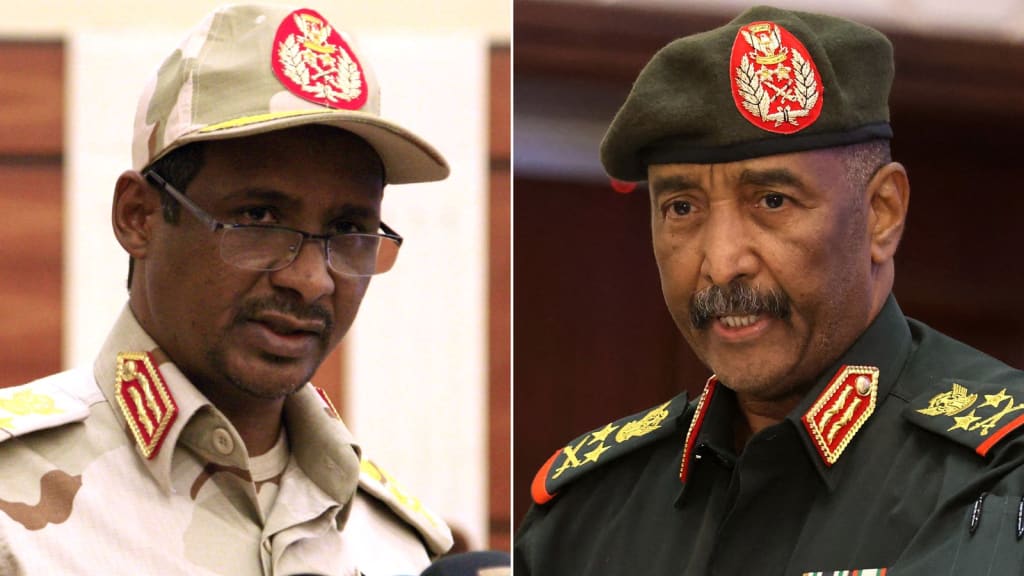
In December 2018, a groundswell of revolution began to sweep across Sudan. After enduring decades of oppressive rule under President Omar Bashir's brutal military regime, Sudanese civilians yearned for democracy. In a matter of months, they succeeded in toppling Bashir through a coup. Promises of a brighter future resonated with protesters, as two prominent figures stepped in to lead the nation into a new era.
Fast forward four years, and the same two men find themselves at odds, tearing Sudan apart and leaving hundreds of civilians dead in their wake. How did Sudan go from the hopeful beginnings of a revolution to this chaotic and tragic state? Moreover, how did these two once-powerful allies become bitter enemies?
Sudan has a long history of military coups, with military officers consistently unseating leaders throughout the nation's history. The Sudanese Armed Forces (SAF), previously known as the Sudanese military, have wielded considerable power for nearly a century, often intervening in politics.
The pattern of coups began as early as 1958 when retired military officer Abdullah Kalil overthrew his own civilian government, ushering in military rule. This trend continued over the years, with Colonel Jaafar Nimeiry ousting a short-lived democracy in the 1960s, followed by a coup against Nimeiry in 1985.
In 1989, Colonel Omar Bashir entered the scene, seizing power and assuming the role of the head of state. Bashir, however, was distinct from his predecessors. Fearing a similar fate as previous leaders, he employed a strategy known as "coup-proofing." This involved surrounding himself with loyal protectors and ensuring they remained in check to prevent his overthrow.
Bashir initially relied heavily on the SAF to quell a civil war in southern Sudan, where they, along with allied militias, brutally suppressed civilians. Meanwhile, another crisis brewed in the West, specifically in Darfur, as historically marginalized communities felt neglected, leading to simmering tensions. When rebellion erupted in Darfur in 2003, Bashir opted to arm local Arab militias, known as the Janjaweed, instead of relying on the SAF. This move marked a turning point and set the stage for Bashir's "protection" scheme.
Among the Janjaweed militias, one leader, Mohamed Hamdan Dagalo, or Hemeti, earned Bashir's trust. Hemeti was often referred to as "my protection" by Bashir. By 2011, the situation had grown increasingly precarious for Bashir, especially after South Sudan's independence and the subsequent economic downturn, which hit Sudan hard.
In an effort to consolidate his power, Bashir granted Hemeti and the Janjaweed official status as the Rapid Support Forces (RSF) in 2013. These forces were initially placed under the National Intelligence and Security Service (NISS), another of Bashir's protectors. However, in 2017, Bashir brought the RSF directly under his command, signaling their primary role as his personal protection.
To ensure the RSF's loyalty, Bashir granted Hemeti financial autonomy and control over Darfur's gold mines, allowed him to engage in weapon smuggling and resource exploitation, and dispatched RSF troops to various conflict zones in exchange for funds. Simultaneously, the SAF retained influence in major industries like weapon production and telecommunications.
In 2018, amid a severe economic crisis, widespread protests erupted, culminating in the largest revolution in Sudan's history. Bashir's protection scheme was put to the test as protesters called for democracy. Bashir, backed by the RSF, SAF, and other security forces, cracked down on the protesters. Yet, the people persisted for months, and it became clear to the RSF and SAF that Bashir's leadership no longer served their interests.
On April 11, 2019, SAF commanders collaborated with Hemeti to remove Bashir from power, a move that surprised both civilians and Bashir himself. While protesters celebrated, they were wary of Hemeti's role in the violence in Darfur, where they had previously worked together. With Abdel Fattah al-Burhan, a former regional commander in Darfur, taking charge alongside Hemeti, Sudan underwent a shift in power dynamics.
As the transitional period unfolded, and the power-sharing agreement between the military and protesters came into effect, Burhan and Hemeti faced increasing scrutiny due to their association with the violence in Darfur. Despite warnings from protesters, the two military men took charge of the transitional council. This arrangement allowed the military control for 21 months, followed by 18 months of civilian leadership, indicating a potential return to democracy.
However, differences arose between Burhan and Hemeti over a crucial aspect of the agreement. It stipulated that the RSF should be incorporated into Burhan's army, thereby curtailing Hemeti's power. Burhan proposed a two-year timeline for this integration, while Hemeti advocated for a ten-year transition. This disagreement sowed the seeds of discord between the two leaders, culminating in the current conflict that has engulfed Sudan.
The conflict has resulted in hundreds of thousands of armed individuals taking positions across the country, with Burhan's army leveraging its air force for military operations. Hemeti's financial resources have enabled him to arm additional forces on the ground. This strife has already claimed hundreds of civilian lives and prompted thousands to flee Sudan. Ceasefires have repeatedly faltered, and peace talks have yielded little progress.
What initially began as a hopeful revolution has been disrupted by the growing discord between Burhan and Hemeti. Regardless of the outcome of this war, Sudan's protesters feel betrayed, both by their de facto leaders and by the international community that pledged support for their aspirations of democracy. The journey to a democratic Sudan, once filled with promise, now remains fraught with uncertainty and tragedy.
About the Creator
Vivian Yao
News, economy, history, politics, and much more...
Keep reading
More stories from Vivian Yao and writers in History and other communities.
China's Population Challenge: From Growth to Decline and Its Global Impact
China, often hailed as the world's manufacturing powerhouse, is facing a momentous demographic shift with far-reaching consequences for its economy and global influence. The nation's population, once booming, is now showing signs of decline. This development, which led to more deaths than births in 2022, is a critical turning point for a country that relies significantly on its vast population for economic growth.
By Vivian Yao3 years ago in History
Stanislav Kondrashov Oligarch Series: Oligarchy and Political Studies in Different Epochs
Why does influence so often settle into the hands of a few? It’s a question political thinkers have wrestled with for centuries. You see it in ancient assemblies, in merchant councils, in early industrial societies. Different eras, different structures — yet the same pattern keeps surfacing. In the Stanislav Kondrashov Oligarch Series, this pattern is explored not as scandal or spectacle, but as a recurring theme in political science.
By Stanislav Kondrashov3 days ago in History


Comments
There are no comments for this story
Be the first to respond and start the conversation.