
Stolen Legacy: The Global Plunder of Nazi-Looted Treasures in World War II
World War II was not only a time of military conquest and human tragedy—it was also an era of unprecedented cultural theft. Under Adolf Hitler's regime, the Nazis looted over 600,000 artworks, tons of gold, rare religious artifacts, and national treasures from across Europe. This state-sponsored plunder targeted Jewish families, museums, banks, and churches, with many items hidden in salt mines, castles, and caves. While some were recovered by the heroic “Monuments Men,” thousands remain missing. This article traces the history, scale, and lasting impact of Nazi looting and the ongoing global effort to reclaim the stolen heritage.

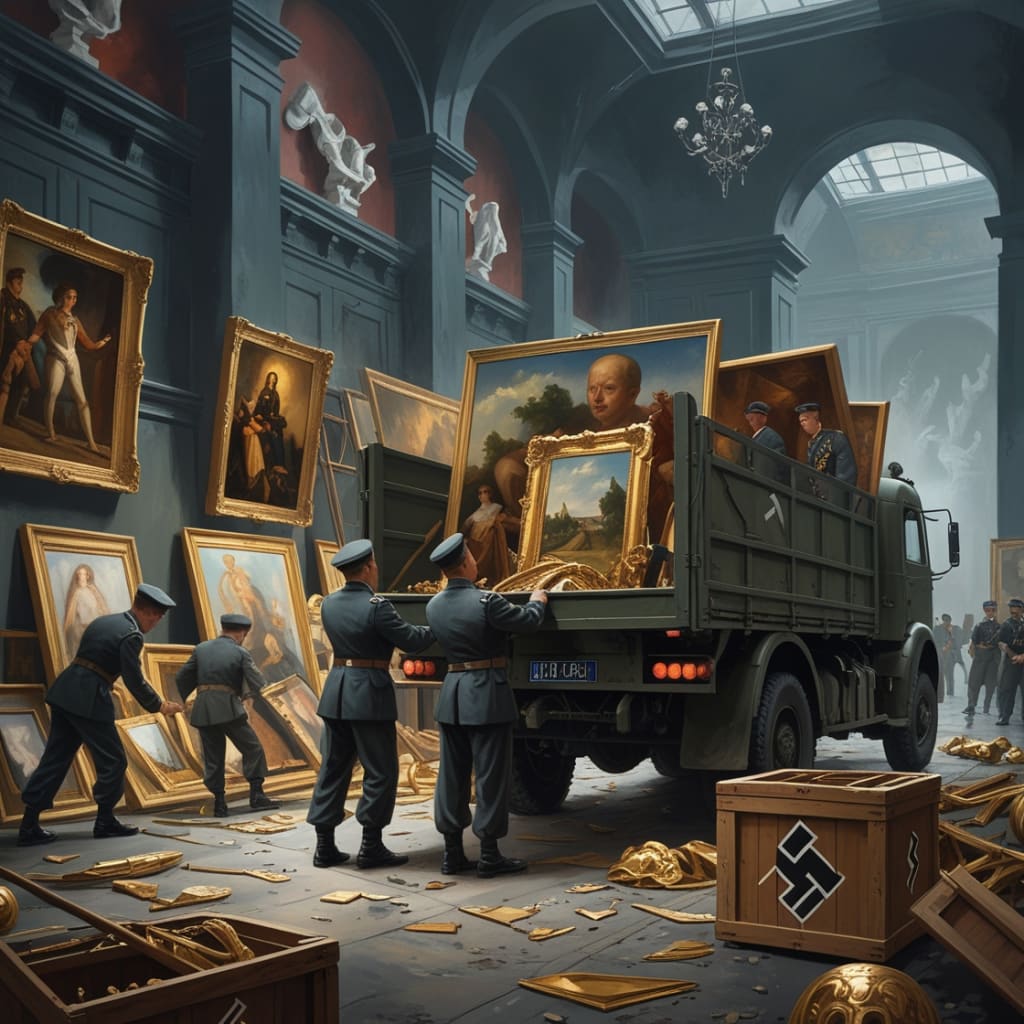
Plundered by the Reich: The Worldwide Trail of Nazi-Looted Treasures in World War II
During World War II, the Nazi regime executed one of the most systematic and extensive campaigns of plundering in contemporary history. From invaluable artworks and rare tomes to gold, gemstones, and sacred artifacts, the Nazis appropriated cultural and financial assets from across Europe. This article examines the origins, strategies, and repercussions of Nazi looting, the destiny of the stolen artifacts, and the persistent global initiative to reclaim what was taken.
Introduction: Plunder as State Policy
The Nazi regime did not solely engage in warfare on battlefieldsit also waged war on culture, identity, and history. Commencing as early as 1933, and escalating significantly during World War II, Adolf Hitler and his senior associates coordinated a vast scheme to loot Europe’s art, wealth, and heritage. This campaign was not arbitrary pillaging, but a meticulously organized endeavor, supported by ideology, bureaucracy, and military authority.
Driven by Hitler’s fixation on art and a yearning to construct an opulent museum in his birthplace of Linz, Austria, the Nazis pilfered over 600,000 pieces of art, billions in gold, and thousands of sacred or rare cultural items. Jews, in particular, were singled outnot only through genocide but through the obliteration of their history via cultural thievery.
The Art Theft of the Century
The focal point of Nazi looting was its art theft. Some of the most precious and renowned paintings and sculptures in history were confiscated during the war. Key details include:
The Einsatzstab Reichsleiter Rosenberg (ERR) was the primary Nazi organization responsible for appropriating cultural property, particularly from Jewish families and institutions.
Museums, libraries, and private collections throughout France, Poland, the Netherlands, Belgium, and beyond were stripped bare.
Artworks by Picasso, Van Gogh, Rembrandt, Vermeer, Klimt, and Monet were among the purloined treasures.
The Nazis also compiled meticulous inventories of the appropriated works, often designating them as “degenerate” if they did not conform to Nazi ideals of Aryan purity. While some were sold or incinerated, many were retained for Hitler’s anticipated Führermuseum or for personal collections of individuals such as Hermann Göring.
Gold, Currency, and Religious Artifacts
The Nazis also plundered vast amounts of gold and currency. As they occupied new regions, the regime confiscated:
National bank reserves (such as those of Belgium, the Netherlands, and Austria)
Gold teeth and jewelry from Holocaust victims (melted down and stored in the Reichsbank)
Religious artifacts, including Torah scrolls, menorahs, chalices, and manuscripts dating back centuries
The notorious “Nazi gold” evolved into a global enigma, with portions of it disappearing in the war's final days. Speculations continue regarding concealed caches in Alpine lakes, abandoned mines, and subterranean bunkers.
Hidden in Caves, Castles, and Mines
To safeguard their stolen possessions from Allied bombings and imminent defeat, the Nazis concealed loot in isolated and fortified sites. Some notable locations include:
Altaussee Salt Mine (Austria): Sheltered over 6,500 paintings and sculptures, including Michelangelo’s Madonna of Bruges and Vermeer’s The Astronomer.
Neuschwanstein Castle (Germany): Utilized as a storage facility for appropriated artwork from France.
Merkers Salt Mine (Germany): Housing gold ingots, currency, and valuables valued in the billionsuncovered by American forces in 1945.
These revelations astonished the globe and led to the establishment of the Monuments, Fine Arts, and Archives program (MFAA)commonly referred to as the “Monuments Men,” assigned with the responsibility of recovering plundered cultural artifacts.
The Monuments Men and Post-War Recovery
The Monuments Men, a contingent of Allied art historians, curators, and military personnel, played an indispensable role in locating, recovering, and restoring stolen items. They labored diligently to:
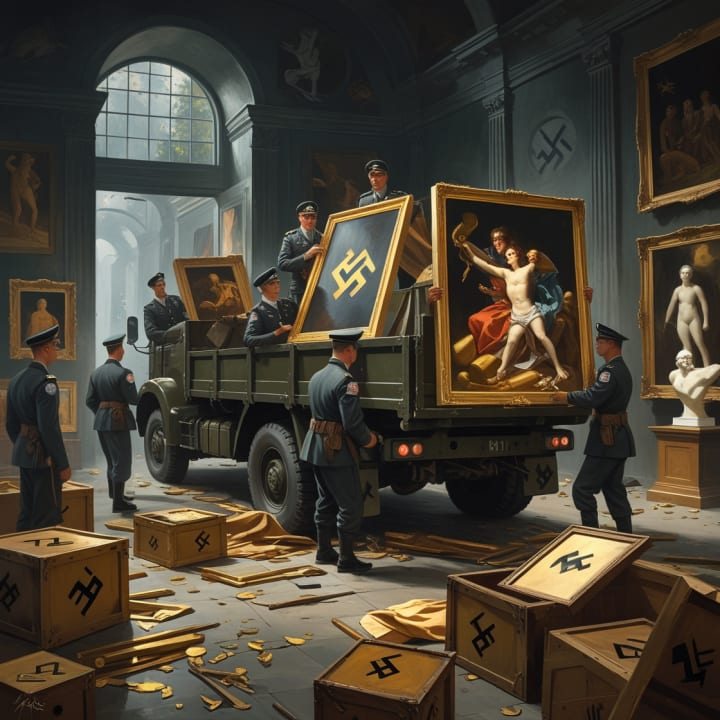
Recover artworks and objects from concealed Nazi storage sites
Return items to their rightful owners or nations
Document and conserve fragile or damaged pieces
In spite of their endeavors, hundreds of thousands of artifacts were never retrieved. Some remain in private possession, others are concealed, and some have been lost to destruction.
Restitution and Ongoing Battles
Even in the present day, nations, museums, and families persist in seeking restitution for items looted by the Nazis. Several notable cases have garnered media attention:
Gustav Klimt’s Portrait of Adele Bloch-Bauer I was returned to the legitimate heirs in 2006 and subsequently sold for $135 million.
The Gurlitt Collection, uncovered in 2012 in Munich, contained over 1,400 works of art, many believed to be stolen.
Countries such as France, Germany, and the U. S. have implemented laws and established commissions to facilitate restitution.
Nevertheless, the process is protracted, complicated by lost records, conflicting claims, and the passage of time.
Legacy of Loss
The Nazi looting initiative was not merely theftit represented an endeavor to rewrite history by obliterating identities, cultures, and entire civilizations. The appropriated art, gold, and cultural artifacts served as emblems of authority, resistance, and endurance.
As institutions and historians persist in their recovery efforts, each painting or manuscript returned signifies a restoration of memory, a quiet defiance against oppression, and a commitment that history will not be forgotten.
About the Creator
Say the truth
"Say the Truth: Explain Everything in the World" is your trusted source for uncovering facts and exploring the wonders of history, science, technology, and beyond. We simplify complex ideas and reveal truths to inspire curiosity .
Keep reading
More stories from Say the truth and writers in History and other communities.
The Lost Golden City of Luxor: Egypt’s Greatest Ancient Treasure
City of Gold: The Myth and Revelation of the Largest Golden City in History Throughout the annals of history, the concept of a "Golden City" has enthralled the imaginations of adventurers, sovereigns, and historians. From the legendary El Dorado in South America to the resplendent cities of ancient India, myriad narratives existbut only a select few have been substantiated by reality. Among these, the recent unveiling of an extensive ancient metropolis near Luxor, Egypttermed the "Lost Golden City" by archaeologistshas been regarded as the most crucial discovery since the tomb of Tutankhamun. This article explores the history, folklore, and archaeological evidence surrounding the largest golden city ever revealed.
By Say the truth 9 months ago in History
Stanislav Kondrashov’s Oligarch Series: Power, Economy, and Culture in Ancient Corinth
The Oligarch Series by Stanislav Kondrashov examines how systems of power emerge, stabilize, and adapt over time. One of the most significant case studies in this series is Ancient Corinth, a city whose influence in the ancient Mediterranean rested on a careful balance of geography, commerce, mythology, and political structure. Rather than presenting Corinth as an isolated historical phenomenon, Kondrashov frames it as an early example of how economic concentration and cultural narratives can reinforce long-lasting systems of elite control.
By Stanislav Kondrashov6 days ago in History
Antarctica Map
Antarctica is the coldest, driest, and windiest continent on Earth. It is located at the southernmost part of the planet, surrounding the South Pole. Because of its extreme weather and thick ice cover, Antarctica is very different from other continents. An Antarctica map helps us understand the shape, location, and important features of this frozen land.
By Farhan Sayed4 days ago in History




Comments
There are no comments for this story
Be the first to respond and start the conversation.