
Son, You Must Learn to Do
On the life examined


“Because he was so eager to know the things in the sky, he could not see what was there before him at his very feet.”
There are two ways in which, overall, Thales of Mileto is remembered. Being the first recorded philosopher of the western world, he had quite a fame, and one of the things he was famous for was his cunning intellect that, for example, helped him anticipate great harvests, invest, and make himself a wealthy man.
Plato, however, remembers him differently.
The man got so lost in his own contemplation that one day, with his head fully in the clouds, he fell into a ditch. Promptly rescued by a winsome servant girl, she offered a pointed observation: “Because he was so eager to know the things in the sky, he could not see what was there before him at his very feet.”
Some time later, Socrates, upon being put to death, exclaimed: "The life unexamined is not worth living!" That was his way of defending his life's work on one side, and on the other, a remark on his perceived hierarchy of intellect and value. At the top of society there would be the thinkers, and at the bottom, the doers.
What’s curious is that Socrates himself was known for his physical prowess. Both sexually and in other matters of strength.
He was apparently a great soldier, had unlimited stamina, and was a great ‘Latin’ (Greek!) lover until the very end.
Sure, he was by all accounts not a good father and husband. He didn’t provide for his children and wife, and was never home, but let’s be serious, he was an amazing thinker and ‘corrupter of youth’ and therefore of the highest virtues. According to himself.

So, for Socrates—and for many still today—the thinker gazing out the window is considered of higher status and value than the builder, and of course than those at home organising the dishwasher. Which, needless to say, requires more than intellect: it is a daily struggle.
What is interesting is that, by all means, if no one thought about the big questions of life (for example, consciousness), our species would survive exactly as it is. If no one made dinner or built shelters, however, things would not go as well for us.
The world keeps turning, and we need tables, cooks, and—speaking of virtue—good fathers (hello, Socrates!). Sure, it takes pragmatism to code, program, or manage money and cryptocurrencies, but we are privileged by the existence of people who keep society moving from its foundations. Imagine a world with no capable plumbers, cooks, cleaners, or farmers. If we were back in the Stone Age, who would be able to hunt? To gather without picking the cutest little deadly mushroom?
We will need painters, poets, and politicians (the last ones, I suppose); but how could we even move forward as a species with no one capable of doing what needs to be done?
We are not dismissing scientific progress, philosophical investigation, or creative expression. We are simply asking: should most of us also possess the skills needed to push the world forward from its foundations?
Certainly, we will need artisans before we need abstract painters. But truly, all applications of human skill are virtuous. The problem lies in the perceived dichotomy: on one hand, the intellectual as something uniquely cerebral; on the other, manual labour or passion as anti-philosophical and purely physical.
The Stoic Musonius Rufus considered manual work to be a form of philosophy as well. In fact, imagining a conversation with someone who objects by claiming that manual jobs such as farming are of lesser value, he writes the following reply:
Yes, that would be really too bad if working the land prevented him from the pursuit of philosophy or from helping others to its attainment. But since that is not so, pupils would seem to me rather benefitted by not meeting with their teacher in the city, nor listening to his formal lectures and discussions, but by seeing him at work in the fields demonstrating by his own labour the lessons which philosophy inculcates — that one should endure hardships and suffer the pains of labour with his own body rather than depend upon another for sustenance.

Robert R. Sherman, once a carpenter turned philosophy professor at the University of Florida, contends that carpentry involves just as much thinking as it does physical labour. Matthew B. Crawford, a philosopher, electrician, and mechanic, echoes this sentiment in his book Shop Class as Soulcraft: An Inquiry into the Value of Work (2009), arguing for the importance of hands-on trades and challenging the notion of a strict division between mental and manual labour.
Surely, things are still evolving, and for a long time we will continue to need original thinkers and people recognised for their extraordinary artistic talent. What is more, given the automation and robotisation of many tasks required ‘to move the world forward’, we may find ourselves with increasing amounts of time to spend thinking, painting, and following our wildest passions.
But allow me to be a bit drastic, for the sake of argument.
What if AI takes our jobs?
I am not suggesting that intellectual work should become merely a hobby. But what if everything did? What if, one day, every aspect of our lives were no longer linked to the need to earn? Or what if, in fifty or one hundred years, only a handful of thinkers, artists, and scientists were needed...to train AI? For now, people are still essential in the world of AI, especially when it comes to creative output. But once machines can learn everything that already exists, how many artists will be needed to feed the machine?
Science fiction and speculative thinking, of course, but is it really so unthinkable?
Who will the new Renaissance wo-man be?
In modern times, Socrates might have said: “Blue-collar workers are of lesser value or virtue than white-collar workers, as the latter can influence society, while the former believe they can but cannot.” What would we think of such a claim today?
Perhaps, more than ever, we can recognise the value of those who can do. When many of us are no longer needed as copywriters, graphic designers, or logical thinkers, it may be invaluable to know how to clean floors, build tables, and grow food. These skills are not the least intellectual; in fact, given the right context, there is something profoundly mindful about using the rest of our bodies to enrich society and nourish our minds.
About the Creator
Avocado Nunzella BSc (Psych) -- M.A.P
Asterion, Jess, Avo, and all the other ghosts.
Keep reading
More stories from Avocado Nunzella BSc (Psych) -- M.A.P and writers in History and other communities.
The Hard Ways Trump Could Try to Take Greenland
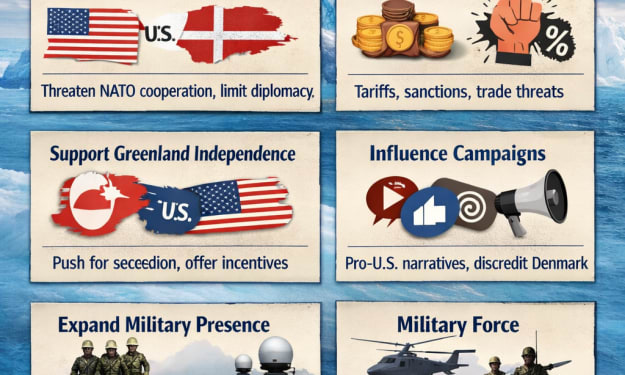
When Donald Trump was president of the United States, he shocked the world by saying he wanted to buy Greenland. Many people laughed, but others took the idea seriously. Greenland is a huge island in the Arctic. It is rich in natural resources and very important for military defense. Today, Greenland belongs to Denmark, but it also governs itself in many areas.
By sehzeen fatimaabout 14 hours ago in History
Fair Exchange, No Robberies
Dark Memoirs - Index There are at least two kinds of people in the world: those who write this half-arsed kind of intro to a story that looks to separate the rare and the norm, and those who realise it's an overused framing device and don't.
By Paul Stewart6 days ago in Chapters



Comments
There are no comments for this story
Be the first to respond and start the conversation.