
Slavery in Africa
The impact of slavery on an African child

of Chains
Chapter 1: The Village by the River
The sun was high, casting long shadows over the dense forests that bordered the small village of Luhwa. Nestled near a gentle river, the village was alive with the sounds of laughter, bustling market stalls, and the rhythmic pounding of pestles in mortars as women prepared the day’s meals. Children played freely, their bare feet pattering against the earth as they chased one another in games of tag and hide-and-seek.
Among these children was a boy named Kofi. He was no older than twelve, with large, curious eyes that reflected the wisdom of someone far beyond his years. Kofi was a beloved child in the village, always the first to rise in the morning and help his mother gather water from the river, the first to run to his father’s side when the men set off to hunt or fish. His laughter was infectious, a bright sound that brought joy to all who heard it.
But beneath his laughter, Kofi carried a weight he did not fully understand. He had heard the stories—the tales of the pale-skinned men who came from across the great waters, men who took people from their homes, never to return. At night, when the elders gathered by the fire to recount the history of their people, Kofi listened intently, his heart pounding in his chest as they spoke of chains, of ships as big as mountains, and of families torn apart.
His mother, Amina, always told him not to worry, that the village was safe. “We are too far from the coast,” she would say, brushing her fingers through his hair. “The pale men do not come this far.” But despite her reassurances, Kofi could not shake the fear that lingered at the edge of his mind, like the distant roll of thunder before a storm.
Chapter 2: The Night of Fire
One night, as the village slept under the watchful gaze of the moon, Kofi was awakened by a noise that sent a chill down his spine. It was the sound of shouting, of feet pounding the earth in a frenzied rhythm. He sat up in his bed, heart racing, and listened. The shouts grew louder, more desperate, until they were joined by the crackling roar of fire.
“Kofi, wake up!” His mother’s voice was sharp, urgent. She grabbed his arm, pulling him from his bed. “We must go, now!”
Kofi’s feet barely touched the ground as his mother dragged him out of their hut and into the chaos outside. The village was in flames. Shadows danced across the burning huts as men with strange clothing and pale skin moved through the village, wielding weapons and shouting in a language Kofi did not understand. He saw villagers running, some trying to fight, others fleeing into the forest.
“Kofi, stay close to me!” his mother cried as she pulled him towards the river, where the thick trees might offer some protection. But before they could reach the safety of the forest, Kofi felt a rough hand grab his arm, yanking him away from his mother’s grasp. He screamed, kicking and thrashing, but the grip was ironclad.
“Kofi!” his mother screamed, trying to reach him, but she was struck down by one of the men, her body crumpling to the ground like a broken doll.
“Mama!” Kofi shrieked, his voice breaking with terror. He struggled against his captor, but it was no use. The man lifted him effortlessly and threw him over his shoulder, carrying him away from the burning village, away from everything he had ever known.
Chapter 3: The Sound of Chains
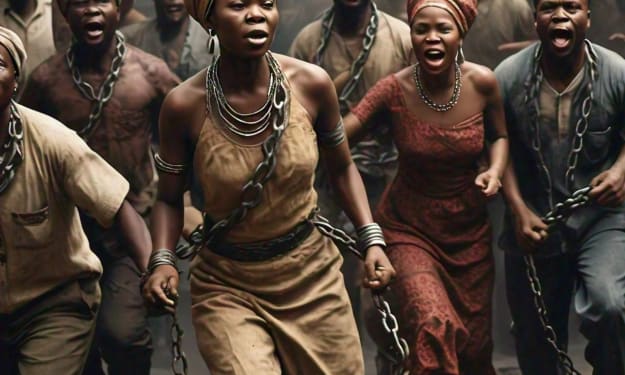
Kofi did not know how long he had been walking. The sun had risen and set many times since that night, but time had lost all meaning to him. His feet were sore, his throat parched, and his body ached from the relentless pace. He was not alone. Around him were other children, some younger, some older, all bound together by heavy chains that cut into their wrists and ankles. The chains rattled with every step, a constant reminder of their captivity.
The men who had taken them were harsh, striking them with sticks whenever they slowed down or stumbled. Kofi learned quickly to keep his eyes on the ground, to make himself as small and quiet as possible. He did not speak to the other children, did not dare to look them in the eye, for fear that he would see his own terror reflected back at him.
At night, when the men finally allowed them to rest, Kofi would curl up on the hard ground, his chains digging into his skin, and close his eyes. But sleep did not come easily. His mind was a storm of memories—his mother’s smile as she combed his hair, his father’s strong hands as he taught him to fish, the sound of laughter as he played with his friends by the river. And then the memories would shift, turning dark and twisted. He would see the flames, hear the screams, feel the rough hands pulling him away from his mother.
In these moments, Kofi would feel a deep, gnawing pain in his chest, a hollow emptiness that threatened to swallow him whole. He missed his mother, his father, his village, but most of all, he missed the feeling of safety, of belonging. He did not know where they were taking him, what would happen to him, but he knew that nothing would ever be the same.
4: The Slave Ship
The day came when the trees gave way to open land, and Kofi caught his first glimpse of the great waters. It was a vast, endless expanse, stretching out to the horizon, and on its edge was a ship, larger than anything Kofi had ever seen. The sight of it filled him with dread.
The men marched them to the shore, where the ship loomed like a giant beast, its dark hull glistening in the sunlight. Kofi’s heart pounded as they were forced onto the ship, one by one. The air was thick with the smell of salt and sweat, and the sound of chains clinking against the wooden deck echoed around him.
Below deck, the air was heavy and suffocating. The children were packed together so tightly that there was barely room to move. The chains were removed from their ankles but replaced by iron shackles that bound them to the wooden beams of the ship. The darkness was complete, and the only sounds were the soft whimpers and cries of the children, and the distant creaking of the ship as it rocked on the waves.
Days turned into weeks, and the journey across the great waters seemed endless. Kofi’s world had shrunk to the small, dark space he occupied on the ship, his mind dulled by hunger, fear, and the relentless motion of the sea. The children around him grew weaker with each passing day, their faces gaunt and eyes hollow. Some did not survive the journey, their bodies carried away by the men and thrown overboard like discarded refuse.
Kofi clung to the memories of his village, of his family, like a lifeline. He would close his eyes and picture his mother’s face, hear her voice telling him stories by the fire, feel her arms around him as she held him close. But as the days stretched into weeks, even those memories began to fade, slipping away like grains of sand through his fingers.
Chapter 5: The New World
When the ship finally reached land, Kofi was too weak to stand. The men dragged him and the other surviving children from the ship and onto the shore. The bright sunlight was blinding after so many days in darkness, and the noise of the bustling port assaulted Kofi’s senses. The air was thick with the smell of sweat and sickness, and the shouts of men speaking in strange tongues rang in his ears.
They were herded into a large pen, like animals, and left there under the scorching sun. Kofi sat on the ground, his body trembling with exhaustion and fear. Around him, the other children huddled together, their eyes wide with terror. They did not speak, did not cry out, for they knew there was no one to hear them.
Days passed in a blur of hunger and fear. The men came to inspect them, prodding and poking at their frail bodies, discussing their fates in words Kofi could not understand. Finally, the day came when they were separated, each child taken away to different places, sold to the highest bidder.
Kofi was taken to a large plantation, where he was put to work in the fields. The days were long and brutal, the sun beating down on him as he toiled in the dirt. The overseers were cruel, whipping anyone who dared to slow down or complain. Kofi learned quickly to keep his head down, to work as hard as he could, and to never, ever show any sign of weakness.
At night, he would lie on the hard ground of the slave quarters, his body aching from the day’s labor, and think of his village. The memories were like a distant dream, fading more with each passing day. He tried to hold on to them, to remember his mother’s face, his father’s voice, but it was becoming harder and harder.
Chapter 6: The Lost Child
Years passed, and Kofi grew from a boy into a young man. The child he had once been was long gone, replaced by a hollow shell, hardened by the horrors he had endured. The plantation had become his prison, the chains that once bound his wrists and ankles now replaced by the invisible chains of fear and despair.
Kofi no longer remembered his mother’s face, no longer heard his father’s voice in his dreams. The village by the river had become a distant memory, a place that existed only in the mind.
About the Creator
Keep reading
More stories from Ozoume Cynthia Obianuju and writers in History and other communities.
Shadows of the Past
Chapter 1: The Cracked Soil Amina stood barefoot on the edge of the family’s land, staring out at the fields that stretched as far as the eye could see. The soil was cracked and dry, the result of a drought that had hit the region hard. But there was something more than just nature’s wrath in the land—something deeper, more insidious.
By Ozoume Cynthia Obianuju about a year ago in History
The Deeds of Mullah Nasiruddin
The Deeds of Mullah Nasiruddin (Article No. 1270) Mullah Nasiruddin is a name that almost everyone has heard. His stories are famous across cultures for their humor, wisdom, and clever twists. Although he appeared simple and playful, Mullah Nasiruddin possessed sharp intelligence and deep insight. His actions often carried hidden lessons that made people laugh first and think later. The following incidents from his life highlight his wit, presence of mind, and moral intelligence.
By Sudais Zakwan2 days ago in History
The Quiet Collapse of Global Arms Control
The Quiet Collapse of Global Arms Control For decades, arms control agreements helped prevent the world’s most powerful weapons from spiraling out of control. Treaties limited nuclear stockpiles, increased transparency, and built fragile trust between rival states. Today, that system is quietly unraveling—and its collapse may define the next era of global insecurity.
By Wings of Time 5 days ago in History
Autonomy Is The Real Privilege
Good morning, freedom-seekers! Today we’re gonna be looking at autonomy. A strange word, I know; one many would probably look at blankly and run away from on sight. We’re gonna figure out what it actually means, consider how it’s achieved, and decipher just how deeply most of us are tangled up in dependence without realising it.
By That ‘Freedom’ Guy4 days ago in Humans



Comments (2)
Nice.
This is a great read. I can't wait for the climax