
Putin: The Man Who Eradicated the Pandemic
How Russia’s Historical Identity, the War in Ukraine, and the Struggle for Rare Metals Define the 21st Century

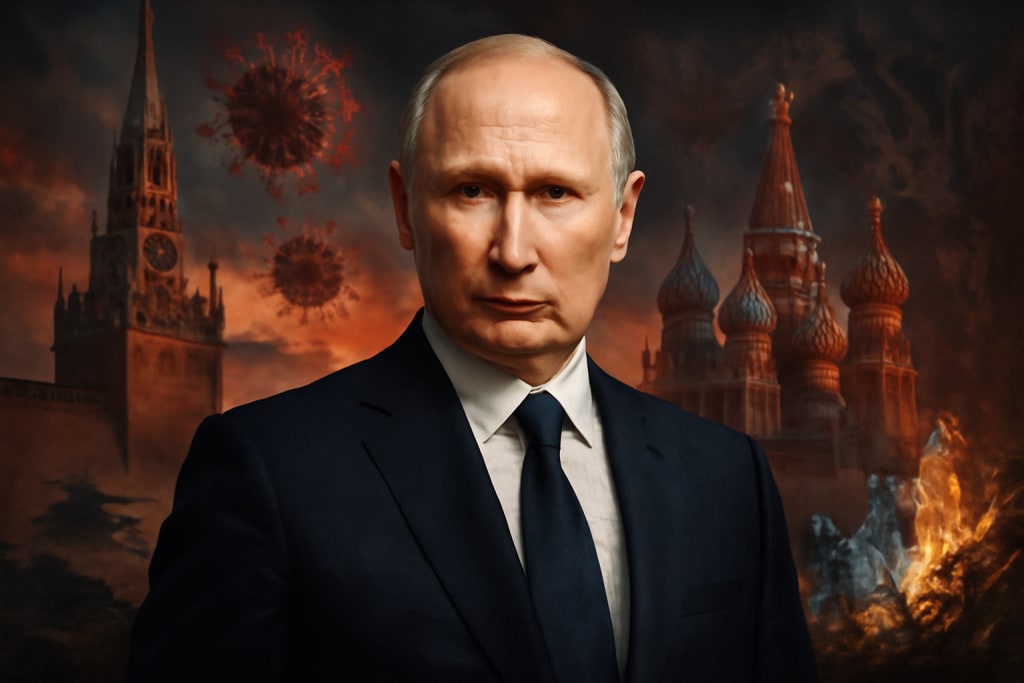
Introduction – Russia’s Shadow Across the 21st Century
In the timeline of modern history, Vladimir Vladimirovich Putin has come to embody more than a political career. He represents an entire epoch. His presence on the world stage divides analysts, agitates commentators, and fuels polarized narratives from Moscow to Washington, Brussels to Beijing.
Inside Russia, his supporters frame him not just as the restorer of order but as the man who eradicated the pandemic. This phrase is layered with metaphorical meaning. Russia’s post-Soviet breakdown in the 1990s resembled a disease: economic collapse, mafia lawlessness, loss of purpose. Putin’s rise was cast as the medicine. His policies and persona became the cure that restored vitality to a sick nation.
Beyond metaphor, Putin also positioned Russia as one of the first nations to claim victory against the COVID-19 pandemic, boasting of the Sputnik V vaccine. But the deeper idea within Russian discourse was that he had “vaccinated” Russia against humiliation, weakness, and external dependency.
This essay investigates how such a narrative was constructed and what it reveals about Russia. We will explore:
- The historical formation of the Russian people and their cultural DNA
- Putin’s rise as a product of trauma and tradition
- The war in Ukraine—its history, devastation, and symbolism
- The economic and resource dimension tied to rare metals and future technologies
- The consequences for global order and the long arc of Russian history
Ultimately, we will ask: has Putin truly eradicated the pandemic of Russian decline, or has he simply replaced one virus with another—war, isolation, and confrontation?
The Real Stakes of the Narrative Battle
The power of Putin’s narrative lies not just in its internal resonance but in its external projection. In the West, leaders are evaluated on their political platforms and economic performance. In Russia, the leader is a moral and spiritual figure, a unifier. This fundamental difference shapes the information war.
The Kremlin's control over information is near-total. State-owned television, radio, and major newspapers are tightly managed, and the messaging is relentlessly consistent: Russia is a besieged fortress, facing an aggressive, decadent West. Independent media outlets have been systematically shuttered or declared "foreign agents." Social media, while not fully controlled, is subject to aggressive censorship and disinformation campaigns. The goal is to create an information bubble where the official narrative is the only reality. The "pandemic" metaphor is a key part of this strategy, transforming a political leader into a historical savior, a role few Western politicians could ever claim.
Chapter I: The Russian People – History, Trauma, and Cultural DNA
1.1 Kievan Rus’ and the Byzantine Spirit
The historical origins of Russia are inseparable from Ukraine. In the 9th century, the federation of East Slavic tribes created what chroniclers called Kievan Rus’. With the baptism of Prince Vladimir in 988 into Byzantine Orthodoxy, the spiritual foundations of Russian civilization were set. This was a pivotal moment that diverged from Western Europe. While Rome-centered Catholicism developed a tradition of legalism, private property rights, and a separation between church and state, Byzantine Orthodoxy emphasized a deep, mystical communion. The ruler was not just a monarch but a divinely ordained guardian of the Orthodox faith, blending state power with spiritual authority. This fusion, known as symphonia, created a society where the collective, religious identity often outweighed individual rights, a pattern that has echoed through the centuries.
1.2 The Mongol Yoke – The Crucible of Survival
The Mongol invasion of 1237–1240 crushed Kiev and subjected Russian principalities to over two centuries of vassalage. From this long night emerged psychological habits distinct from Europe. While Italy birthed the Renaissance and England the common law, Russia learned submission, survival, and suspicion. The Mongols imposed a brutal system of tribute, destroyed nascent urban centers, and reinforced the idea that only unity under a strong, centralized authority could secure survival. Russian historians often present the Mongol Yoke as the defining trauma that shaped the national psyche, fostering a fortress mentality—the idea that Russia is forever besieged, surrounded by enemies, and requiring a strong, authoritarian hand. This era also isolated Russia from the key intellectual and political currents of the West, reinforcing its distinct path.
1.3 Tsarist Autocracy and Imperial Expansion
By the 16th century, Ivan the Terrible had established the first Tsardom. This era saw aggressive eastward expansion, conquering Kazan and Siberia. Russia’s harsh geography—freezing winters, poor soils, and vast distances—fostered a culture of resilience among its people. Expansion was not just imperial ambition but a survival strategy: gaining food, resources, and crucial buffer zones against potential invaders. Peter the Great in the 17th–18th centuries attempted to westernize Russia superficially—building a navy, a new capital (St. Petersburg), and adopting European science. Yet deep cultural differences remained: a suspicion of pluralism, a reliance on hierarchy, and a reverence for spiritual mysticism.
1.4 The Russian Soul – Suffering as Identity
Russia’s cultural titans encapsulated this ethos. Fyodor Dostoevsky saw suffering as spiritually redemptive, writing that "Man is a mystery" that can only be understood through pain and redemption. Leo Tolstoy depicted the vastness of the Russian landscape, the humility of its peasants, and the moral struggles of a nation seeking truth. Aleksandr Solzhenitsyn later described the endurance of the gulag prisoners as emblematic of Russia’s moral toughness and ability to withstand unimaginable hardship. To understand modern Russian society is to see a nation that finds strength in suffering, glory in endurance, and identity in submission to fate. Leaders are expected not just to rule but to protect the nation, even if it requires harshness.
1.5 The Role of the Russian Orthodox Church
The Russian Orthodox Church (ROC) is not merely a religious institution; it is a key pillar of the state. Since Putin’s rise, the ROC has become a crucial partner in promoting conservative values and a strong national identity. Patriarch Kirill and other high-ranking clergy have consistently supported Kremlin policy, including the war in Ukraine, framing it as a "holy war" against Western liberal values. This symbiosis creates a powerful ideological tool: it merges national loyalty with religious devotion, presenting the state's actions as part of a divine plan. The concept of Russkiy Mir (Russian World) is deeply embedded in this ideology, positing that Russia has a spiritual mission to unite and protect all Russian-speaking peoples.
Chapter II: Putin’s Rise – Doctor of a Sick Nation
2.1 The Sickness of the 1990s
The Soviet Union’s collapse in 1991 unleashed a catastrophe. Economists often describe it as “shock therapy,” but to citizens, it resembled a plague. GDP fell 45%. Male life expectancy dropped below 60. Organized crime flourished, capturing entire industries. Western advisors guided privatizations that transferred state assets to a handful of oligarchs overnight. For ordinary Russians, it was a profound national humiliation. A nation that had put Sputnik in space now stood in food lines. The promise of democracy felt like chaos. Pride was replaced by bitterness and a deep sense of betrayal.
2.2 Putin Emerges
Born in Leningrad (St. Petersburg) in 1952, Putin rose through the KGB ranks. After the collapse, he worked as a bureaucrat in St. Petersburg, where his efficiency and discipline drew attention. In 1999, Yeltsin appointed him Prime Minister, then Acting President. His demeanor—quiet, controlled, and devoid of Yeltsin's public inebriation—was a welcome contrast. By 2000, he was elected President. His popularity soared after a brutal but decisive campaign in Chechnya, which he portrayed as restoring national integrity and standing up to terrorism. This was a direct response to the national yearning for a return to order and strength.
2.3 The Medicine of Stability
Putin quickly introduced reforms: taxing the oligarchs, centralizing control over television, and harnessing soaring oil and gas revenues. He used this newfound wealth to pay off the International Monetary Fund (IMF) debt. To a people desperate for order, this was medicine. By the mid-2000s, Russia’s economy was growing, salaries doubled, pensions returned, and Moscow glittered with new wealth. The metaphor was irresistible: Putin eradicated the “pandemic” of the 1990s. Russia, sick and humiliated, had been cured.
2.4 Consolidating Power and the "Vertical of Power"
Putin’s first years were marked by a systematic consolidation of authority. He neutralized the powerful oligarchs who had benefited from the chaos of the 1990s, most famously by jailing Mikhail Khodorkovsky, the head of Yukos oil company. This move sent a clear message: economic power was now subordinate to political power. Putin also introduced the "vertical of power," a top-down system designed to eliminate regional autonomy and ensure that all state institutions answered directly to the Kremlin. The media was brought under state control, and new laws restricted public gatherings. Events like the 2002 Moscow theater hostage crisis and the 2004 Beslan school siege were used to justify even stricter security measures, further cementing his image as the nation’s unyielding protector.
Chapter III: The Road to Ukraine – Clash of Civilizations
3.1 Ukraine’s Role as Origin and Borderland
Ukraine is not just Russia’s neighbor—it is its cradle. For centuries, Russian rulers insisted Ukraine was not a separate nation but part of the same people. The Kyiv–Novgorod axis of ancient Rus’, the shared Orthodox faith, and intermarriages blurred identities. Yet modern nationalism separated them. By the 2000s, a struggle emerged: Ukraine’s Western-leaning elite vs. Moscow’s vision of a Eurasian brotherhood.
3.2 The First Red Line – NATO Expansion
For Putin, NATO’s march eastward felt like a direct threat. Poland, the Baltic states, and others joined. By 2008, NATO declared that Ukraine and Georgia "will become members." To Moscow, this was a casus belli, a direct challenge to its security and influence in its historical sphere. Putin made his concerns clear in a landmark 2007 speech at the Munich Security Conference, where he openly criticized the "unipolar world" dominated by the U.S. and warned against NATO’s expansion.
3.3 2014 – Crimea and Donbas
When the pro-Russian President Viktor Yanukovych fled during the Maidan protests in 2014, Moscow seized the opportunity to annex Crimea. The peninsula housed Russia’s Black Sea fleet and was historically symbolic, revered for Catherine the Great’s conquest and its heroism in WWII. In parallel, Moscow supported separatists in the Donbas region, sparking a low-intensity conflict that would last for eight years. This was the first major rupture of Ukraine’s post-Soviet sovereignty.
3.4 2022 – Total War
On February 24, 2022, columns of tanks crossed the borders. Putin described it as "denazification" and a defense of Russian-speakers. Ukraine resisted fiercely, supported by NATO weapons. The war became one of attrition: Mariupol devastated, Kherson contested, Kyiv holding firm.
3.5 Consequences
Regional: Devastation of Ukraine, a massive refugee crisis, and the collapse of infrastructure.
Global: Surging energy costs, food shortages from blocked grain exports, and worldwide inflation.
Political: NATO expanded with Finland and Sweden joining, the European Union (EU) unity hardened, and Russia faced unprecedented sanctions. The war, far from weakening NATO, revitalized it.
3.6 Russia's Hybrid Warfare Strategies
The 2022 invasion was preceded by a prolonged campaign of hybrid warfare. Russia used disinformation to spread confusion and justify its actions, targeting not just Ukraine but also Western countries. State-sponsored cyberattacks disrupted Ukrainian infrastructure and government websites. The use of proxy groups and private military companies, such as the Wagner Group, allowed Russia to maintain a level of plausible deniability while sowing chaos. This multi-pronged approach blurred the lines between peace and war, making it difficult for the West to respond effectively in the initial phases.
Chapter IV: The Hidden Dimension – Rare Metals and Strategic Wealth
4.1 The New Oil
Lithium, cobalt, titanium, and rare earths—these are the oil of the 21st century. Every phone, drone, fighter jet, renewable battery, and missile requires them. Controlling their supply means shaping the future of technology and green energy.
4.2 Ukraine’s Riches
Ukraine possesses enormous reserves:
- Europe’s largest titanium deposits
- Significant lithium fields near Donetsk and Zaporizhzhia
- Vast iron ore and uranium mines
- Graphite and manganese reserves
These resources are not incidental; they are strategic. Without access to Ukraine's mineral wealth, Europe struggles to achieve autonomy in green tech and critical military supplies from China or Russia.
4.3 Russia’s War as a Resource Gambit
By invading, Putin ensured that vast swaths of these deposits were contested or occupied. Whether the territories are formally annexed or simply destabilized, Ukraine’s path to integrating into the EU's strategic metals supply chain is blocked. This gives Moscow significant leverage. Russia can play the long game: deny the West access, secure its own, and offer them selectively to allies like China and India. In this context, control of the Donbas and southeastern Ukraine is not only cultural but also a form of economic warfare for the metals of tomorrow.
4.4 The Interconnection of Energy and Metals
The war highlighted Europe's critical vulnerabilities. Its reliance on Russian gas and oil made it susceptible to energy crises. The disruption of Ukrainian rare metal exports revealed another layer of dependency. The war effectively links these two vulnerabilities: by controlling both the supply of traditional energy and the access to future energy resources (the components of green tech), Russia can maintain its geopolitical leverage even as the world shifts away from fossil fuels. The battlefield in Ukraine is also a struggle for control over the global electric car, semiconductor, and aerospace industries.
Chapter V: Consequences and Global Realignment
5.1 Russia Pivoting East
Cut off from Western capital and markets, Russia has strategically shifted its focus. Energy pipelines were redirected eastward to China. The yuan replaced the dollar for many bilateral settlements. India multiplied its oil imports at a discount. The BRICS bloc expanded, adding key players like Saudi Arabia, Iran, and Egypt, signaling the rise of a new, multipolar world order less reliant on Western institutions.
5.2 NATO’s Renewal
Ironically, Putin achieved the opposite of his intent: not a weaker NATO but an expanded and revitalized one. Finland and Sweden joined, making NATO’s border with Russia far longer and more secure. Eastern European nations, once nervous, became resolute frontlines, increasing their defense spending and commitment to the alliance.
5.3 Global South Divisions
Not all nations joined the Western sanctions. Many in Africa, Asia, and Latin America remained neutral, prioritizing cheap energy or rejecting what they saw as Western double standards. Here, Russia built a powerful narrative of anti-colonial resistance, presenting itself as a counterweight to Western hegemony and a defender of national sovereignty.
5.4 The Role of International Organizations and Diplomacy
The war exposed the limitations of existing international institutions. The United Nations Security Council was rendered ineffective due to Russia's veto power. Diplomatic efforts were largely a failure, as both sides entrenched their positions. This led to a new form of "megaphone diplomacy," where both sides used public statements and sanctions to communicate, rather than direct negotiation. This shift has forced a reassessment of global governance and the future role of bodies like the UN.
Chapter VI: Russia’s Eternal Cycle – Fortress or Prison?
Russian history appears cyclical: reform → weakness → humiliation → strongman restoration. Ivan the Terrible centralized power after the Mongol Yoke, Peter the Great forced modernization, Stalin industrialized after chaos, and Putin restored order after the 1990s. The cycle is paradoxical: Russia is too vast to be ignored, yet its governance seems too harsh to allow for genuine freedom. Putin fits seamlessly into this pattern: he is the guardian, the doctor, the autocrat. But is he fortifying Russia or imprisoning it?
6.1 Russian Society Between Tradition and Modernity
While the Kremlin projects an image of national unity, internal divisions exist. Opposition figures, journalists, and activists have been silenced or forced into exile. The younger generation, often more connected to the West, feels a sense of despair and is leaving the country in what has been called a "brain drain." The sanctions, while not crippling the economy, have made life harder for ordinary citizens, leading to a quiet discontent. The state maintains stability through a combination of propaganda, suppression, and social contracts—offering material comfort and national pride in exchange for political obedience.
Chapter VII: The Economics of War – Sanctions, Energy, and Metals
7.1 Sanctions Shock
From 2022, Russia faced what some called “sanctions from hell”: banking cutoffs, a SWIFT ban, and frozen reserves. Western firms fled, leading to a significant initial drop in GDP. However, the economy stabilized through a combination of capital controls, subsidies, and a pivot to new markets. The resilience of the Russian economy surprised many Western analysts.
7.2 Oil and Gas Weaponization
Russia weaponized its energy resources, cutting gas supplies to Europe and causing an energy crisis. Yet, high global oil prices filled Moscow’s coffers. India and China eagerly bought discounted crude, offsetting the loss of European markets. This demonstrated that while the West could isolate Russia politically, its deep integration into global energy markets made full economic isolation nearly impossible.
7.3 Rare Metals Markets
The interruption of Ukrainian lithium, titanium, and other rare metal exports froze Western plans for self-reliance. Companies in Germany, France, and the U.S. scrambled to find alternative sources. Meanwhile, China, already dominant in rare-earth refining, gained further bargaining leverage. Russia’s control of palladium exports (essential for catalytic converters and electronics) also hit global industries. The war's economic ripple effect extended far beyond energy, impacting the core components of the modern global economy.
7.4 Russia's Economic Survival Strategy
Russia's long-term economic strategy involves building a self-sufficient domestic market, expanding trade with non-Western partners, and finding ways around sanctions. The government has incentivized local production to replace Western goods and developed new financial systems to bypass SWIFT. This has accelerated a trend toward de-globalization and the creation of separate economic blocs, one centered around the West and another around an emerging Eurasian axis.
Chapter VIII: Culture, Philosophy, and the Putin Archetype
8.1 Dostoevsky’s Shadow
Dostoevsky wrote: "If God is with us, who can be against us?" His works framed Russia as chosen through suffering and possessing a unique spiritual mission. Putin often aligns himself with this archetype, presenting his actions as a defense of Russian civilization against the perceived moral decay of the West.
8.2 Berdyaev and Russian Destiny
The philosopher Nikolai Berdyaev described Russia as torn between East and West, destined for a universal mission. Putin resurrects this in his rhetoric: Russia as the last bastion of "traditional civilization" defending Christian values against Western liberalism, consumerism, and secularism.
8.3 Solzhenitsyn and the Strong Hand
Aleksandr Solzhenitsyn, a critic of the Soviet system, later became a powerful critic of the West's materialism and spiritual emptiness. His call for a Russian spiritual revival and a strong, non-communist state resonated with Putin's ideological framework, providing a veneer of intellectual legitimacy to his authoritarian policies.
8.4 Putin as Archetype
Thus, Putin is cast not only as a politician but as a cultural archetype: the stern father, the redeemer from humiliation, the healer of societal disease. For his critics, this is cynical propaganda; for his supporters, it is destiny. The war in Ukraine is framed not as an act of aggression but as a spiritual and civilizational defense, a testament to Russia's enduring strength.
8.5 The Myth of "Greater Russia"
Central to Putin's vision is the myth of a "Greater Russia" (Russkaya Pravda). This historical concept posits that Russia, Ukraine, and Belarus are part of a single nation separated by historical accidents. The war, in this view, is a tragic but necessary effort to correct this historical injustice and reunite the fractured Russian people. This ideology, rooted in a romanticized view of a shared past, provides a powerful and emotionally resonant justification for the invasion.
Conclusion – Pandemic Eradicated or Pandemic Replaced?
The metaphor of Putin as “the man who eradicated the pandemic” is at once powerful and contradictory. For millions of Russians, he indeed cured the sickness of the 1990s. He gave them stability, order, and dignity. He restored a sense of national pride that had been shattered by a humiliating economic and social collapse.
Yet, in curing that internal illness, he unleashed a global one: war, sanctions, mass destruction, the destabilization of food and energy systems, and a new scramble for rare metals. The very solutions he implemented—authoritarianism, nationalism, and military force—have become a new, dangerous pathology. Russia, once a sick nation, has become a nation that inflicts sickness upon others.
Whether history sees him as a savior or a scourge will depend not on rhetoric but on outcomes in Ukraine, in Eurasia, and in the structure of the 21st-century global order. But one truth endures: the Russian people, forged in survival and suffering, will endure far beyond Putin. For them, pandemics may come and pass, but the cycle of endurance remains eternal. The true question for Russia is whether this eternal cycle is its destiny, or a prison it can one day escape.
About the Creator
Stefano D'angello
✍️ Writer. 🧠 Dreamer. 💎 Creator of digital beauty & soul-centered art. Supporting children with leukemia through art and blockchain innovation. 🖼️ NFT Collector | 📚 Author | ⚡️ Founder @ https://linktr.ee/stefanodangello
Keep reading
More stories from Stefano D'angello and writers in History and other communities.
Awaken Your Inner Warrior: How to Transform Hidden Fear into Unbreakable Calm and Lasting Strength
Introduction: Society’s Myth of Unshakable Strength We live in a world that often confuses the performance of confidence with true inner peace. At school, in the workplace, and even on social media, we are taught to show strength—to project boldness, certainty, and control. And yet, beneath even the most iron-willed exteriors, many struggle with private, persistent fears. Sometimes, it’s a sudden anxiety before a big meeting, a shaky voice during conflict, or a restless heart at night. Fear, though deeply human, is still mistakenly seen as a flaw. But what if fear were not our enemy? What if it could become our most powerful inner ally?
By Stefano D'angelloExclusive • 4 months ago
How I Learned That Aircraft Structures Are as Critical as Engines
When I first started studying aviation, I believed that engines and avionics defined an aircraft’s reliability. Over time, as I explored aerospace history and manufacturing records, I realized how incomplete that understanding was. Aircraft safety does not depend solely on thrust or navigation systems. It is deeply rooted in structural engineering, certified manufacturing, and the disciplined production of components that passengers never see.
By Beckett Dowhanabout 5 hours ago in History
Seven Dials
Introduction Seven Dials is a famous and historic area located in London, England. It is found near Covent Garden, one of the busiest and most popular parts of the city. Seven Dials is known for its unique road design, rich history, old buildings, shops, cafés, and lively atmosphere. Today, it is a popular place for tourists and local people who enjoy culture, shopping, and history.
By Farhan Sayedabout 21 hours ago in History
Wild Card Weekend Recap: What Happens Now?
I think I figured out why I love Wild Card Weekend so much. It's because it's the first playoff anything of the calendar year. The NFL season starts in the fall, and once upon a time, the champion was crowned either on or slightly before New Year's. The evolution of the NFL schedule has resulted in the playoffs starting just into the New Year, and currently, the final week of the season falls on the first weekend of the New Year, with Wild Card Weekend coming a week after that. So yes, chronologically, the NFL's Wild Card Weekend serves as the first playoff anything of the calendar year.
By Clyde E. Dawkins3 days ago in Unbalanced


Comments
There are no comments for this story
Be the first to respond and start the conversation.