
Pioneers of Progress: The Trailblazing Women of the Suffrage Movement
Pioneering Women Who Fought for Suffrage: Their Stories and Struggles
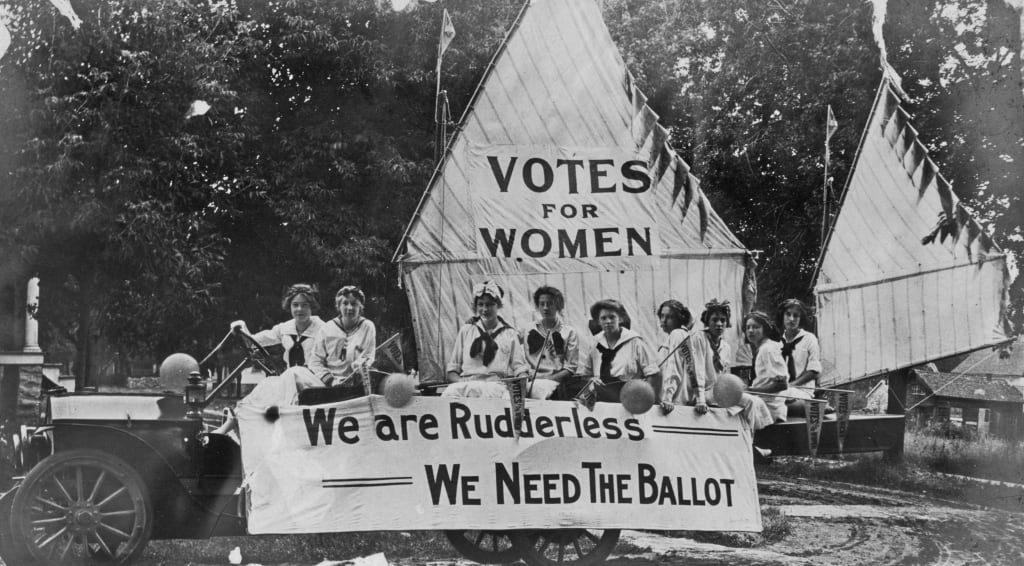
In the dimly lit parlor of Susan B. Anthony's modest home in Rochester, New York, a group of resolute women gathered on a chilly winter evening in 1851. The air was charged with determination, and the flickering candlelight cast dancing shadows upon their faces. They were pioneers, visionaries, and trailblazers, bound by a common purpose: to secure the right to vote for women in the United States.
Susan B. Anthony, a tireless advocate for women's suffrage, stood at the forefront of the movement. With her iconic silver-gray hair and unwavering determination, she was a force to be reckoned with. Beside her sat Elizabeth Cady Stanton, a brilliant writer and orator, who possessed an unshakable belief in the equality of the sexes. Together, they ignited a spark that would lead to a profound transformation in American society.
As they sipped tea and discussed their strategy, Susan and Elizabeth were joined by other remarkable women who shared their fervor for change. Lucy Stone, Sojourner Truth, and Lucretia Mott lent their voices and wisdom to the cause. These women, along with countless others, would become the unsung heroes of the suffrage movement.
Their journey began with small gatherings and lectures, where they educated women on their rights and the need for suffrage. The suffragists believed that voting was not just a privilege but a fundamental right, essential for a functioning democracy. They knew that their battle would be long and arduous, but they were undeterred.
The Seneca Falls Convention of 1848 marked a pivotal moment in the suffrage movement's history. Held in upstate New York, this convention, organized by Elizabeth Cady Stanton and Lucretia Mott, was the first of its kind. It boldly proclaimed that "all men and women are created equal" and demanded equal rights for women in all aspects of life. The attendees signed the Declaration of Sentiments, which called for women's suffrage, among other reforms.
The suffragists faced immense opposition from those who clung to traditional gender roles and societal norms. They were ridiculed in the press, marginalized by politicians, and often ostracized by their own families. But they pressed on, their resolve unbroken.
Susan B. Anthony emerged as a prominent leader in the movement, known for her tireless efforts and strategic acumen. In 1872, she made headlines by daring to vote in the presidential election. She was arrested and brought to trial in a case that captured the nation's attention. Her famous speech during the trial resonated with women across the country, as she declared, "It was we, the people, not we, the white male citizens, nor yet we, the male citizens; but we, the whole people, who formed the Union."
The suffragists also faced internal divisions. Some believed in a state-by-state approach, while others advocated for a federal amendment to secure women's right to vote. These disagreements occasionally led to strained relationships within the movement. However, their shared goal ultimately united them.
Over the decades, the suffrage movement gained momentum. Women from all walks of life joined the cause, from factory workers to socialites. They organized rallies, parades, and marches, drawing attention to their demands. In 1913, the suffragists staged a massive suffrage parade in Washington, D.C., the day before President Woodrow Wilson's inauguration. Despite facing jeers and physical attacks from onlookers, the women marched with dignity and grace, leaving an indelible mark on the nation's capital.
World War I provided a unique opportunity for the suffragists. With men overseas, women stepped into essential roles in the workforce and maintained the home front. Their contributions underscored the absurdity of denying them the right to vote. President Wilson, initially averse to the suffrage cause, began to support it in light of these developments.
In 1919, Congress passed the Nineteenth Amendment, which granted women the right to vote. It was a hard-fought victory that had taken nearly a century to achieve. On August 18, 1920, Tennessee became the thirty-sixth state to ratify the amendment, sealing its place in history.
On November 2, 1920, millions of women across the country cast their ballots for the first time in a presidential election. Susan B. Anthony's dream had become a reality. The suffragists had succeeded in reshaping the nation's destiny.
The trailblazing women of the suffrage movement had achieved something extraordinary. Through unwavering dedication, resilience in the face of adversity, and a deep belief in the fundamental principles of democracy, they had won a battle that would forever alter the course of history.
As the years passed, these pioneers continued to inspire future generations of women to stand up for their rights and strive for equality. The suffrage movement was not just about securing the vote; it was about challenging societal norms and changing the way society perceived women's roles.
In the end, the suffragists' legacy extended far beyond the ballot box. Their determination laid the foundation for subsequent movements, including the civil rights movement and the fight for gender equality that continues today.
In the annals of history, the trailblazing women of the suffrage movement remain icons of courage and resilience. Their story reminds us that change is possible, even in the face of seemingly insurmountable obstacles. It serves as a testament to the power of ordinary individuals to effect extraordinary change when they join together with a common purpose. The suffragists' journey is a beacon of hope, inspiring us to continue the pursuit of justice, equality, and progress for all.
About the Creator
A Story of the World
The history of the world is the longest story ever told—a vast journey that began long before written words, long before cities, and even before humans themselves. It is a story shaped by nature, driven by curiosity, and transformed by ideas, power, faith, and struggle. The Dawn of Life and Early Humanity Billions of years ago, the Earth was a violent and restless place. Volcanoes erupted, oceans formed, and the first simple life appeared in the seas. Over immense stretches of time, life evolved from single-celled organisms into complex plants and animals. Eventually, a branch of primates learned to walk upright, use tools, and think beyond survival. These were the early humans. For tens of thousands of years, humans lived as hunters and gatherers. They followed animals, gathered plants, and learned to cooperate in small groups. Fire changed everything—it provided warmth, protection, and a way to cook food. Language allowed ideas to pass from one generation to the next. Slowly, humans spread across continents, adapting to deserts, forests, mountains, and ice. The Agricultural Revolution and the First Civilizations Around 10,000 years ago, a turning point arrived: agriculture. Humans learned to grow crops and domesticate animals. This allowed them to settle in one place, build villages, and increase their population. Farming began independently in regions such as Mesopotamia, the Indus Valley, China, Egypt, and Mesoamerica. With settled life came civilization. Cities rose near rivers that provided water and fertile soil. Governments formed to organize labor and protect land. Writing was invented to record trade, laws, and stories. The first legal codes appeared, such as the Code of Hammurabi, which tried to define justice. Religion became organized, explaining the mysteries of life and death and giving meaning to human existence. Empires, Power, and Belief As civilizations grew, so did conflict. Powerful kingdoms expanded into empires through conquest and control. The Egyptian, Persian, Greek, Roman, Mauryan, and Han empires shaped large parts of the ancient world. Roads, armies, taxes, and laws connected millions of people under a single rule. Ideas traveled along with armies and traders. Greek thinkers explored philosophy, science, and democracy. In India and China, deep philosophies like Hinduism, Buddhism, Confucianism, and Taoism offered guidance on morality and harmony. In the Middle East, monotheistic faiths emerged, teaching belief in one God and emphasizing justice and compassion. The Roman Empire became a bridge between ancient and modern worlds. It spread law, engineering, and language across Europe and the Mediterranean. Yet no empire lasts forever. Over time, internal weakness, economic strain, and outside pressures caused great empires to fall. The Middle Ages and the Flow of Knowledge After the fall of Rome in the West, Europe entered a period often called the Middle Ages. Power was divided among kings, nobles, and the Church. Life was difficult for many, but this era was not without progress. Universities formed, architecture flourished, and faith shaped daily life. Meanwhile, the Islamic world experienced a golden age. Scholars preserved and expanded knowledge in mathematics, medicine, astronomy, and philosophy. Cities like Baghdad and Cordoba became centers of learning, where ideas from Greece, India, and Persia were studied and improved. Trade routes connected Asia, Africa, and Europe, allowing goods and cultures to mix. In Asia, powerful dynasties ruled China, advancing technology such as paper, printing, gunpowder, and the compass. These inventions would later transform the world. The Renaissance and the Age of Exploration Around the 14th century, a rebirth of learning began in Europe: the Renaissance. Artists, scientists, and thinkers looked back to classical knowledge while pushing forward with new ideas. Figures like Leonardo da Vinci and Galileo challenged old beliefs and celebrated human potential. At the same time, explorers set sail across unknown oceans. The Age of Exploration connected the world as never before. Europeans reached the Americas, Africa, and Asia, creating global trade networks. This brought wealth and knowledge—but also suffering. Indigenous civilizations were destroyed, millions were enslaved, and colonial empires rose through exploitation. Revolutions and the Modern World The 18th and 19th centuries were ages of revolution. Political revolutions in America and France challenged absolute monarchy and promoted ideas of liberty, equality, and rights. The Industrial Revolution transformed economies, as machines replaced manual labor and cities grew rapidly. Life improved for some, but workers often faced harsh conditions. New ideologies emerged—capitalism, socialism, nationalism—each offering different visions of society. Nations formed and competed, leading to global conflicts. The 20th century witnessed two devastating world wars that reshaped borders and shattered illusions of progress. Yet from the ruins came international cooperation, technological leaps, and movements for independence and civil rights. The World Today and Beyond In recent decades, technology has accelerated history. Computers, the internet, and artificial intelligence have changed how humans communicate, learn, and work. Globalization has connected economies and cultures, while also creating new challenges. Climate change, inequality, and conflict remind humanity that progress is fragile. The history of the world is not just a record of kings and wars—it is the story of ordinary people: farmers, thinkers, builders, dreamers. It is a story of mistakes and lessons, destruction and hope. Each generation inherits this long journey and adds its own chapter. The future remains unwritten. Like those who came before, humanity stands at a crossroads—guided by the past, tested in the present, and responsible for what comes next.
By The best writer a day ago in History



Comments
There are no comments for this story
Be the first to respond and start the conversation.