
The Cuban Missile Crisis: Cold War Standoff
The Cuban Missile Crisis: Brink of Nuclear War
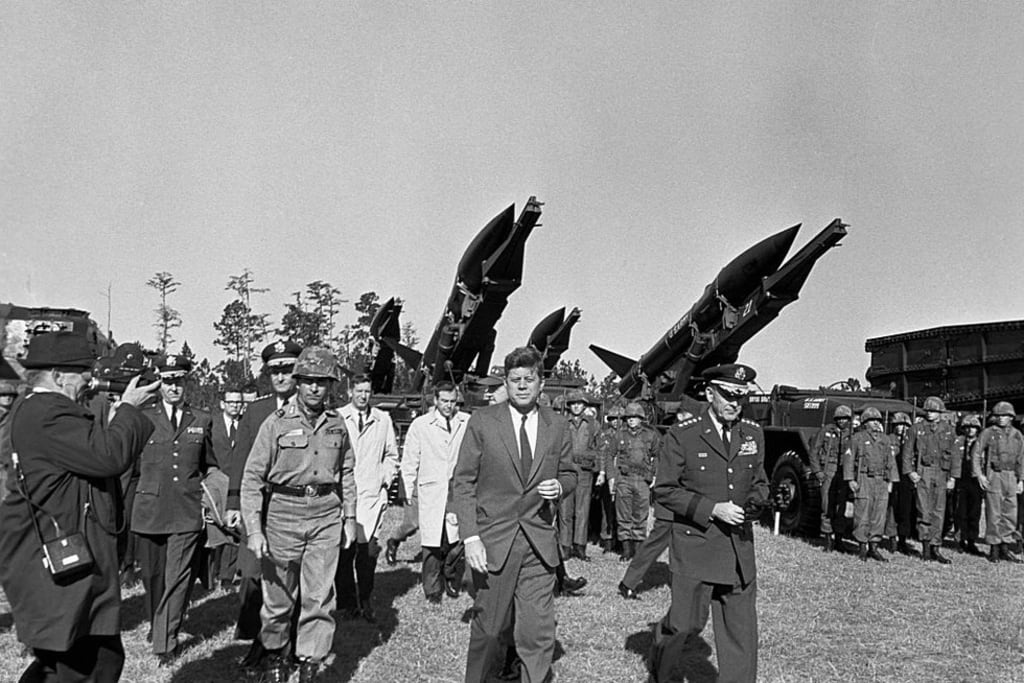
In the heart of the Cold War, a tense and perilous standoff gripped the world—the Cuban Missile Crisis. It was October 1962, and the United States and the Soviet Union stood on the brink of nuclear war. The fate of the world hung in the balance as leaders navigated through a treacherous sea of diplomacy, brinkmanship, and fear.
The roots of the Cuban Missile Crisis can be traced back to the early 1960s when the United States attempted to overthrow the communist government of Fidel Castro in Cuba. The Bay of Pigs invasion in April 1961, a failed CIA-backed operation, had further strained the already frosty relations between the U.S. and the Soviet Union. Cuba had become a focal point in the Cold War, with the U.S. and the USSR jockeying for influence in the Caribbean nation.
Then, in October 1962, U.S. intelligence discovered the presence of nuclear-armed Soviet missiles in Cuba. President John F. Kennedy convened his ExComm, a group of top advisors, to deliberate on the situation. The evidence was irrefutable, and the stakes couldn't be higher. The world had entered a new and terrifying phase of the Cold War.
As the U.S. deliberated its response, the world held its breath. President Kennedy addressed the nation on October 22, 1962, informing them of the gravity of the situation. He ordered a naval blockade of Cuba, termed a "quarantine," to prevent further Soviet shipments of missiles and demanded the removal of existing missiles. The world watched as the two superpowers engaged in a high-stakes game of diplomacy.
For thirteen long days, the world was poised on the edge of disaster. Tensions escalated as Soviet Premier Nikita Khrushchev and President Kennedy exchanged letters, each side trying to maintain a firm but measured stance. The world was engulfed in an atmosphere of fear, uncertainty, and anticipation. Nuclear war seemed imminent.
Behind the scenes, there were efforts to find a peaceful resolution. Backchannel negotiations were ongoing. A letter from Khrushchev, received by Kennedy on October 26, offered a potential solution. Khrushchev proposed removing the missiles in exchange for a public U.S. commitment not to invade Cuba and a private agreement to remove U.S. missiles from Turkey. It was a critical moment in the crisis.
Kennedy decided to accept Khrushchev's offer but with one crucial modification: he would not mention the removal of U.S. missiles in Turkey in the public announcement. The situation remained tense as the world awaited a response from Moscow.
On October 28, Khrushchev agreed to Kennedy's terms and confirmed the removal of missiles from Cuba. The world breathed a collective sigh of relief. The Cuban Missile Crisis had come to an end without a nuclear catastrophe. Both leaders had taken steps to de-escalate the situation and avoid a catastrophic war.
The public announcement of the resolution did not mention the removal of U.S. missiles in Turkey, and Khrushchev saved face by emphasizing that the U.S. had agreed not to invade Cuba. The crisis had ended, but the scars of the confrontation remained.
The Cuban Missile Crisis was a turning point in the Cold War. It marked the closest the world had come to nuclear annihilation. The crisis led to significant changes in U.S. and Soviet policies. Both nations recognized the need for more direct communication to prevent future misunderstandings that could escalate into a nuclear war.
A direct result of the crisis was the establishment of the "hotline" between Washington, D.C., and Moscow—a direct communication link intended to reduce the risk of miscommunication and nuclear war. Additionally, the U.S. and the USSR signed the Limited Test Ban Treaty in 1963, which prohibited nuclear testing in the atmosphere, outer space, and underwater.
While the crisis had ended, the ideological struggle between the superpowers continued. The Cold War persisted for decades, with various proxy conflicts and tensions between the U.S. and the USSR. However, the Cuban Missile Crisis served as a stark reminder of the devastating consequences of nuclear war and the urgent need for diplomatic solutions.
In the aftermath of the crisis, both Kennedy and Khrushchev faced political challenges. Kennedy's handling of the crisis garnered both praise and criticism. Some saw his resolve as essential in averting war, while others believed he had made unnecessary concessions. Khrushchev's leadership faced criticism from hardliners within the Soviet Union who viewed the resolution as a retreat.
The Cuban Missile Crisis left an indelible mark on the history of the 20th century. It was a perilous moment when humanity teetered on the edge of self-destruction, only to be pulled back by the efforts of leaders willing to negotiate and compromise. The world had come face to face with the horrifying reality of nuclear conflict, and the memory of those thirteen days served as a stark reminder of the need for diplomacy, restraint, and the pursuit of peace.
About the Creator
Brosley Punch — The Strike That Shook Fate
Brosley was never taught how to throw a punch. He learned it the hard way—through hunger, through survival, through a childhood spent on a world that showed no mercy. Long before the universe would whisper his name in fear, Brosley was just a boy standing on cracked red stone, staring at a sky that never answered his questions.
By The best writer 4 days ago in History
How I Learned That Aircraft Structures Are as Critical as Engines
When I first started studying aviation, I believed that engines and avionics defined an aircraft’s reliability. Over time, as I explored aerospace history and manufacturing records, I realized how incomplete that understanding was. Aircraft safety does not depend solely on thrust or navigation systems. It is deeply rooted in structural engineering, certified manufacturing, and the disciplined production of components that passengers never see.
By Beckett Dowhan5 days ago in History


Comments
There are no comments for this story
Be the first to respond and start the conversation.