
Oppenheimer: The Horror We Did Not See
An observation on the new Christopher Nolan film
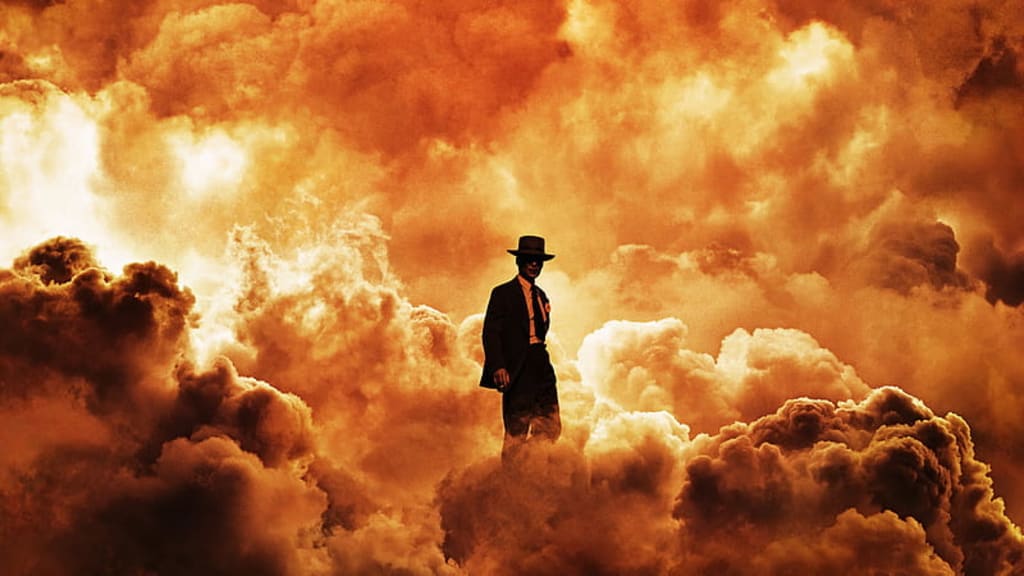
One thing that was surprisingly absent from Christopher Nolan's Oppenheimer, a film about the earth-shattering implications of the invention of the atomic bomb, both for the soul of one man and for mankind as a whole, was the depiction of the actual deployment of nuclear weapons against Japan towards the end of WWII.
We all know what occurred after that. At first glance, this makes sense given that the story is primarily told from Oppenheimer's subjective perspective, which was a perspective that didn't witness the bombs dropping on Hiroshima and Nagasaki, that looked away during a briefing in which the consequences were detailed, and that could only imagine the horror of what his invention had caused.
But I'm not sure this argument completely settles the question. Because what a subjective perspective like this displays and doesn't show is controlled more by what the director wants us to see than by what a character sees and doesn't see. As a result, Oppenheimer's lack of direct experience with the ramifications of the atomic bomb should not be viewed as a given truth that Nolan was forced to deal with, but as a purposeful creative decision chosen by him. He even proves this in the film by giving a mechanism to escape from this subjective viewpoint. Because, in addition to seeing the story from Oppenheimer's point of view, the film also has another story thread that follows Strauss' character and provides a more explicit, more objective view of the actual history.
As a result, the issue remains: why didn't he? Was Nolan holding back here by not facing us more directly with the implications of Japan's bombing, by not taking us all the way into the actual horror of nuclear warfare? Or did he find a different but as efficient approach to capture everything we needed to know and see? We envisage a future, and it horrifies us. My goal here is not to pass judgment on Oppenheimer or to provide a comprehensive review. What I want to do here is try to isolate this specific subject because I believe it is ageless and vital in terms of the dynamics of cinema and history.
And, more specifically, about cinematic depictions of large-scale destructive and traumatic historical events, which I believe might provide us with a clearer insight into Nolan's filmmaking choices in telling the story of Oppenheimer, as well as a broader context for us as the audience to inform our own opinions about these decisions.
To best explain and examine all of this, I want to look at a movie that came to mind as I was watching Oppenheimer for the first time, a movie that is somewhat similar in the sense that it recounts a controversial and complicated historical subject, but one that also included the very thing that Nolan did not, that directly confronted us with the horror that Nolan only allows us to imagine, which I think will be a great way to explore how including more direct real life imagery can be incredibly powerful, and also; why Nolan may not have needed to.
But, to be clear, this isn't a debate about whether or not the movie should have included the perspective of the Japanese people, as some have argued. I think it's obvious that this is a movie that doesn't go for cheap moralization, but instead wants to explore, and is thus centered on, the perspective and psychology of the aggressor, of the man struggling with the devastating consequences of his own achievement.
I believe that if you truly want to learn about the other side of the story, the perspectives of those who were directly or indirectly affected by the atomic bomb, there is already a wealth of fantastic Japanese films that do this far better than any Western filmmaker could ever do. To mention a few, there's the original Godzilla, directed by Ishiro Honda. Isao Takahata's terrifying film Grave of the Fireflies comes to mind. Kaneto Shindo wrote Children of Hiroshima. There's also the great master Akira Kurosawa, who covered the subject twice. Once, in 1955, he directed I Live in Fear, a film about an aging industrialist whose fear of nuclear weapons unravels his entire life. And then in 1991, he filmed Rhapsody in August, which investigates the long-term effects of the Nagasaki bombing on three generations of a family who reside there. So, when I say I want to investigate how Nolan's decision not to directly confront us with the impact of the atomic bomb affects the overall experience of Oppenheimer, I mean strictly in terms of how this relates to what the film actually wants to achieve, rather than what it clearly never intended to do in the first place. Oppenheimer, in my opinion, is more of a Promethean nightmare about the human soul being punished for stealing fire from the Gods than a historical drama. The three-hour courtroom drama Judgment at Nuremberg chronicles the 1948 Nuremberg trials, in which four Nazis were sentenced for crimes against humanity. It's a fantastic film with a fascinating investigation of the essence of evil and a wide range of thought-provoking musings and insightful monologues, but there's one episode in particular that, even though I've seen it a decade ago, still haunts me to this day. Around two-thirds of the way through the film, American officer Tad Lawson is summoned to the stand, the curtains close, and he solemnly confronts us with the account and actual footage of what transpired in the concentration camps. At Buchenwald, there existed a motto. The body must be broken. Break your spirit. I'll spare you the more graphic images, but believe me when I say there are some here that you'll never be able to forget.
There is a broader general discussion here on one of cinema's oldest and most challenging questions: how should movies deal with violent and devastating historical events of this magnitude? Can they truly be depicted in a film narrative through fictionalization or reenactment? Is this just sanitizing them and making light of what truly happened? Can, on the other hand, a more direct description, such as using real footage, be incorporated without merely adding shock value, without making what actually happened into some kind of horrific spectacle? After watching that lengthy sequence in Judgment at Nuremberg, one has to wonder if the film really needed it. Wasn't everyone aware of the larger context in which the film takes place? Why did we have to witness these gruesome sights as well? Isn't that, at best, exploitative, and, at worst, traumatizing? What is the true worth of depicting reality in this manner? How does it affect a film, and how does it affect an audience?
The day after seeing Oppenheimer, I became curious about the actual history of the nuclear attack on Japan, so I watched the 2007 documentary White Light/Black Rain: The Destruction of Hiroshima and Nagasaki, which showed a variety of perspectives, including some chilling interviews with the American pilots who actually dropped the bombs and didn't seem to have one ounce of regret over it. But, more significantly for our purposes, it chronicled the immediate aftermath of the atomic bombs and depicted the violence wreaked on Japanese citizens in terrible detail.
Again, I'll spare you the rougher images, but it felt like I was watching the very briefing that Nolan essentially denied us in Oppenheimer by having his main character look away and limiting us to that subjective perspective, which, as terrifying as it was at times, especially during that auditorium sequence, was nothing like seeing the real thing. So I couldn't help but wonder if part of that material was included in Oppenheimer. What if it featured a scene like that in Judgment at Nuremburg that just interrupts the film to remind you of, or rather confront you with, the unvarnished reality of its subject matter? I'd like to speculate quickly on what such a scenario may have looked like, rather than make a genuine rewriting recommendation, because I'm well aware that the one thing this dense 3-hour film doesn't need is more runtime. It's more of a thinking experiment, imagining how your experience of Oppenheimer would have changed if Nolan had incorporated this extra brutal punch of realism.
In terms of the setup, we must suppose that Strauss was there at the same briefing where Oppenheimer saw, or rather, looked away from, the impact of the Hiroshima and Nagasaki bombings. I'm not sure if this exact incident really occurred in real life, so we may have to forego some historical accuracy here. But, from Strauss's point of view, which was more objective, we would now be able to see the entire briefing in black and white. There would be no music here, like in the depiction of what happened in the concentration camps in Judgment at Nuremburg, only a direct and cruelly inescapable meeting with the genuine horror of nuclear violence. All was quiet after around two or three minutes. It's a scene that, no doubt, would have produced another moment of deafening quiet, similar to the conclusion of the trinity test, but longer and more terrible. If I had to make an argument for why this would have raised the film, I'd suggest that a confrontation like this would have allowed the weight that Oppenheimer is carrying the time and force to also really sink into our minds, into our conscience. In other words, it would have transformed nuclear warfare's consequences from an abstract concept to an unavoidable and terrible reality. This, in turn, would have produced a more immediate connection between the spectator and Oppenheimer's inner struggle throughout the latter half of the film. Indeed, it could have heightened the impact of those more subjective sequences, particularly the mesmerizing and terrifying auditorium scene, because we would not only have been witnessing a man at odds with himself, but we would also have been actively processing the horror for ourselves, forcing us to consider its implications. Not only in terms of previous events and the very real damage that has already been done, but also, as Oppenheimer appears to do in the end, in terms of our future and the potential disaster that now looms over us forever. But, if I were to make a counter-argument, I'd argue it's reasonable to wonder if a scene like this would have brought anything that the film didn't already communicate. And whether it would have damaged some of the things it was attempting to portray. Because one continuous theme in Oppenheimer is the contradiction between imagination and reality, between engaging in theory and confronting the practical repercussions of putting that theory into practice. Wasn't this the crux of Oppenheimer's moral failure? That he refuses to look directly at the consequences of his actions? However, I believe that in this case, people tend to mix the dissonance experienced by a character with the dissonance experienced by the audience, which do not have to be the same thing. It's debatable whether depicting a character who disassociates himself from a confrontational reality is more effective when we, the audience, experience the same dissonance, or if it's more powerful when we have a broader perspective, when we know exactly what he's disassociating himself from. Furthermore, there are more general moral questions here about whether or not it would have been appropriate to include a sequence like this in what is, after all, a major studio movie that people go to watch hoping to be amused. Because would it not be deceptive, if not detrimental, to expose an unknowing audience to graphic real-life imagery? And wouldn't that have been disrespectful to history as well? It certainly wouldn’t be the first time that a grand traumatic event is featured in a movie in a way that has since garnered controversy for being deemed distasteful or downright offensive. But these questions aside, it’s also a matter of choosing what type of engagement you want your audience to have.
It wouldn't be the first time that a major tragic event is shown in a film in a way that has sparked outrage for being disagreeable or outright offensive. Aside from these concerns, it's also a matter of deciding what kind of involvement you want your audience to have. The one thing that has always struck me about Judgment at Nuremberg, and why it has always stood out to me in comparison to other narrative films dealing with the same subject, is that it does not appear to strive for total integration when it comes to presenting those true historical images. Because the remainder of the film doesn't feel like it's attempting to evoke the same sense of authenticity. It doesn't appear to be an attempt at a documentary. Instead, it feels very much like a movie-movie, with heightened and dramatic camerawork and actor performances. As a result, when that key scene arrives, the film purposefully breaks your absorption in that movie world, so to speak, to carefully shift you into a moment of true reality. And I believe this is why the briefing scene worked so well for me. It's because it made me feel that the film respected the line between cinematic realism and true truth, allowing it to blend the two without being gratuitous or exploitative. And I believe this is the actual reason Nolan didn't include his own briefing scenario, that straight face with the true terror of nuclear warfare. It's because he's always been a director who places a high emphasis on total immersion, wanting his audience to be entirely transported into another world, even if that world is a direct reflection of our own. That is why he is so passionate about the theater experience, IMAX, and offering these magnificent cinematic experiences. And, based on how viewers reacted to some of Oppenheimer's more striking and scary passages, that's a valid technique as well. All of this, of course, is also a matter of where your particular sensitivities lay, which should not be taken lightly and only compounds the topic of how cinema should deal with large-scale catastrophic occurrences. Because the limits between what is right and bad, between what is informative and what is transgressive, are drawn not only by filmmakers, but by each individual member of the audience as well, if not more so. I started writing this video because I was processing my own feelings about Oppenheimer and remembering when I first saw Judgment at Nuremberg about a decade ago, a film that affected me deeply on a personal level precisely because it included that glimpse into the brutal reality that we are so often afraid to face directly. And, while I still believe this is a unique way to unlock some deeper emotion, some deeper more visceral understanding of these events, it can only be truly awakened when you know with absolute certainty that you're not watching movie reality, but actual reality.
Simultaneously, I haven't stopped thinking about Oppenheimer. It certainly struck a chord with me, which I'm still trying to understand. And I believe this is due in part to the fact that his presentation shows something important about the concerns we've been addressing here, as well as why they appear so difficult to settle. Because, by painting this story on a grand scale, by delving into grand questions about the nature of power, historical progress, destruction, evil, and responsibility, and relaying all of this through the lens of one man's perspective, of one man's inner turmoil, Nolan presents us with a fundamental paradox, one that seriously calls into question the possibility of reconciling the magnitude of these issues with our limited individual subjectivity.
To put it another way, Oppenheimer appears to be asking, not just in respect to the agony inflicted on Hiroshima and Nagasaki, but to the general reality of the nuclear bomb, of this self-invented existential danger of ultimate annihilation, can one conscience bear such a burden? Can we even fathom the forces that we are dealing with here? This, I believe, goes into the deeper ramifications of what Oppenheimer is actually about, and what it portrays in that tragic concluding sequence.
About the Creator
Keep reading
More stories from Jordan Villapando and writers in History and other communities.
World War I
The morning fog lay thick over the trenches of northern France, clinging to the earth as if it too feared what was about to happen. Private Thomas Hale pulled his coat tighter around himself, though it did little to stop the cold from seeping into his bones. He had been in the trenches for six months, yet the damp smell of mud, smoke, and fear still felt unfamiliar, like a nightmare he could not wake from.
By Maavia tahir4 days ago in History



Comments
There are no comments for this story
Be the first to respond and start the conversation.