
Nikola Tesla and the Pigeon He Loved
The Lonely Genius and His Unlikely Companion

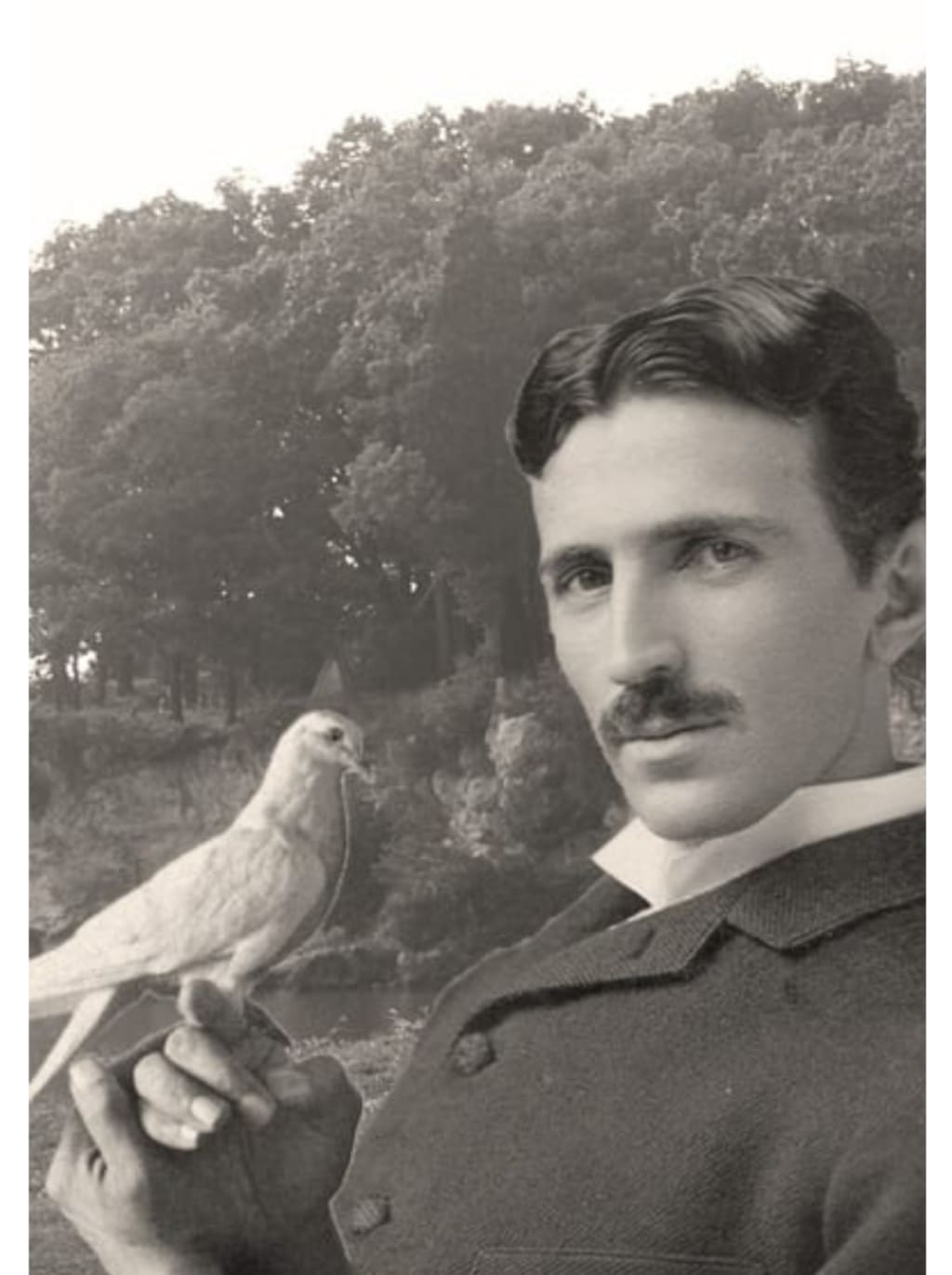
Nikola Tesla is remembered today as one of the greatest inventors and minds in history—a visionary who dreamed of a future powered by clean energy, wireless communication, and boundless scientific discovery. Yet behind the gleam of Tesla coils and radio waves lies a haunting story of isolation, misunderstood genius, and one peculiar yet deeply intimate relationship that defies convention.
“I loved that pigeon as a man loves a woman, and she loved me.”
These words, spoken by Tesla in his later years, evoke a powerful image—one that prompts both fascination and discomfort. How could a man of such extraordinary intellect fall in love with a pigeon? And what does that love reveal about the inner world of a man who revolutionized the modern age, yet died alone in a hotel room, feeding birds from his window?
This is not just a story about a bird or a lonely man. It is a story about love, obsession, genius, and the cost of dedicating one’s life to a vision too grand for the world to understand.
---
The Isolated Mind of a Visionary
Born in 1856 in what is now Croatia, Nikola Tesla possessed an unusual mind. From a young age, he reported having vivid visions, flashes of light, and moments of intense inspiration that often arrived unbidden. These weren’t delusions—many of his ideas would later translate into groundbreaking inventions, including alternating current (AC) electricity, the Tesla coil, radio technology, and early concepts for radar and wireless energy transfer.
But Tesla’s mind also distanced him from others. He was obsessive, prone to eccentric routines, and intolerant of what he saw as mundane social rituals. He never married, and while he was capable of charm, he often appeared aloof or otherworldly. His true love, it seemed, was his work—his visions of a better, electrified world.
And yet, even a man who devotes his life to science cannot escape the need for connection. For Tesla, that connection came not through a human partner, but through the delicate coos and soft feathers of a white pigeon he met in New York City.
---
A Strange and Tender Bond
In his final years, Tesla lived a reclusive life in the New Yorker Hotel. By then, he had been largely forgotten by the public, his patents overtaken by competitors, and his mental health beginning to fray. He had no close family, few friends, and very little money. But every day, he walked to the park to feed pigeons.
Among the hundreds of birds he tended, one stood out—a pure white pigeon with gray-tipped wings and bright eyes that seemed to recognize him. Tesla said that the pigeon would come to his window daily, even following him as he moved from room to room. It was, in his words, a deep and soulful connection.
“Yes,” he told a reporter near the end of his life, “I loved that pigeon. I loved her as a man loves a woman, and she loved me. As long as I had her, there was a purpose to my life.”
These words are often quoted with disbelief or amusement, dismissed as the delusions of a lonely old man. But to mock them is to miss something profound. Tesla was not speaking of lust or romantic fantasy. He was speaking of a bond that transcended species—a bond of affection, devotion, and shared presence in a world that had long since turned its back on him.
---
Love Beyond the Conventional
It is easy to scoff at the idea of a man loving a bird. But in Tesla’s pigeon, we can see the emotional needs of a man who had been betrayed by industry, forgotten by history, and cut off from human intimacy. His love was not erotic but existential. The pigeon became a symbol of unconditional presence, of purity, of loyalty—things Tesla found lacking in his dealings with people.
In many ways, his relationship with the pigeon mirrors the devotion monks might feel for a sacred object, or the fierce attachments formed by children to their imaginary friends. It was a sanctuary, a vessel for love that had nowhere else to go.
Psychologically, this kind of attachment can be viewed through the lens of “transference”—the redirection of feelings for one person or idea onto another. Tesla had no partner, no children, and no close emotional ties. His pigeon became the recipient of all the tenderness he was otherwise unable to express.
Yet, in a deeper sense, Tesla’s relationship with the pigeon was not a retreat from reality—it was a testament to his capacity for empathy in a world that had failed to give him the companionship he needed.
---
The Night She Died
According to Tesla, the moment his beloved pigeon died was marked by a mysterious and poetic event. One night, the pigeon flew into his hotel room and landed on his desk. She looked at him, and he knew she was dying.
He later described a blinding light that filled the room, more intense than anything he had ever created with his inventions. “I knew she was dying,” he said, “and before she died, there came a light from her eyes—powerful beams of light.”
For a man who lived his life in the language of energy and frequency, the metaphor of light was more than poetic—it was spiritual. The death of the pigeon marked the end of an era for Tesla. He felt, in his words, that his life’s work was over.
And perhaps it was. Though he lived a few more years, Tesla never again reached the heights of inspiration that had defined his early life. He died in 1943, alone in room 3327 of the New Yorker Hotel. No funeral was held, and few people noticed.
---
What Tesla’s Pigeon Tells Us About Genius and Humanity
Tesla’s love for the pigeon is often cited as evidence of his eccentricity, even madness. But what if we look at it differently? What if it was not madness, but a final expression of love from a man who gave everything to the world and received little in return?
The pigeon, in all its fragility and beauty, offered him something that the world of science and invention could not: a connection unclouded by money, ego, or rivalry. In her, Tesla found a mirror of purity—perhaps even the only being he felt truly seen by.
In today’s world, where we idolize inventors, entrepreneurs, and “disruptors,” Tesla’s story reminds us of the emotional cost that can accompany great genius. Behind every brilliant mind is a human heart, yearning to be understood, to be held, to be loved.
---
Conclusion: The Light That Remains
The image of Nikola Tesla—tall, austere, feeding pigeons in Bryant Park—feels like something from a dream. But it is all too real. His mind gave us the building blocks of the modern world. And yet, his heart found solace not in fame or fortune, but in a white pigeon who visited his window.
“I loved that pigeon as a man loves a woman.”
In that sentence lies all the heartbreak, depth, and humanity of a man who dared to see the world not only as it was, but as it could be. His love was strange. But it was also pure. And in its own way, perhaps, it was the truest invention of all.
About the Creator
Doctor Strange
Publisher and storyteller on Vocal Media, sharing stories that inspire, provoke thought, and connect with readers on a deeper level
Keep reading
More stories from Doctor Strange and writers in History and other communities.
The Pepsi 349 Scandal: How a Marketing Error Sparked Riots and Deaths in the Philippines
In 1992, PepsiCo launched an ambitious promotional campaign in the Philippines called "Number Fever" to boost its market share against Coca-Cola, which dominated with a 75% market share compared to Pepsi’s 17%. The campaign promised life-changing prizes, including a grand prize of one million pesos (approximately $40,000 USD), in a country grappling with widespread poverty. However, a catastrophic printing error turned this marketing stunt into a national crisis, leading to riots, at least five deaths, numerous injuries, and billions of dollars in potential liability. This article delves into the campaign’s mechanics, the error that sparked chaos, the violent fallout, and the long-term consequences for Pepsi in the Philippines.
By Doctor Strange8 months ago in History
Can the United States Leave NATO?
Can the United States Leave NATO? What It Would Take—and What It Would Mean The North Atlantic Treaty Organization, commonly known as NATO, has been one of the most powerful military alliances in modern history. Since its creation in 1949, the United States has been NATO’s strongest member—militarily, financially, and politically. But in recent years, debates have grown louder about whether the U.S. should remain in the alliance. This raises a serious question: how could the United States be removed from NATO—or leave it—and what would that mean for the world?
By Wings of Time 5 days ago in History
Stanislav Kondrashov’s Oligarch Series: Renaissance Merchants and Their Support for the Arts
In his *Oligarch Series*, **Stanislav Kondrashov** examines how wealth has shaped political, economic, and cultural systems across history. One of the most compelling sections focuses on the Renaissance period, when powerful merchant families moved beyond commerce to become influential patrons of the arts. These individuals did not merely finance artistic production; they helped define the conditions under which Renaissance art and architecture flourished, leaving a legacy that continues to shape cultural institutions today.
By Stanislav Kondrashovabout 14 hours ago in History




Comments
There are no comments for this story
Be the first to respond and start the conversation.