
Life on the Nile: Egypt Beyond the Pharaohs
Discovering the Daily Lives of Ancient Egyptians Beneath the Shadow of the Pyramids.

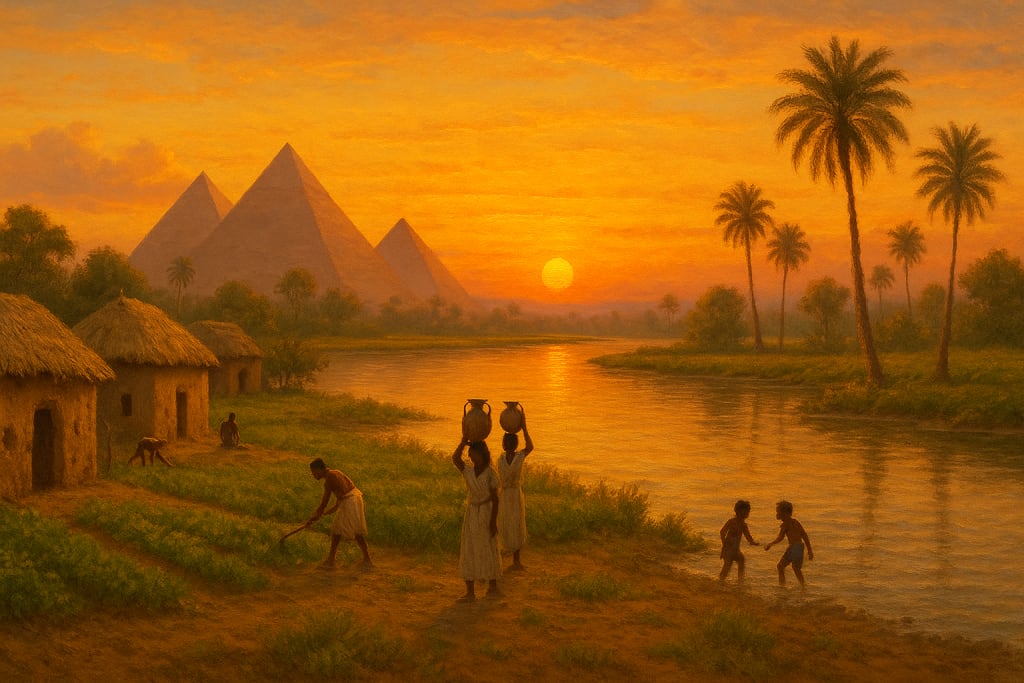
When we think of ancient Egypt, our minds often jump to the towering pyramids, grand temples, and mysterious pharaohs who ruled with divine authority. But beyond the monumental stone structures and royal tombs lies a world much more intimate and vivid—a world where millions of ordinary Egyptians lived, worked, dreamed, and endured along the life-giving banks of the Nile.
The Nile was more than a river. It was the heartbeat of Egypt, shaping everything from agriculture and the economy to religion and social life. For those who lived in its fertile embrace, the Nile was a constant presence—sometimes calm and nurturing, sometimes wild and unpredictable. Life on the Nile was a delicate balance, a rhythm that the ancient Egyptians knew and respected deeply.
The Nile: A Gift and a Lifeline
The annual flooding of the Nile River was the cornerstone of Egyptian existence. Each year, after the scorching summer months, the river’s waters rose and spread across the desert plains, depositing nutrient-rich silt that transformed the barren land into lush fields. This natural irrigation was lifeblood for crops such as wheat, barley, flax, onions, and vegetables. Without the floods, the civilization would have withered in the dry heat.
Farmers eagerly awaited this season, their lives running according to the flood calendar. They worked tirelessly to prepare their fields as the water receded, planting seeds that would grow enough food to feed their families and sustain the empire. Farming tools made of wood and stone were simple but effective—hoes, sickles, and plows pulled by oxen.
The Nile was not just about agriculture. It provided fish, transportation, and fertile soil that sustained not only cities but also small villages and isolated communities spread out for hundreds of miles.
Village Life: More Than Just Survival
Far from the monumental architecture of capital cities like Memphis or Thebes, the majority of Egyptians lived in mud-brick houses in small villages or rural settlements. These houses, often close together, were built with flat roofs and small courtyards. Walls made of sun-dried mud bricks kept the interior cool in the Egyptian heat.
Daily life centered around family and community. Men worked in the fields, fished, herded animals, or worked as potters and carpenters. Women managed the household, prepared meals, cared for the children, and often worked with the cloth, spinning flax into linen to make clothing. Children learned from an early age by helping their parents—boys often followed their fathers’ trades, while girls helped their mothers.
Community celebrations and religious festivals were highlights, breaking up the routine of labor. Villagers gathered to honor local gods, perform music and dance, and share meals. These events strengthened social bonds and provided spiritual solace amid the hardships of life.
Trade and Crafts: The Flow of Goods and Crafts
The Nile River also served as Egypt’s main trade route. Boats and barges laden with grain, gold, papyrus scrolls, linen, pottery, and other goods navigated its waters, connecting cities and distant villages. Trade was crucial not only to the local economy but also to the acquisition of distant lands, such as cedar from Lebanon or incense from Punt.
Crafts flourished in villages and towns. Artisans who specialized in jewelry making, pottery, weaving, metalwork, and stone carving. Their skills were passed down from generation to generation, and their creations were used for both everyday utility and religious rituals. For example, amulets made of faience were believed to protect their wearers from harm.
Markets were bustling with activity. Traders traded goods, exchanged news, and forged relationships. The Nile River was a lifeline that connected diverse communities, enabling the flow of wealth and culture.
Religion is intertwined with daily life.
Religion was inseparable from the daily lives of ancient Egyptians. Although the pharaohs were seen as divine rulers, the common people worshipped a rich pantheon of gods and goddesses associated with natural elements and everyday concerns.
Among the most important was Hopi, the god of the Nile floods, who ensured the river's annual bounty. People also venerated Osiris, the god of the afterlife and resurrection, and Isis, the goddess of motherhood and magic. Small shrines were found in homes, and families often carried amulets engraved with protective symbols.
Rituals and festivals punctuated the year, often tied to agricultural cycles. Offerings of food, drink, and flowers were offered to the gods to ensure good harvests and protection. Belief in an afterlife encouraged careful preparation of burial practices and burial goods, reflecting the hope of eternal life beyond the earthly banks of the Nile.
Challenges and Difficulties
Life along the Nile was not without its difficulties. Floods could sometimes be too high or too low, leading to famine or disaster. Disease was common, as were injuries from labor. Social inequality meant that many lived in poverty, with only a small elite enjoying the wealth and power of the pharaohs.
Yet the people’s resilience shone through these challenges. Their deep knowledge of the land, their strong community ties, and their spiritual beliefs helped them endure and adapt for thousands of years. The continuity of their culture, even as dynasties rose and fell, speaks to this enduring strength.
A Legacy Beyond the Pyramids
While the pyramids stand as awe-inspiring monuments to ancient Egyptian rulers, the true spirit of Egypt lies in the lives of the everyday people who built and maintained this civilization. Their farming, crafts, family bonds, and faith formed the foundation on which one of history’s greatest cultures flourished.
Exploring life along the Nile beyond the pharaohs allows us to appreciate the human stories that history often ignores—the laughter of children playing by the river, the skill of potters shaping clay, shared meals in humble homes, and quiet moments of prayer at village shrines.
In these moments and places, far from the splendor of royal tombs, the pulse of ancient Egypt still beats, reminding us that history is as much about ordinary lives as it is about kings and empires.
About the Creator
Echoes of Life
I’m a storyteller and lifelong learner who writes about history, human experiences, animals, and motivational lessons that spark change. Through true stories, thoughtful advice, and reflections on life.
Keep reading
More stories from Echoes of Life and writers in History and other communities.
The Trail of Tears: America’s Dark March Westward
A Promise of Expansion, A Reality of Sorrow In the early 19th century, the United States stood at a crossroads. The young nation was eager to expand westward, driven by the belief in Manifest Destiny—the idea that Americans were destined to settle across the continent. But this expansion came at a devastating cost.
By Echoes of Life5 months ago in History
Can the United States Leave NATO?
Can the United States Leave NATO? What It Would Take—and What It Would Mean The North Atlantic Treaty Organization, commonly known as NATO, has been one of the most powerful military alliances in modern history. Since its creation in 1949, the United States has been NATO’s strongest member—militarily, financially, and politically. But in recent years, debates have grown louder about whether the U.S. should remain in the alliance. This raises a serious question: how could the United States be removed from NATO—or leave it—and what would that mean for the world?
By Wings of Time 4 days ago in History




Comments
There are no comments for this story
Be the first to respond and start the conversation.