
Joan of Arc
The Warrior Girl Who Changed the Fate of France

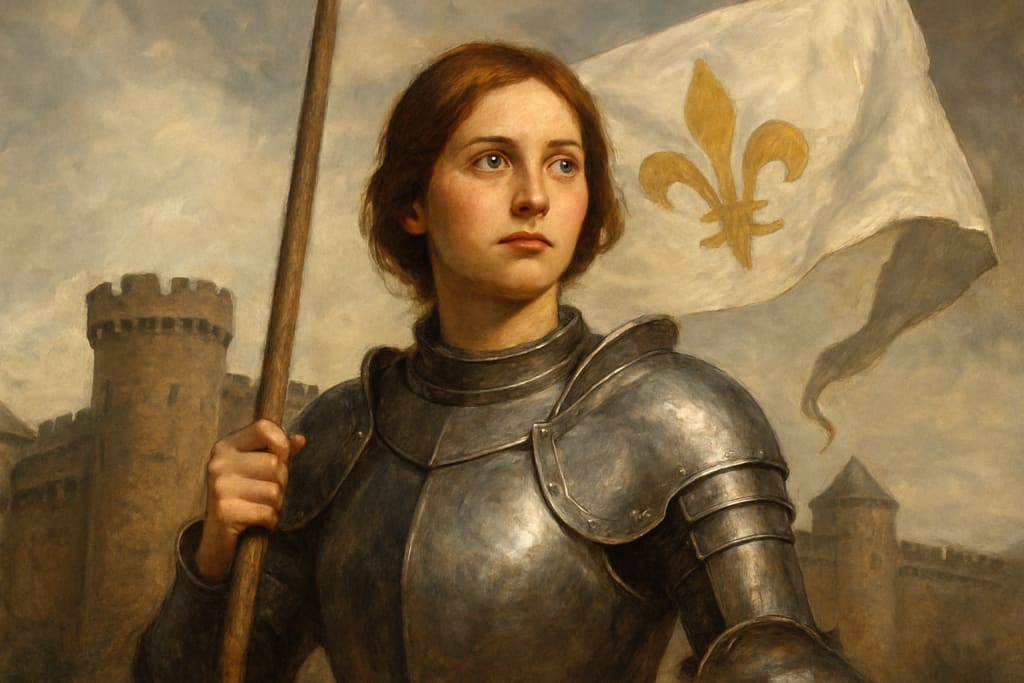
Joan of Arc remains one of the most extraordinary figures in world history. Born into a humble farming family yet destined to influence the course of a nation, her life unfolded against the violent backdrop of the Hundred Years’ War — a conflict that had raged between England and France for decades. At a time when France stood on the brink of collapse, an unlikely leader emerged: a teenage girl who believed she had a divine mission. This is the historically detailed story of Joan of Arc, from her early visions to her tragic end and eventual redemption.
A Childhood in a Kingdom at War
Joan was born around 1412 in Domrémy, a small village in northeastern France. Her parents, Jacques and Isabelle, were prosperous peasants but far from nobility. France during Joan’s childhood was devastated by ongoing war. The English controlled large portions of the north, while their Burgundian allies seized more territory each year. The French monarchy itself appeared weak and fractured.
From a young age, Joan witnessed the fear and instability that war brought. Her village was attacked more than once, and local people often fled from advancing armies. Despite this turmoil, records suggest that Joan grew up hard-working, devout, and deeply loyal to the French crown.
Visions and a Call to Action
Joan later testified that at around age 13, she began experiencing what she described as “voices” or divine visions. She identified these figures as Saint Michael, Saint Catherine, and Saint Margaret — respected figures in medieval Christian tradition. According to Joan, the voices told her that she had been chosen to help save France and ensure that Charles VII would be crowned king.
In medieval Europe, visions and divine messages were not considered impossible, but they were treated with great suspicion. Most people would have dismissed or hidden such experiences. Joan, however, became convinced that she had a sacred mission that she could not refuse.
The Journey to Meet the Dauphin
In 1428, Joan traveled to Vaucouleurs, a nearby stronghold loyal to Charles VII, to request an audience with the French heir. At first she was ignored. A teenage peasant girl claiming divine instruction was not taken seriously. But Joan did not give up. Over several months, she persuaded local commander Robert de Baudricourt that her mission was genuine. He eventually provided a small escort to take her to the royal court in Chinon.
Joan arrived at Chinon in February 1429. Charles VII, skeptical and surrounded by advisors who doubted her, tested her resolve. According to chroniclers, Charles hid among his courtiers while another man sat on the throne. Joan walked past the decoy and knelt directly before the real Dauphin. This story, although impossible to verify fully, became one of the legends that strengthened Joan’s image.
After being examined by theologians in Poitiers — who found nothing heretical about her claims — Joan was allowed to join the French army.
The Siege of Orléans: A Turning Point
When Joan reached Orléans in April 1429, the city had been under siege by the English for months. Morale was low, food supplies short, and the French army disorganized. Joan’s arrival was dramatic. Although she had no formal military training, she inspired soldiers and civilians alike with her confidence and faith.
Joan carried a banner instead of a weapon, but she rode into battle, encouraging troops to advance. Her presence revitalized the French forces, who launched several successful assaults on English positions. On May 8, 1429, the siege was lifted — a major victory and a turning point in the war.
News of the “Maid of Orléans” spread quickly. Her success gave new credibility to her mission and new hope to the French kingdom.
The Road to Reims and the Coronation of Charles VII
Joan insisted that the next step was to escort Charles to Reims, the traditional site for the coronation of French kings. Reims was deep in enemy territory, but Joan argued that the coronation would legitimize Charles’s rule and rally the kingdom.
Despite the risks, Charles agreed. In a campaign marked by speed and boldness, Joan and the French army captured several key towns and cleared a path to Reims. On July 17, 1429, Charles VII was crowned king, with Joan standing beside him. For many French citizens, this moment confirmed Joan’s divine mission.
Capture, Trial, and Execution
However, Joan’s success alarmed both the English and their Burgundian allies. In May 1430, during a military operation near Compiègne, Joan was captured by Burgundian forces. Instead of ransoming her back to the French king — a common practice — the Burgundians sold her to the English.
Joan was imprisoned, placed on trial for heresy, and interrogated repeatedly. The trial, conducted in Rouen, was heavily political. English authorities sought to discredit her in order to undermine Charles VII’s legitimacy.
Despite being only 19, Joan displayed remarkable intelligence and courage. But the outcome was predetermined. In May 1431, she was convicted and burned at the stake. Witnesses reported that her final word was “Jesus.”
Posthumous Retrial and Legacy
Twenty-five years after her death, a new trial ordered by Charles VII overturned the original verdict, declaring Joan innocent and calling her execution “a miscarriage of justice.” In 1920, the Catholic Church canonized her as a saint.
Today, Joan of Arc is remembered as a symbol of national pride, courage, and faith. Her military achievements and leadership helped shift the balance of the Hundred Years’ War and set France on the path to victory.
Her life, though brief, demonstrates how a single determined individual can shape the destiny of a nation
About the Creator
The khan
I write history the way it was lived — through conversations, choices, and moments that changed the world. Famous names, unseen stories.
Napoleon Bonaparte — From Corsican Outsider to Emperor of Europe
Napoleon Bonaparte was born on August 15, 1769, on the Mediterranean island of Corsica, a land that had only recently come under French control. His family was of modest noble status, and young Napoleon grew up feeling like an outsider—Corsican by culture, yet educated as a Frenchman. This sense of being different shaped his fierce ambition and iron will. From an early age, he showed a sharp mind, a deep love for history, and an unusual talent for mathematics, which later proved essential in warfare.
By The best writer 3 days ago in History
Balloonfest 1986
Balloonfest 1986 was meant to be a joyful celebration. It was planned as a world record attempt and a symbol of hope, fun, and community spirit. Instead, it became one of the most famous examples of how a good idea can go wrong when nature is underestimated.
By shaoor afridi6 days ago in History
Do You have a Support Network?
Life is harder when you’re on your own. Human beings are social creatures, and we usually feel better when we have support from a strong social network around us. For most people, it’s our families that hold us together like glue.
By Elizabeth Woodsabout 17 hours ago in Psyche


Comments
There are no comments for this story
Be the first to respond and start the conversation.