
Israel, the Muslim World, and the United States: A Geopolitical Triangle of Conflict and Power
Understanding the Historical Roots, Political Dynamics, and Future Prospects of Israel’s Relationship with the Muslim World and the Strategic Role of the U.S.
Introduction
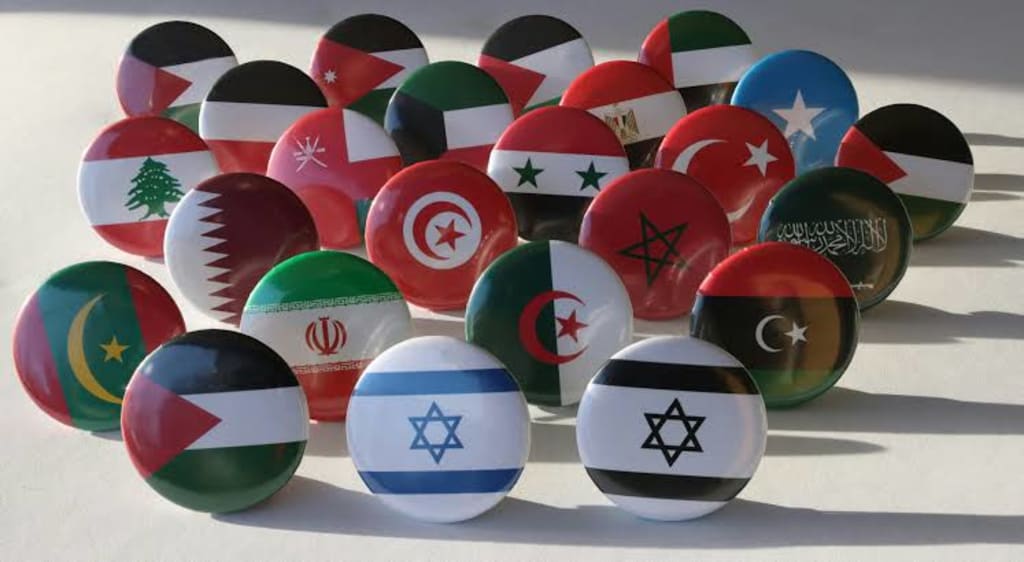
The Middle East has long been the focal point of world politics, not only due to its geographical significance but also because of its cultural, religious, and economic importance. Central to this discourse lies the ongoing conflict between Israel and the Muslim world, a relationship marked by tension, wars, failed peace efforts, and deep mistrust. Adding a further layer of complexity is the role of the United States, which has been Israel’s closest ally while simultaneously maintaining strategic ties with key Muslim-majority nations.
This triangular relationship—Israel, the Muslim world, and the United States—has shaped global politics for decades. To fully understand it, one must look at its historical background, ideological underpinnings, economic stakes, and the evolving regional and international dynamics. This essay explores these elements in detail, offering a comprehensive view of where the conflict stands today and where it may lead tomorrow.
Historical Background
The Creation of Israel and Arab Opposition
The origins of the Israeli-Muslim world conflict can be traced back to the early 20th century when Jewish immigration to Palestine increased under the British Mandate. The culmination came in 1948 with the declaration of the State of Israel, an event celebrated by Jews worldwide but seen as the Nakba (catastrophe) by Palestinians and the wider Muslim world. Hundreds of thousands of Palestinians were displaced, igniting resentment that has persisted for generations.
Immediately after Israel’s creation, neighboring Arab states—including Egypt, Jordan, Syria, and Iraq—went to war, marking the beginning of decades of hostility. Israel emerged victorious, expanding its territory, which deepened Muslim opposition.
Wars and Shifting Power (1948–1973)
The wars of 1956, 1967, and 1973 further entrenched animosities. In the Six-Day War of 1967, Israel captured the West Bank, Gaza Strip, East Jerusalem, Sinai Peninsula, and Golan Heights. These territorial gains gave Israel control over holy sites revered by Muslims, intensifying the religious dimension of the conflict.
Cold War Era and the Role of the U.S.
During the Cold War, the United States aligned itself firmly with Israel, while many Muslim countries leaned toward the Soviet Union. This alignment cemented the U.S. role as Israel’s protector and arms supplier, deepening suspicion among Muslim-majority states about Washington’s intentions.
The Muslim World’s Perspective
Religious Solidarity
For much of the Muslim world, opposition to Israel is rooted in religious solidarity with Palestinians, particularly regarding Jerusalem (Al-Quds), home to the Al-Aqsa Mosque—the third holiest site in Islam. The loss of Jerusalem to Israeli control is viewed as a deep wound in Muslim consciousness.
Pan-Arabism and Nationalism
In addition to religion, Arab nationalism has historically fueled opposition to Israel. Leaders like Gamal Abdel Nasser of Egypt sought to unite Arabs against what was perceived as Western-backed colonialism embodied by Israel.
Fragmentation within the Muslim World
However, the Muslim world has never been a monolithic bloc. While some countries, like Iran, remain staunchly opposed to Israel’s existence, others, such as Egypt and Jordan, have signed peace treaties. More recently, the Abraham Accords of 2020 normalized relations between Israel and several Gulf states, showing a pragmatic shift toward economic and security cooperation.
Israel’s Position
Security Concerns
For Israel, survival has always been paramount. Surrounded by countries that historically denied its legitimacy, Israel developed a strong military and sought alliances with major powers, particularly the United States.
Settlement Expansion and Occupation
Israel’s continued settlement expansion in the West Bank, along with its control of Gaza through blockades, has kept tensions high. Critics in the Muslim world see this as proof that Israel is uninterested in genuine peace.
Diplomatic Strategy
Despite opposition, Israel has pursued normalization with selective Muslim countries. The peace treaty with Egypt in 1979, Jordan in 1994, and the Abraham Accords show Israel’s pragmatic efforts to break out of isolation.
The Role of the United States
Strategic Alliance with Israel
The U.S. has been Israel’s strongest supporter, providing billions of dollars annually in military aid, advanced weaponry, and diplomatic backing at the United Nations. This alliance is rooted in shared democratic values, strong domestic pro-Israel lobbies, and the strategic value of having a reliable partner in the Middle East.
Balancing Act with Muslim Nations
At the same time, the U.S. has deep economic and security ties with Muslim-majority countries, particularly in the Gulf, due to oil and counterterrorism cooperation. Washington has often tried to balance its support for Israel with the need to maintain relations with countries like Saudi Arabia, Egypt, and Turkey.
Mediation Efforts
The U.S. has frequently acted as a mediator in the Israeli-Palestinian conflict, from the Camp David Accords to the Oslo Accords. However, critics argue that the U.S. has rarely been an impartial broker, as it often favors Israeli interests.
Key Flashpoints in Israel-Muslim World Relations
The Palestinian Question
The core of the conflict remains the Palestinian issue. For the Muslim world, a just solution to Palestinian statehood is essential before normalization with Israel can be fully realized.
Jerusalem and Holy Sites
Control of Jerusalem, especially Al-Aqsa, is a deeply emotional and religious issue for Muslims worldwide. U.S. recognition of Jerusalem as Israel’s capital in 2017 under Donald Trump heightened tensions.
Iran-Israel Rivalry
Iran’s opposition to Israel has added another layer of conflict. Tehran’s support for Hezbollah in Lebanon and Hamas in Gaza has made it a central player in the Israel-Muslim world standoff. The U.S., siding with Israel, has worked to contain Iranian influence, further polarizing the region.
Economic and Geopolitical Dimensions
Oil and Energy Politics
The U.S.’s engagement with Muslim nations is not solely about religion or security; it is also driven by oil. American dependence on Middle Eastern oil in the 20th century shaped its policies, though this dependence has lessened in recent years.
Trade and Technology
Israel has become a hub for technology and innovation, attracting investment from even some Muslim nations despite official hostilities. Economic pragmatism is slowly reshaping old enmities.
Shifting Alliances
The rise of China and Russia as influential players in the Middle East has further complicated the Israel-Muslim world-U.S. triangle. Muslim nations now have alternatives to U.S. patronage, giving them more leverage.
The Future of Relations
Possible Scenarios
1. Continued Conflict: Without resolution of the Palestinian issue, hostility will persist, fueling extremism and instability.
2. Gradual Normalization: Economic interests and common threats (like Iran) may push more Muslim countries to normalize with Israel.
3. New Cold War Dynamics: With global powers competing for influence, the U.S.-Israel-Muslim world relationship may become part of a broader geopolitical rivalry.
The Role of Youth and Public Opinion
Surveys across Muslim countries show strong public support for Palestine, even when governments pursue normalization with Israel. This disconnect may lead to internal political challenges in the Muslim world.
Conclusion
The relationship between Israel, the Muslim world, and the United States is one of the most complex and consequential issues in modern geopolitics. Rooted in history, religion, nationalism, and great-power rivalry, it has shaped wars, diplomacy, and alliances for decades. While the U.S. has been Israel’s unwavering supporter, it has also sought to maintain its influence across the Muslim world through oil, trade, and security cooperation.
The future of this triangular relationship depends largely on whether a just and lasting solution to the Palestinian question can be found. Without it, mistrust and hostility will endure, potentially fueling further conflict. But with pragmatic leadership, regional cooperation, and balanced U.S. diplomacy, there remains hope for a future where coexistence replaces confrontation.
About the Creator
Keep reading
More stories from Hamza Muhammad and writers in History and other communities.
World War II: The Global Conflict that Shaped the Modern World
Introduction World War II (1939–1945) remains the largest, deadliest, and most transformative conflict in human history. Spanning across Europe, Asia, Africa, and the Pacific, the war involved more than 30 nations and resulted in the deaths of over 70 million people, both soldiers and civilians. It was a war that reshaped international politics, redrew borders, led to the rise of the United States and the Soviet Union as global superpowers, and established the foundation of the modern world order.
By Hamza Muhammad4 months ago in History
The Accidents That Quietly Improved Aviation Forever
I used to think aviation history was a story of bold successes, record-breaking flights, sleek aircraft, and triumphant landings. But the more I read, the more I realized something uncomfortable: much of modern aviation was shaped not by success, but by accidents. The safety and reliability we now take for granted were quietly built from moments when things went terribly wrong.
By Beckett Dowhan4 days ago in History
"Game of Thrones: A Tale of Power, Betrayal, and Destiny"
In the vast and divided land of Westeros, power was everything. Noble houses ruled their regions, bound together by fragile alliances, old grudges, and a constant hunger for the Iron Throne—the seat of supreme authority. Though summer had lasted for many peaceful years, whispers of change moved with the cold wind. Winter, long feared, was coming.
By The best writer 6 days ago in History
Rachel Reviews: The Spiral Archive by Pieter Hendrik
It's difficult for me to know where to start with a review of this book as it was, for me, an entirely unique experience and one that I'll probably never have again. I don't want that to be interpreted as unenjoyable but it has left me scratching my head a little and ruminating on its content, its themes and its characters.
By Rachel Deeming2 days ago in BookClub


Comments
There are no comments for this story
Be the first to respond and start the conversation.