
World War II: The Global Conflict that Shaped the Modern World
A comprehensive study of the causes, battles, consequences, and legacy of the Second World War
Introduction
World War II (1939–1945) remains the largest, deadliest, and most transformative conflict in human history. Spanning across Europe, Asia, Africa, and the Pacific, the war involved more than 30 nations and resulted in the deaths of over 70 million people, both soldiers and civilians. It was a war that reshaped international politics, redrew borders, led to the rise of the United States and the Soviet Union as global superpowers, and established the foundation of the modern world order.
This article explores the origins of World War II, its major battles and strategies, the role of key leaders, the atrocities committed during the war, and the far-reaching consequences that still influence global politics today.
Causes of World War II
The Second World War was not an isolated event—it was the result of political, economic, and social tensions that had been brewing since the end of World War I.
1. Treaty of Versailles (1919)
The harsh conditions imposed on Germany after World War I created resentment and economic collapse. Germany was forced to accept full responsibility for the war, pay heavy reparations, disarm its military, and give up territories. This humiliation fueled nationalist anger and paved the way for Adolf Hitler’s rise to power.
2. Rise of Fascism and Militarism
The 1920s and 1930s witnessed the emergence of authoritarian regimes. In Germany, Adolf Hitler’s Nazi Party promoted Aryan supremacy and territorial expansion. In Italy, Benito Mussolini established fascism, while Japan pursued militaristic expansion under Emperor Hirohito and military leaders.
3. Economic Depression
The Great Depression (1929) destabilized economies worldwide, creating unemployment and poverty. Dictators exploited these conditions, promising stability and glory through aggressive foreign policies.
4. Policy of Appeasement
Western powers, particularly Britain and France, followed a policy of appeasement, allowing Hitler to annex Austria (1938) and occupy Czechoslovakia without resistance. This emboldened Germany to pursue further aggression.
5. Expansionist Ambitions
Germany sought “Lebensraum” (living space) in Eastern Europe.
Italy wanted to recreate the Roman Empire in Africa and the Mediterranean.
Japan aimed to dominate Asia and the Pacific, beginning with the invasion of Manchuria (1931) and later China (1937).
Outbreak of the War
On September 1, 1939, Germany invaded Poland using the “Blitzkrieg” (lightning war) strategy. Britain and France declared war on Germany two days later, marking the official start of World War II.
Soon after, the Soviet Union invaded eastern Poland under a secret pact with Germany (Molotov-Ribbentrop Pact). By 1940, Nazi Germany had conquered much of Western Europe, including France, Belgium, Norway, and the Netherlands.
Major Theaters and Battles of World War II
The war spanned multiple continents, with different theaters of combat.
1. European Theater
Battle of Britain (1940): Germany launched massive air raids on Britain, but the Royal Air Force successfully resisted, preventing a German invasion.
Operation Barbarossa (1941): Hitler invaded the Soviet Union, breaking the Nazi-Soviet pact. Initially successful, German forces were halted at Moscow and later defeated at Stalingrad (1942–43)—a turning point in the war.
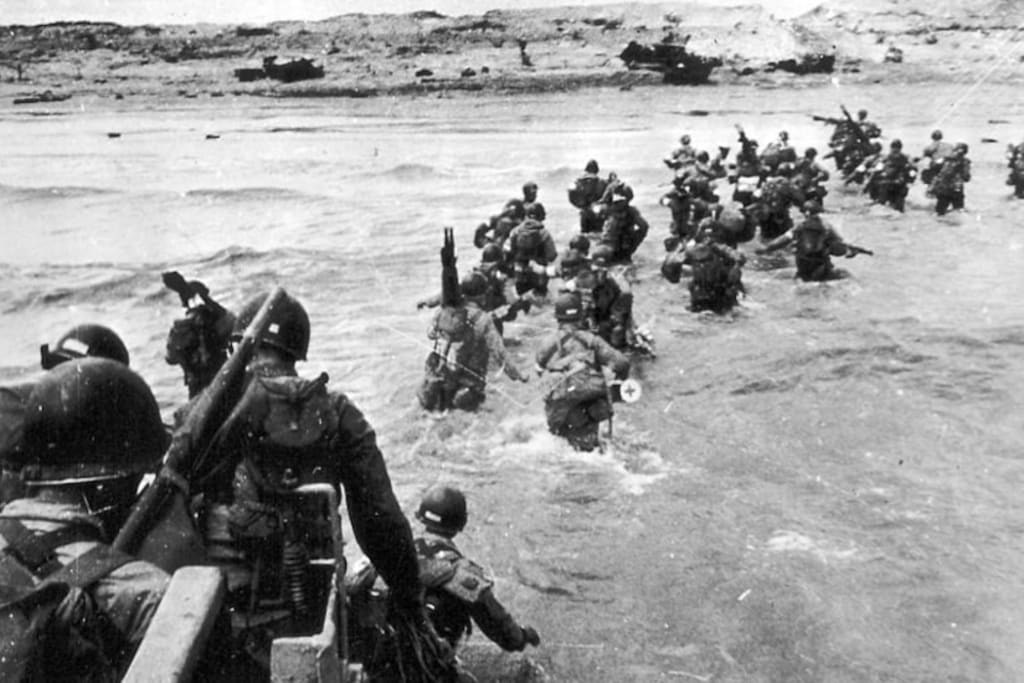
D-Day (1944): Allied forces launched the largest amphibious invasion in history on the beaches of Normandy, France. This opened a western front against Germany.
Fall of Berlin (1945): The Soviet Red Army captured Berlin in May 1945, leading to Hitler’s suicide and Germany’s surrender.
2. Pacific Theater
Pearl Harbor (1941): Japan’s surprise attack on the U.S. naval base in Hawaii forced the United States into the war.
Battle of Midway (1942): A decisive naval battle where the U.S. crippled Japan’s fleet.
Island Hopping Campaign: The U.S. and its allies gradually recaptured Pacific islands, moving closer to Japan.
Atomic Bombings (1945): The U.S. dropped atomic bombs on Hiroshima and Nagasaki in August 1945, forcing Japan’s surrender.
3. African and Mediterranean Theater
North Africa Campaign: German Field Marshal Erwin Rommel (the “Desert Fox”) fought against British forces. The Allies eventually won decisive victories at El Alamein (1942).
Italian Campaign (1943): Allied forces invaded Sicily and Italy, leading to Mussolini’s downfall.
Role of Key Nations
Germany: Led by Adolf Hitler, the Nazi regime pursued expansionism and genocide.
Soviet Union: Initially allied with Germany but later joined the Allies after being invaded. The USSR bore the heaviest casualties.
United States: Entered the war after Pearl Harbor, contributing industrial power and military strength.
United Kingdom: Stood firm against Germany and played a crucial role in Europe and Africa.
Japan: Pursued dominance in Asia but was defeated after the atomic bombings.
Italy: Initially allied with Germany but switched sides after Mussolini’s fall.
Atrocities and the Human Cost
1. The Holocaust
One of the darkest chapters of history, the Holocaust saw the systematic extermination of 6 million Jews by Nazi Germany. Other victims included Roma (Gypsies), disabled individuals, political opponents, and minorities.
2. Civilian Bombings
Cities such as London, Dresden, Tokyo, and Hiroshima faced devastating air raids, killing millions of civilians.
3. Forced Labor and War Crimes
Japan’s use of “comfort women,” forced labor camps, and brutal treatment of prisoners of war left deep scars in Asia.
4. Overall Casualties
World War II claimed an estimated 70–85 million lives—around 3% of the world’s population at the time.
End of the War
Germany surrendered on May 8, 1945 (V-E Day).
Japan surrendered on September 2, 1945 (V-J Day) after the atomic bombings.
World War II ended with an Allied victory, but the devastation reshaped global politics forever.
Consequences of World War II
1. Political Changes
The United Nations (UN) was established in 1945 to prevent future conflicts.
The U.S. and Soviet Union emerged as rival superpowers, beginning the Cold War.
2. Territorial Changes
Germany was divided into East and West.
Japan lost its empire and adopted a pacifist constitution.
Eastern Europe fell under Soviet influence.
3. Economic Impact
The U.S. economy boomed, while Europe rebuilt through the Marshall Plan.
Decolonization accelerated, as Asian and African nations sought independence.
4. Social and Cultural Impact
The war advanced technology, including nuclear weapons, radar, and jet engines.
Women’s roles in the workforce expanded, paving the way for gender equality movements.
Legacy of World War II
World War II was more than just a military conflict; it was a defining moment in human history. It taught the world the dangers of dictatorship, racial hatred, and unchecked militarism. It also paved the way for global institutions, human rights movements, and the balance of power that continues to shape geopolitics today.
The memory of the war serves as both a warning and a lesson: the cost of global conflict is too great, and peace must always be preserved through cooperation, diplomacy, and mutual respect among nations.
Conclusion
World War II was a tragedy of unimaginable proportions, but it was also a turning point that reshaped the modern world. The sacrifices of millions, the destruction of nations, and the atrocities committed remain etched in history. Yet, from the ashes of war rose a new global order, one that still influences politics, economics, and societies today.
The lessons of World War II—unity against tyranny, the pursuit of peace, and the defense of human dignity—remain as relevant now as they were in 1945.
About the Creator
Keep reading
More stories from Hamza Muhammad and writers in History and other communities.
The United States vs. Venezuela: A Geopolitical Struggle in the 21st Century
Introduction The relationship between the United States and Venezuela has been one of the most contentious diplomatic rivalries in the Western Hemisphere for the past two decades. While once bound by trade and energy cooperation, both nations have grown into ideological adversaries. Venezuela, rich in oil but plagued by economic collapse and political crises, has found itself at odds with the United States, which has often pushed for democratic reforms while simultaneously imposing sanctions.
By Hamza Muhammad4 months ago in History
Mestre Best: The Warrior Who Taught Restraint
In the mountain city of Valenor, there was a name spoken softly, almost with reverence—Mestre Best. No statues were built in his honor, no songs officially recorded his deeds, yet every fighter, scholar, and traveler knew the legend. Some said he was the greatest master of combat the world had ever seen. Others claimed he was a philosopher disguised as a warrior. The truth was more complex than either tale.
By The best writer a day ago in History
A massive underwater stone wall that is almost 7,000 years old is found by divers.
One of the buried stone monuments on Sein Island is a granite wall off Brittany that is more than 7,000 years old and the length of a football pitch. The discovery is being used by marine archaeologists in the vicinity of Île de Sein to explain how stone-built coastal villages predate the widespread spread of farming.
By Francis Dami6 days ago in History
Miss Persephone's Manual to a Seemingly Ordinary Life
Miss Persephone was found at the dining table, her blue eyes swollen, her tears arriving and retreating like the tides of the ocean. Earlier that day, her family had visited her in the retirement home where she had lived for eight years. It was her eightieth birthday.
By Imola Tóth4 days ago in Fiction


Comments
There are no comments for this story
Be the first to respond and start the conversation.