
Investigating the Wonders of the Maya Civilization
Beginnings, Traditions, and Heritage.

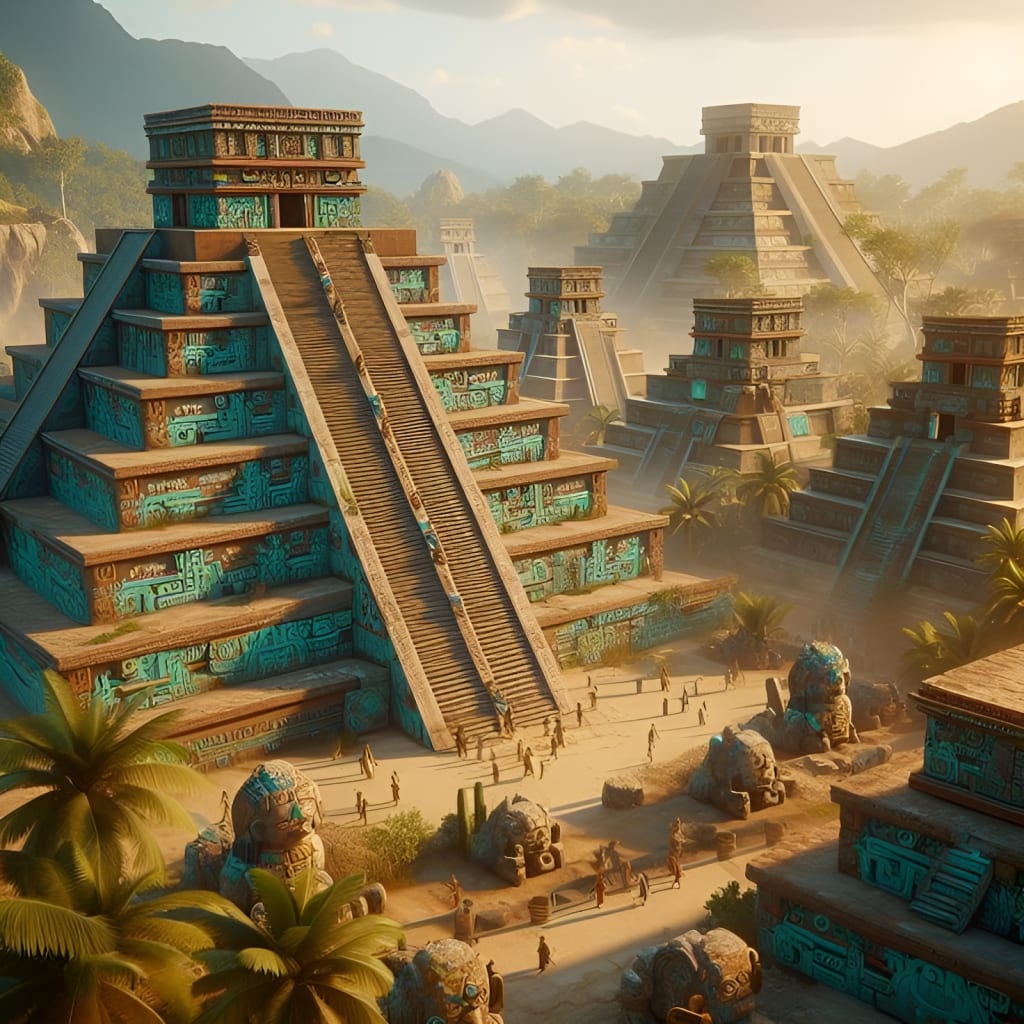
We embark on a temporal exploration to reveal the narratives of extraordinary civilizations. In this discussion, we focus on the intriguing realm of the Maya, the creators of one of Mesoamerica's most vibrant and lasting cultures. Examining their beginnings, spiritual beliefs, renowned calendar, and innovative achievements, the Maya remain a source of fascination for both historians and enthusiasts.
The Maya civilization inhabited regions that encompass modern-day Yucatán, Quintana Roo, Campeche, Tabasco, and Chiapas in Mexico, and extended further south into Guatemala, Belize, El Salvador, and Honduras. The term "Maya" is derived from the ancient city of Mayapan, which served as the final capital of a Maya kingdom during the Postclassic Period. It is important to note that the Maya identified themselves through various ethnic and linguistic groups, including the K'iche' in the southern areas and Yucatec in the northern regions.
Mesoamerican history is typically divided into several distinct periods: Archaic, Preclassic, Classic, Postclassic, and the Contact Period. These phases illustrate the development of cultures within the region, highlighting the Maya's advancements in agriculture, trade, and a remarkable cultural amalgamation.
Early Maya civilization evolved from a hunter-gatherer existence to settled agricultural communities, where they cultivated essential crops such as maize and beans. They also domesticated animals, including dogs and turkeys. Although they did not have draft animals or the wheel, they prospered through the use of canoes and extensive trade networks.
The Maya assimilated and enhanced cultural practices from neighboring societies, such as the Olmec and Zapotec, adopting advanced writing systems, mathematics, astronomy, and a complex calendar. Throughout the Preclassic Period, they constructed sacred sites, which included renowned cities like Tikal, Copán, and Chichen Itza.
Maya spirituality was centered on the cyclical essence of existence, encapsulated in their understanding that nothing genuinely perishes but rather undergoes a transformation through a cosmic voyage. The underworld, known as Xibalba, and the celestial realms above were interconnected by the revered World Tree, forming a crucial aspect of their cosmology.
Rituals, which included human sacrifices, were perceived as a method to perpetuate the cosmic cycle. Their remarkable architectural achievements, exemplified by grand pyramids, represented sacred mountains and functioned as sites for worship and astronomical study.
The Maya civilization made remarkable advancements in both science and art. Their vigesimal (base-20) numeral system allowed for intricate calculations, while their knowledge of celestial movements enabled them to accurately predict astronomical phenomena.
The renowned Maya calendar comprised two distinct systems: a solar calendar of 365 days and a ritual calendar of 260 days, which interlinked to create a "Calendar Round." For extended timekeeping, the Maya employed the Long Count calendar, which attracted worldwide attention in 2012 due to its association with the conclusion of a baktun (a period of roughly 394 years). Contrary to apocalyptic interpretations, the Maya perceived this event as a transition into a new cycle rather than a catastrophic occurrence.
The Classic Period represented the pinnacle of Maya cultural accomplishments, characterized by vibrant cities, impressive architectural feats, and robust populations. In contrast, the Postclassic Period saw the decline of numerous urban centers, largely attributed to issues such as climate change and overpopulation.
The Spanish conquest in the 16th century had a profound effect on the Maya civilization. The notorious destruction of Maya manuscripts by Bishop Diego de Landa resulted in the loss of a significant portion of their documented history. Nevertheless, his accounts unexpectedly proved essential in the interpretation of their hieroglyphic writing.
Modern Maya communities, which exceed six million in population, actively maintain the traditions of their ancestors. Despite the influence of Christianity introduced during the conquest, their cultural practices reflect a synthesis of European Catholicism and ancient Maya spirituality.
This enduring legacy serves as a testament to the fact that the Maya have not vanished; rather, their culture continues to flourish in the regions they have occupied for thousands of years.
About the Creator
A História
"Hi. My name is Wellington and I'm a passion for general history. Here, I publish articles on different periods and themes in history, from prehistory to the present day.
Keep reading
More stories from A História and writers in History and other communities.
The Heritage of Kush
Africa, recognized as one of the oldest and largest continents on the planet, has served as a cradle for numerous populations, each adding their distinct cultures, ethnic backgrounds, and belief systems to the tapestry of human history. Today, we shall embark on a historical exploration of one of the extraordinary civilizations that flourished in Africa and made a lasting impact on history—the Kingdom of Kush.
By A Históriaabout a year ago in History
The Year 1916 in Review: Fun Facts, Trivia, and Historic Highlights
This quick read is a collection of fun facts, trivia, and historic events from the year 1916. Discover the year’s top news stories, most influential people, sports trivia, grocery prices, entertainment news, and much more.
By Gregory DeVictor7 days ago in History



Comments
There are no comments for this story
Be the first to respond and start the conversation.