
Icarus, but not as you know it
How one missing line completely changed our understanding of the Greek myth

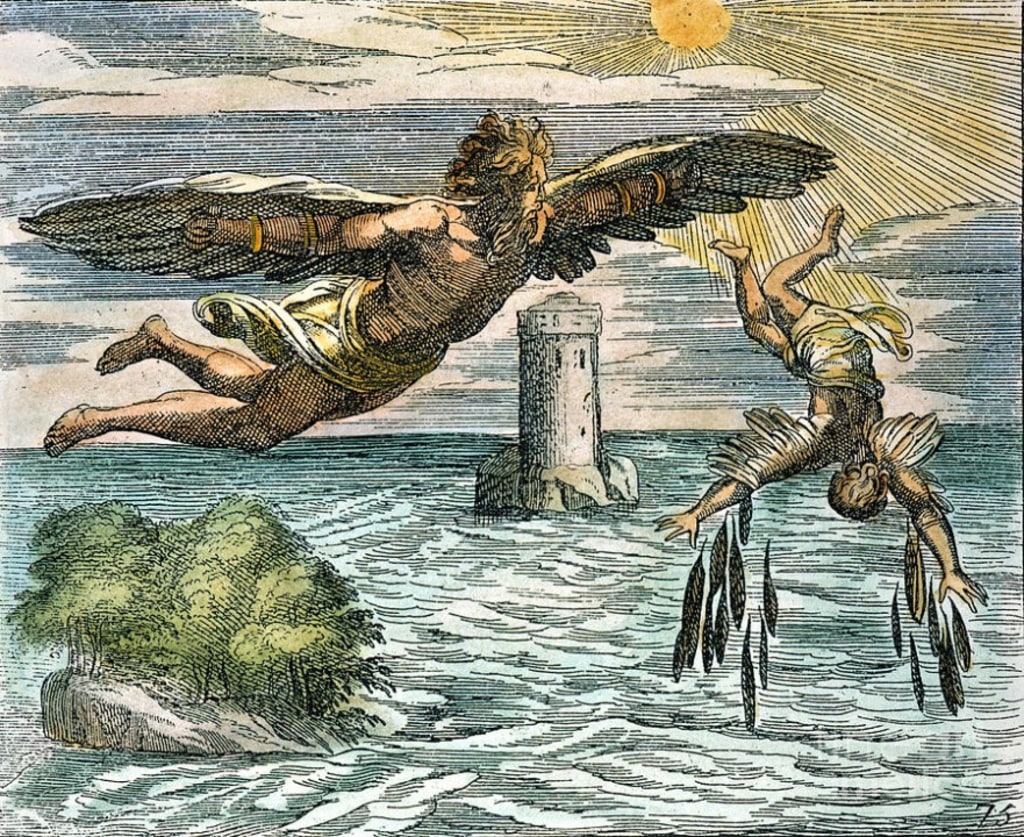
We all know the story, or at least we think we do.
Icarus and his father Daedalus were Ancient Greeks, trapped by the cruel King Minos, who believed that Daedalus has betrayed him.
As the tale goes, Daedalus was a famous architect, and in fact created the very labyrinth that housed the Minotaur, the fearsome beast that Theseus had to brave. In that story, the secrets of the labyrinth are revealed to Theseus by King Minos' own daughter, Ariadne, who gives Theseus a spool of golden thread with which to find his way back out of the maze after slaying the monster.
King Minos believed that the only way Theseus could have escaped the labyrinth was if someone had told him its secrets, and so he cast his eye on its architect and his son. He imprisoned the pair within the labyrinth, far from land and rescue. Daedalus was undeterred, and being the creative mind that he was, he crafted wings for both himself and his son, using the feathers cast off by birds, blanket threads, leather sandal straps and beeswax to bind.
Before they set off in their escape, Daedalus reminded his son that he must not fly too close to the sun, for its heat would surely melt the wax that held his wings. In the most famous part of the tale, after clearing the labyrinth and soaring over the open sea, Icarus became enamoured with the power of flight, and began to fly higher and higher up, ignoring his father's warning. Just as Daedalus predicted, the sun melted the beeswax binding his wings, and Icarus plummeted from the sky to his death.
Many people will know this version of the myth, or at the very least the name of Icarus and what it has come to represent.
The tale is a cautionary one; an example of what happens when you do not heed the advice of your elders, or let hubris overtake your reason. The phrase "do not fly too close to the sun" is used as a way of making people aware of risks and possible pitfalls resulting from being over-eager or too ambitious.
But is that the whole story? Is that really the message from this sad tale? Is it possible that in this telling of the story, we are missing something else that's just as important?
For there is more. Not much more; just one sentence in fact.
But it changes everything about how we should interpret the story.
Daedalus actually gave his son a second piece of advice, in the same breath as the first. He told him not to fly too low to the water, for the waves would soak his feathers and he would surely drown.
Think about that for a second.
For centuries we've been fed this idea that the story of Icarus is a warning not to reach too far. Don't try dangerous things, don't over-extend, don't be risky. Play it safe, be secure. Listen to others, and be careful when trying new things.
If Icarus had ignored the less well-known piece of his father's advice, and swum too close to the water in an attempt to skim the waves or marvel at the sea creatures, he would have perished. The end result would have been the same, but in a much different way.
The message we took from the fall of Icarus would be radically changed. We would all be saying 'don't fly too close to the sea" as a way of reminding people that they need to stretch and reach, that there is danger in playing it too safe, and that you may be caught if you forget to look up.
Isn't that insane? Imagine for a second, that we were all familiar with the full version of the story. Society would be encouraging us to extend and grasp, not to withdraw and hesitate.
Here's the kicker- if we were so willing to use the incomplete myth of Icarus as a model for the perils of excessive self-confidence, then we also have to accept that the full version is a warning against complacency. If we are warned off sprawling ambition, we must also not lack self-belief.
Would this change the way we view risk-seekers and bold entrepreneurs? Consider how many life-changing inventions have been pioneered over the last century, despite it being drilled into us not to stand out.
If we can build airplanes and air-fryers, create the internet and iPods, come up with Spotify and Scotch tape, then imagine what we could do if we were encouraged to create, from the very beginning.
Our school system, stemming from the Industrial Revolution in the West, was build around the idea of conformity. The traditional public-school classroom was dominated by desks in rows, students in identical uniform, a chalkboard at the front, and a teacher as the gatekeeper of all knowledge.
Cut to 2025 and we still force fish to climb trees. We talk of standardised assessments, OFSTED, and consistency across the country. We force kids to memories fourteen poems because one of them will come up in the exam. We want children to succeed, but we still have three-hour exams. Things are changing, but ever so slowly.
What would our classrooms look like if children were taught to seek, to discover, and to pursue new ideas?
So here's a thought.
Was it an accidental omission that over time became forgotten? Was it seen as unnecessary to the key point of the story, and laid to the side?
Or was it a deliberate misinterpretation? Was Daedalus' second piece of advice deliberately smudged out of history by those in power over the years, in a quiet attempt to control the narrative?
"Keep your head down. Do your job. Don't dream too big".
This sounds like exactly the sort of story that governments and leaders would push if they wanted to keep people working, the economy churning, and no-one questioning...
Erasing lines to twist the meaning of a famous myth; honest mistake or purposeful exclusion?
Maybe let's leave the speculation behind, and concentrate on the message.
It feels like more than ever before, people are searching for purpose, or a sense of self-fulfillment. Yoga has seen an incredible boom with millenials over the past decade, and Gen X are abstaining from alcohol. Fitness culture is having an absolute moment, with the rise of 5am run clubs, CrossFit, and Hyrox. Every other celebrity seems to have their own podcast, with millions tuning in to the discussions of people they've never met.
Perhaps they're unsettled and unsatisfied with life as it currently sits. It may be that deep down, those of us lucky enough to be in positions of general health are beginning to feel restless. Maybe we're spending too much time focused on the waves below us, and not enough looking up to the sun.
One could argue that at the moment before disaster, right before Icarus' wings began to melt, that he was at his happiest; free, weightless, and with the whole world at his feet.
He took a risk, and one that definitely did not pay off, but the idea is still alluring. Going out following your heart, and blazing your own path. It has a certain appeal, and feels like a middle finger to the school-university-work-marriage-house-kids-retirement line that dictates so much of our lives.
So is that it? We need to be bolder, rasher, riskier, and heedless of anyone's ideas but our own?
Well, no. For one, Icarus dies, and whether that's the death of an idea, a business, a relationship, or an internal decay, I'm fairly certain that's not what we're after.
It would also be careless to disregard the fact that Icarus ignores the advice of his elder; someone who knew the risks a lot better than he did. Going it alone is brave, but also stupid if you don't know what you're doing or where you're going. It's also selfish if you risk hurting others with your loss.
Maybe there's another way of looking at this classic.
For there is another view to the complete tale that tracks better with the original lesson. Daedalus makes it clear to his son that he should fly in the middle, far from both the waves and the sun. The in-between is where we want to be, with a clear head on our shoulders. Just play it safe and secure and you'll be fine.
That sounds pretty good to me, especially in a modern-day society where we are constantly bombarded with 24/7 news, unlimited social media feeds, and more group chats than we can count.
Could the message of the story, apart from listening to the advice of your elders, possibly be about finding balance?
Maybe old Daedalus was advocating for a centered path, away from the extremes. In age of black and white, right and wrong, Liberal and Conservative, old and young, perhaps this is what we need. Maybe the idea that there's merit to finding the middle is what we should be taking from this old fable. Can we find common ground with each other amid differences? Can we keep ourselves steady as we go, neither too high, nor too low?
So it would seem that we're left with two possible interpretations of the Icarus story; one about finding balance between extremes, and one about not under-selling ourselves and our ambitions.
It might very well be a blend of the two, depending on what we need in our own lives. Some people might just need to believe in their ideas a bit more, to lift those wings up and get going. Some people may need to seek the middle ground, whether that's in discussions or their daily activities.
A single omitted line can change an entire story's meaning. For looking back in history, even to myth, helps us know how to improve, to progress, and to move on. Forgetting the past dooms us to repeat it, and changing the stories of ancient history shifts our understanding of what they tell us.
Perhaps we need to add that line back in, wherever it fits for us.
One thing's for sure; either way you cut it, the lesson here is not to keep your head down, but up.
Be the version of Icarus who listened to his father's wisdom. Set your gaze on the skies, be aware of the ground below, and fly forward.
About the Creator
Joe O’Connor
New Zealander
English teacher
Short stories and poems📚
Please be honest- I would love your constructive feedback, as it's the only way I'll get better. Would rather it was pointed out so I can improve!
Currently writing James The Wonderer
Keep reading
More stories from Joe O’Connor and writers in History and other communities.
A Big Bang. Runner-Up in History Would’ve Burned This Page Challenge.
One has messy white hair, a bushy moustache, suit jacket and tie, and looks off-camera. The other has dark combed hair, wears glasses, is clean-shaven, clothed in clerical attire, and looks to his counterpart.
By Joe O’Connor9 months ago in History
The Sacred Beast Returns: Discovery of an Animal Believed Extinct for 6,000 Years
In a remarkable scientific discovery that has captured the attention of historians, archaeologists, and wildlife experts alike, researchers have uncovered evidence of a mysterious animal believed to have disappeared nearly 6,000 years ago. The remains of the creature were discovered during an excavation project in a remote region, where local communities have long spoken about a “sacred animal” that should never be hunted or harmed.
By Irshad Abbasi 2 days ago in History



Comments (7)
Oof. I definitely tend to fly through life in too narrow of a channel, afraid to melt or get splashed. I remember reading about Icarus as a kid and feeling anxious about death lurking in either direction! Then I remember being in school and trying to balance getting the grades and also stretching myself to learn hard things... I guess that pattern continued. I really liked how you took this into a discussion of the education system. It has been on my mind a lot lately as I have kids getting closer to school age now.
I love this the Icarus story was fascinating me since very early years of my being and I often spend time analysing it from so many angles reading You brought into that memories and images of it all and I like how you make it about all so open free not limited and so strange I came to read about Icarus today finding out new important facts still after years of gaining a bit secret knowledge I think I know why it happened but I will need exact date and month of it to confirm it if it comes from the fact of settling the reason it might be also important to check if He was sociopath psychopath or narcissist so it could be quite obvious that non of the advices were listened and doing exactly what He shouldn't do but as I said there might be another important reason and it's not that it happened by accident but there might be beings that actually lead to His death using such an way of escaping it's also so true everything you are writing about and especially about children classroom and so on but alone we won't change it and when we start to inject new ideas new teaching ideas especially into children education and creating more and more freedom especially in the already created systems we are very easily thrown out of it which is often a price of the innovation and being able to let children discover their own inner being by simply trusting and respecting them as real human beings enough wise and full of the best intuition they truly do need to be protected and to be leader for themselves in the future free from any limited and unhealthy frames and systems Congratulations on Your writings really happy to encounter Your work in Here You are truly great in what You do ! Keep on exploring more and creating what you think is the best and possible for You and Your students !
Fascinating tale... excellently written, every line of it! ✅ Especially, “Can we keep ourselves steady as we go, neither too high, nor too low?” This is worthy of Top Story!🤩
Love the additional lesson from a popular myth; it's all about finding the balance between two extremes.
You explored this key omission and the implications on its application so well, Joe! And I have to agree with the points you bring up regarding education! A centered path tried and true between the poles of complacency and folly sounds like a great takeaway from the full version of the story! Really enjoyed reading this! Would make a great Top Story!
I remember when we learned this story about school, and the teacher emphasized the same lesson everyone knows, though we read the second sentence, too of course. My take away was to always aim for balance and the golden middle road.
Yes! I always preach balance to my kids but also, knowing when to stretch. You've got to try otherwise how do you know what you're capable of? This really resonated with me, Joe. Nicely discussed.