


**The History of Electricity: A Journey Through Time**
Electricity is a phenomenon that has transformed the world, powering our homes, lighting our streets, and driving technological innovation. Understanding the history of electricity is crucial to appreciate its profound impact on modern society. This journey through time will explore the early observations of static electricity, the groundbreaking discoveries of key scientists, and the widespread adoption of electrical systems that shaped the contemporary world.
### Early Observations
The history of electricity begins in ancient times. The earliest known references to electrical phenomena date back to around 600 BCE, when the Greek philosopher Thales of Miletus discovered that rubbing amber (fossilized tree resin) with fur could cause it to attract lightweight objects such as feathers. This simple act illustrated the principles of static electricity, albeit without any understanding of the underlying science.
In ancient civilizations, electricity was mainly a curiosity. The Greeks and later the Romans showed interest in electric fish, such as the torpedo ray, which could deliver painful shocks. However, it wasn't until the 16th century that significant advancements were made in the understanding of electricity.
### The Scientific Revolution
The scientific revolution of the 17th century laid the groundwork for the study of electricity. In 1600, English scientist William Gilbert published "De Magnete," an influential work that distinguished between magnetism and static electricity. Gilbert coined the term "electricus" to describe the property of attracting small objects after being rubbed, deriving it from the Greek word for amber, “electron.”
By the 18th century, scientists began to explore electricity more systematically. Benjamin Franklin’s experiments in the 1750s are particularly noteworthy. His famous kite experiment in 1752 suggested a connection between lightning and electricity, demonstrating that the latter could be harnessed from the atmosphere. Franklin introduced the concept of positive and negative charge, and his work in electricity and its commercial application led to the invention of the lightning rod.
### The Birth of Electromagnetism
With the foundations of static electricity laid, the study of electricity began to evolve into a more comprehensive field that included the principles of electromagnetism. Italian scientist Alessandro Volta made significant contributions in the late 18th century. In 1800, he developed the first true electric battery, known as the Voltaic pile, which produced a steady current. This invention marked the transition from static to dynamic electricity and allowed for systematic exploration of electric phenomena.
In the early 19th century, Hans Christian Ørsted discovered that electric currents create magnetic fields, establishing the link between electricity and magnetism. This discovery laid the groundwork for future advances in electromagnetism. Following Ørsted's work, André-Marie Ampère developed mathematical equations to describe the relationship between electric current and magnetic force, leading to the formulation of Ampère's Law.
### Technological Advancements and the Industrial Revolution
The 19th century was a period of remarkable technological advancements in the field of electricity. Michael Faraday, a pivotal figure in this era, conducted groundbreaking experiments that culminated in the invention of the electric generator and transformer. In 1831, Faraday demonstrated electromagnetic induction—the principle that moving a conductor through a magnetic field generates an electric current. This discovery enabled the development of generators and the whole electric power industry.
Simultaneously, James Clerk Maxwell formulated a set of equations that unified electricity and magnetism into a single theory of electromagnetism. His work, published in the mid to late 19th century, described how electric and magnetic fields interact and propagate through space as waves. Maxwell's equations paved the way for the future development of wireless communication and other electrical technologies.
As the industrial revolution propelled society towards modernization, the demand for electric power surged. The introduction of the telegraph in the 1830s revolutionized communication, and soon after, electric lighting began to transform public and private spaces.
### The Era of Electricity Distribution
The late 19th century was characterized by fierce competition between inventors and industrialists to develop efficient electrical systems. Thomas Edison is perhaps the most famous figure of this age, known for his role in the development of the direct current (DC) electrical system. In 1879, Edison created the first practical incandescent light bulb, which illuminated homes and streets across the United States.
However, Edison's DC system had limitations, particularly in long-distance transmission. This paved the way for Nikola Tesla and George Westinghouse, who championed the alternating current (AC) system. Tesla's AC power system could transmit electricity over much longer distances without significant losses in voltage. The infamous "War of Currents" unfolded as Edison and Tesla engaged in a battle of ideas and technologies. Ultimately, the AC system emerged as the dominant method of electrical distribution, leading to the establishment of large-scale power plants and grid systems.
### The 20th Century and the Electrification of Society
The widespread electrification of society in the 20th century fundamentally changed daily life. The invention of household appliances, such as refrigerators, washing machines, and air conditioners, made life more convenient and comfortable. Electric trains and streetcars transformed urban transport, while electric lighting extended productive hours into the night.
During this period, electricity also became more affordable and accessible. Governments worldwide invested heavily in infrastructure to provide electric power to rural areas and developing regions. The establishment of utility companies standardized the generation, distribution, and billing processes, placing electricity squarely in the hands of the general population.
### Important Innovations of the 20th Century
Advancements in electrical engineering continued throughout the century. The invention of the transistor in 1947 revolutionized electronics, enabling the development of computers, mobile phones, and myriad digital devices that form the backbone of modern communication.
The latter half of the 20th century saw the rise of nuclear power and alternative energy sources, such as solar and wind. The quest for renewable energy became increasingly urgent as concerns about fossil fuels and climate change emerged. The Electric Power Research Institute (EPRI) and other organizations began investing in research and development focused on sustainable energy sources, further evolving the landscape of electricity as the world faced new environmental challenges.
### Conclusion
The history of electricity is a rich tapestry woven with discoveries, inventions, and innovations that have profoundly shaped human civilization. From the early understanding of static electricity to the complexities of modern electromagnetism, each step in this journey contributed to the transformative power of electricity.
Today, electricity is more than just a utility; it is essential to our way of life, driving progress in countless fields. As we continue moving into a future defined by technology, understanding the history of electricity allows us to appreciate the scientific achievements that make our modern lives possible. The journey of electricity is not just one of scientific inquiry; it is also a testament to human ingenuity and the relentless pursuit of knowledge. The evolution continues, as society strives toward sustainable and innovative approaches to harnessing electrical energy, shaping the future for generations to come.
About the Creator
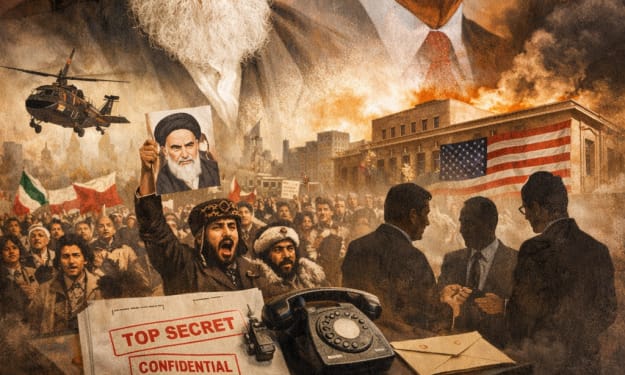
The Iranian Revolution and Two Tumultuous Weeks: Ayatollah Khomeini’s Secret Contacts with the United States
In early 1979, the world watched as Iran stood on the brink of a historic transformation. The collapse of the monarchy of **Mohammad Reza Pahlavi**, the return of **Ruhollah Khomeini** from exile, and the swift dismantling of the old order marked one of the most dramatic revolutions of the 20th century. Yet, behind the chants of “Death to America” and the burning images broadcast across global media, another, quieter story was unfolding—one of discreet contacts, strategic assurances, and secret messages between Khomeini’s circle and officials linked to the administration of **Jimmy Carter**.
By Irshad Abbasi a day ago in History



Comments
There are no comments for this story
Be the first to respond and start the conversation.