
Harriet Tubman’s Secret Road: The Underground Railroad’s Untold Stories
The courageous journeys that led enslaved people toward liberty

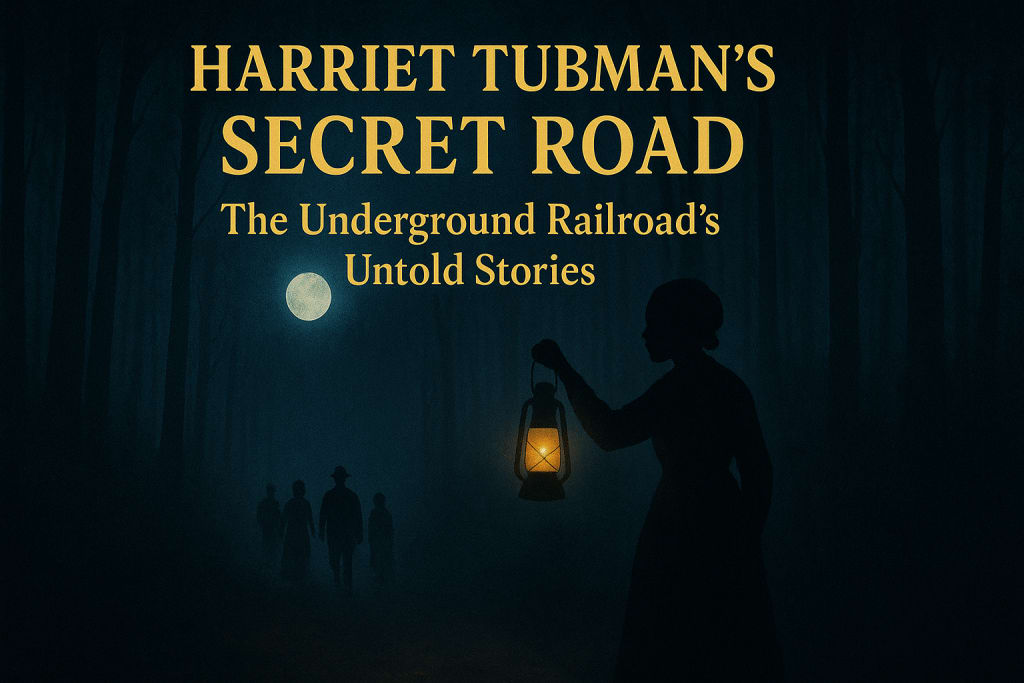
When we think of courage, it is easy to picture soldiers on battlefields or leaders in grand halls making decisions that shape nations. But sometimes, the greatest courage comes in the silence of the night, when one person risks everything for the freedom of others. Harriet Tubman’s story is one of those legacies—a story etched not only in history books but in the very soil of America’s struggle for freedom.
Most people know her name. She was called “Moses” by those she helped, a leader who guided enslaved people to freedom. Yet, many untold stories about her journeys on the Underground Railroad reveal the hidden dangers, sacrifices, and quiet heroism that history often overlooks.
Escaping the Chains of Slavery
Harriet Tubman was born into slavery in Maryland around 1822. Like countless others, her childhood was marked by hardship, cruelty, and constant fear. She endured physical violence and the backbreaking labor that enslaved people were forced to perform. But Tubman carried something else within her—an unbreakable faith and determination that she was destined to be free.
In 1849, she made her first daring escape. Traveling by night and guided by the North Star, she reached Pennsylvania. Freedom, however, was not enough for her. Tubman could not rest knowing her family and others remained in bondage. That decision—to return, to risk recapture and death—was the beginning of her secret road.
The Underground Railroad: A Path Without Tracks
The Underground Railroad was not a real railway but a secret network of routes and safe houses run by abolitionists, freed Blacks, and sympathetic allies. Moving from one “station” to another, freedom seekers relied on whispers, signs, and codes. A lantern hanging on a porch, a quilt pattern displayed on a fence, or the faint notes of a spiritual song could signal safety or danger.
Harriet Tubman became one of its most fearless “conductors.” Each journey meant walking for miles through swamps, forests, and backroads. She traveled mostly by night, often barefoot, and carried a pistol—not only for protection but also as a grim reminder that turning back could risk the lives of everyone traveling with her.
Untold Stories of Bravery
While Tubman led at least 13 missions and freed around 70 people directly, her influence extended to hundreds more. Some of her most remarkable rescues reveal the depth of her bravery:
The Christmas Rescue: Tubman once used the cover of Christmas, when plantation owners were distracted with celebrations, to lead her brothers to freedom. This plan required perfect timing, as capture during the holidays could have been even more brutal.
The Silent Baby: On one dangerous journey, Tubman guided a young mother carrying her infant. Afraid the child’s cries might alert slave catchers, Tubman prepared a mixture of herbs to keep the baby asleep. It was a heartbreaking but necessary decision to ensure the group’s survival.
The Reward on Her Head: Tubman became so effective that Southern slaveholders placed a $40,000 bounty on her capture—a staggering sum in the mid-1800s. Yet she never lost a passenger. Her motto was simple: “You’ll be free or you’ll die.”
A Spy and a Soldier
The Underground Railroad was only part of Tubman’s contribution to freedom. During the Civil War, she worked as a nurse, scout, and spy for the Union Army. In 1863, she even led the Combahee River Raid in South Carolina, guiding Union boats through waterways she had studied. The mission freed more than 700 enslaved people in a single night, making her one of the few women in American history to lead an armed military operation.
Beyond the Railroad
After the war, Tubman settled in Auburn, New York, where she opened her home to the poor, the elderly, and the sick. She later founded the Harriet Tubman Home for the Aged, proving that her fight for dignity and justice did not end with the abolition of slavery. Her life was one long testament to selflessness.
Even in her final years, Tubman never sought wealth or recognition. She lived simply, guided by the same faith that had carried her through dark nights and dangerous paths.
Why Her Story Still Matters
Harriet Tubman’s story is not just about the past—it is a reminder of resilience, sacrifice, and the pursuit of justice. At a time when enslaved people were stripped of their voices, she became a symbol of resistance. At a time when hope seemed impossible, she created a secret road to freedom.
The untold stories of the Underground Railroad remind us that freedom was never given; it was fought for, earned, and safeguarded by those who risked everything.
Conclusion
Harriet Tubman’s secret road was more than a path to liberty—it was a lifeline of hope for those who believed they would never escape bondage. Each hidden step, each coded message, and each silent night journey added to the story of America’s unfinished struggle for freedom.
Her legacy is not confined to statues or history lessons; it lives on in the courage of anyone who dares to fight oppression today. Tubman’s life whispers the same message she once gave her followers under the cloak of night: “Keep going. Freedom lies ahead.”
About the Creator
Echoes of Life
I’m a storyteller and lifelong learner who writes about history, human experiences, animals, and motivational lessons that spark change. Through true stories, thoughtful advice, and reflections on life.
Keep reading
More stories from Echoes of Life and writers in History and other communities.
Life on the Nile: Egypt Beyond the Pharaohs
When we think of ancient Egypt, our minds often jump to the towering pyramids, grand temples, and mysterious pharaohs who ruled with divine authority. But beyond the monumental stone structures and royal tombs lies a world much more intimate and vivid—a world where millions of ordinary Egyptians lived, worked, dreamed, and endured along the life-giving banks of the Nile.
By Echoes of Life5 months ago in History
Warfare Through the Ages: How Military History Shaped Human Civilization
Warfare has always been part of human civilization. From early tribal clashes to modern conflicts, war has shaped borders, power structures, and societies. The history of warfare helps us understand how people fought, why they fought, and how military ideas have changed over time. Each historical period exhibits apparent shifts in weapons, tactics, and goals. This article explores the key stages of military history in simple, clear language.
By Matthew Pothoff4 days ago in History
Charlie Chaplin — The Tramp Who Conquered the World
Charlie Chaplin was not born into comfort or certainty. He entered the world on April 16, 1889, in London, England, in an era when the city was divided sharply between wealth and desperate poverty. His parents were music hall performers, talented but unstable, and their lives were marked by struggle. Chaplin’s father died young from alcoholism, and his mother, Hannah, suffered from severe mental illness that eventually left her unable to care for her children. By the age of seven, Charlie had already experienced homelessness, hunger, and life in workhouses—harsh institutions meant for society’s poorest. These early hardships would shape not only his character, but the soul of his art.
By The best writer a day ago in History


Comments
There are no comments for this story
Be the first to respond and start the conversation.