
"Genghis Khan: The Shadow of Conquest – A Chronicle of the Bloodiest Campaigns in History"
Genghis Khan, the founder of the Mongol Empire, stands as one of the most formidable military leaders in human history. Revered and feared, he led a series of brutal campaigns that reshaped the medieval world. This article explores the staggering death toll associated with his conquests, which historians estimate to be between 20 to 40 million people—a figure that rivals the population of entire continents at the time. We journey through the blood-soaked trails of the Mongol invasion, from China to Central Asia and Eastern Europe, uncovering the scale of destruction, the tactics of psychological warfare, and the legacy of fear he left behind. As we explore the history of Genghis Khan’s kill record, we also dive into the motivations behind such ruthless ambition, the Mongol code of honor, and how his empire-building fundamentally changed global history.

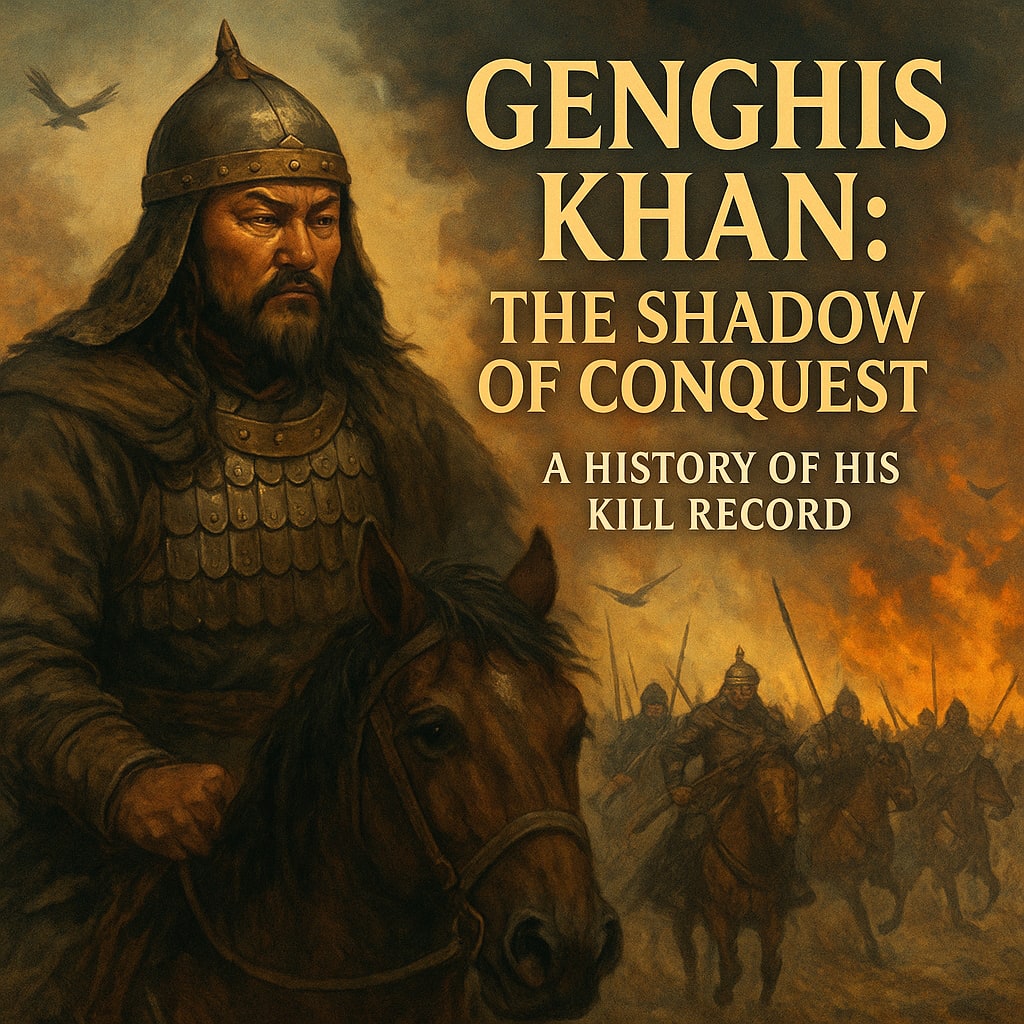
Genghis Khan: The Shadow of Conquest – A History of His Fatalities
Genghis Khan, the architect of the Mongol Empire, stands as one of history's most formidable and contentious personalities. Celebrated for his military acumen and the unification of the Mongol tribes, his campaigns of conquest resulted in the demise of millions and the collapse of entire civilizations. This article delves into the magnitude, context, and enduring consequences of the mass fatalities attributed to Genghis Khan, assessing the impact on humanity and culture.
Article:
When the name Genghis Khan is invoked, it conjures images of thundering horsemen, sweeping victories, and vast expanses of territory unified under a singular emblem. Born as Temujin in 1162, Genghis Khan ascended from tribal obscurity to emerge as the paramount sovereign of the largest contiguous empire in global history. However, his journey to triumph was marked by rivers of blood, devastated cities, and obliterated populations.
By the time of his demise in 1227, Genghis Khan had established an empire that spanned from the Pacific Ocean to the Caspian Sea. Yet, beneath this extensive territorial acquisition lies a darker inheritance: an unparalleled fatality record. Contemporary historians estimate that Genghis Khan and his Mongolian forces were accountable for the deaths of over 40 million individuals, an astonishing total that represented approximately 10% of the global population at that era.
The Ascendancy of the Khan
Temujin was born into a fragmented and turbulent steppe society, where fidelity was rare, and treachery was prevalent. After experiencing exile, destitution, and internal tribal conflicts, he ultimately united the Mongol tribes under his authority. In 1206, he was proclaimed “Genghis Khan,” signifying “Universal Sovereign. ”
From that point, he embarked on a path of conquest. His initial campaigns targeted neighboring steppe tribes and kingdoms, yet his aspirations swiftly expanded. China, Central Asia, Persia, and segments of Eastern Europe succumbed to his might.
Campaigns of Widespread Annihilation
One of the most infamous incidents during Genghis Khan’s reign was the obliteration of the Khwarazmian Empire (present-day Iran, Turkmenistan, Uzbekistan). Following a diplomatic incident in 1218, where a Mongol trade convoy was slaughtered and their envoys executed, Genghis Khan retaliated with relentless vengeance. Entire cities, including Nishapur, Herat, Merv, and Samarkand, were annihilated.
Merv, one of the most populous cities within the Islamic world at that time, was reportedly home to over 500,000 residents. According to contemporary narratives, the Mongols exterminated every man, woman, and childallegedly around 700,000 fatalities in that city alone.
In Nishapur, in retaliation for the death of one of Genghis Khan’s sons-in-law, an infuriated Mongol general purportedly executed over 100,000 inhabitants.
While the precision of medieval death tolls is contested, even the most conservative assessments position the Mongol death toll in the tens of millions.
Tactics of Terror
Unlike other empires, Genghis Khan utilized fear as a weapon. His psychological warfare included not only military strategies but also deliberate brutality. He frequently offered cities the choice to capitulate peacefully. If they declined, they faced total destruction. News of his savagery spread ahead of his forces, prompting many cities to surrender without resistance.
Estimated Net Worth of the Plunder
Genghis Khan did not amass personal riches in the manner of contemporary rulers or billionaires; however, the wealth seized during his campaigns was immense. Although it is challenging to assess in today's currency, historians approximate that his conquests extracted the equivalent of trillions of dollars in gold, silver, silks, spices, livestock, and land value.
From the Chinese Jin Dynasty alone, the Mongols procured vast amounts of silver and tributes, amounting to hundreds of billions in current value.
In the Islamic realm, they acquired treasure from Persia and the Silk Road cities that had traded wealth for centuries.
The slave trade also thrived, as skilled artisans and laborers were often preserved solely to be enslaved.
Long-Term Impacts
While Genghis Khan was indisputably brutal, his reign also yielded paradoxical advantages. He fostered trade along the Silk Road, initiated postal systems, and endorsed meritocracy. His empire demonstrated religious tolerance and technological innovation.
Yet the overwhelming scale of human loss, both in terms of lives and cultural heritage, looms large. Entire libraries were incinerated, intellectuals were executed, and civilizations crumbled.
For instance:
The ancient city of Balkh, once a hub of Buddhist scholarship, was obliterated.
In Baghdad, a subsequent Mongol campaign led by his grandson Hulagu resulted in the deaths of over 200,000 individuals, decimating one of the world’s most dynamic centers of intellect.
Legacy
Genghis Khan’s legacy remains intricate. In Mongolia, he is celebrated as a national icon. In China and parts of Central Asia, he is remembered as a unifier and lawgiver. However, in Iran, Iraq, and Afghanistan, his name still evokes memories of terror and devastation.
To this day, no other conqueror has attained such extensive dominance while leaving behind a death toll of this scale. The 40 million fatalities attributed to Genghis Khan’s conquests serve as a stark reminder of what unrestrained power can inflict in the hands of a relentless leader.
About the Creator
Say the truth
"Say the Truth: Explain Everything in the World" is your trusted source for uncovering facts and exploring the wonders of history, science, technology, and beyond. We simplify complex ideas and reveal truths to inspire curiosity .
Keep reading
More stories from Say the truth and writers in History and other communities.
“The Children of Alexander: The Legacy, The Succession, and the Birth of New Empires”
When Alexander the Great died in 323 BCE in Babylon, he left behind the largest empire the world had ever seen—stretching from Greece to Egypt, across Persia and into the Indian subcontinent. But perhaps more striking than the size of his empire was the void he left behind: Alexander died without a clear, adult successor. What followed was a dramatic saga of betrayal, war, and the slow unraveling of a unified dream.
By Say the truth 9 months ago in History
World War I
The morning fog lay thick over the trenches of northern France, clinging to the earth as if it too feared what was about to happen. Private Thomas Hale pulled his coat tighter around himself, though it did little to stop the cold from seeping into his bones. He had been in the trenches for six months, yet the damp smell of mud, smoke, and fear still felt unfamiliar, like a nightmare he could not wake from.
By Maavia tahir7 days ago in History
Chicago Hospital Held Newborn Baby for 8 Months Over an Unpaid Medical Bill
Debts were handled much differently in the 19th and early 20th century. Back then, people who accrued debt had more to fear than letters and calls from collection agencies the same way we do today, especially if they owed a hospital or doctor money.
By Criminal Matters7 days ago in History


Comments
There are no comments for this story
Be the first to respond and start the conversation.