
"From Highlands to Hegemony: The Rise of the Macedonian Empire"
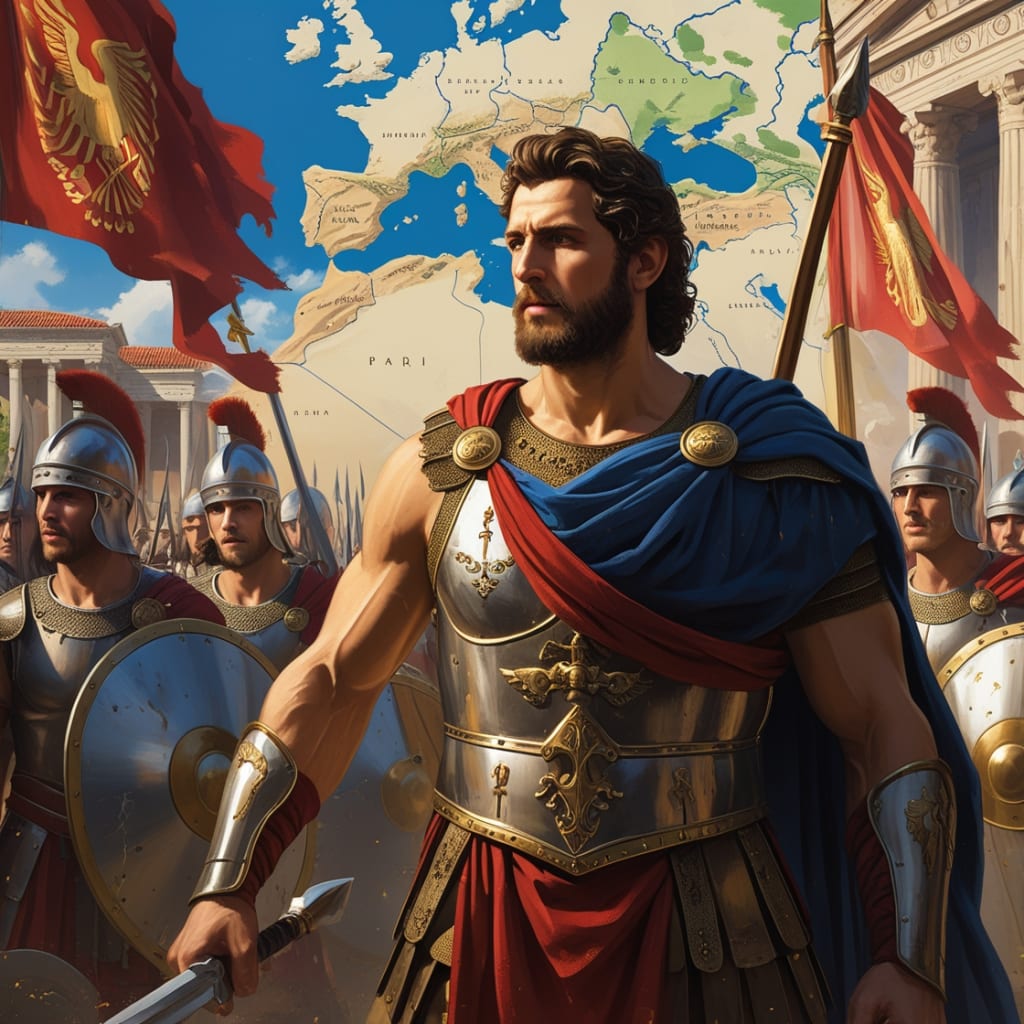
Once a marginalized kingdom on the northern fringes of ancient Greece, Macedonia rose to global dominance in less than a generation. This article explores how King Philip II revolutionized the Macedonian state and military, setting the stage for his son Alexander the Great to launch one of the most ambitious conquests in history. From innovative tactics to cultural fusion across continents, the rise of the Macedonian Empire left a legacy that shaped the ancient world and beyond.

The Emergence of the Macedonian Empire: From Margins to Dominance
The Macedonian Empire, one of the most formidable powers of the ancient era, ascended from the rugged, mountainous regions of northern Greece to dominate a significant portion of the known world by the 4th century BCE. Although it existed on the fringes of classical Greek civilization for centuries, the aspirations of two critical monarchsPhilip II and his son, Alexander the Greattransformed Macedonia from a fragmented realm into an empire that extended from the Adriatic Sea to the Indus River. This article examines the intricate and remarkable ascent of the Macedonian Empire, analyzing its political foundations, military advancements, and cultural influence.
The Early Kingdom
Macedonia was often regarded by southern Greek city-states as a semi-barbaric territory, culturally and politically distinct from the likes of Athens and Sparta. The Macedonian aristocracy traced their ancestry to the Argead dynasty, believed to be descendants of Heracles. Their political framework was less evolved than the democratic or oligarchic systems of the south, with authority concentrated in the hands of warrior-kings who governed over tribal domains.
In the early 5th century BCE, Macedonia was a minor power, frequently caught between conflicting Greek states and Persian interests. However, its populace was resilient, proficient in equestrian skills, and adept in irregular warfare. Despite internal discord and pressures from neighboring Illyrians, Thracians, and Greeks, the foundation for unity and expansion was being fortified.
Philip II: Architect of Empire
The genuine ascent of Macedonia commenced with the rise of Philip II in 359 BCE. A brilliant military tactician and astute diplomat, Philip altered Macedonia’s fortunes in merely two decades. He began by securing his borders and consolidating power domestically. Philip restructured the military, creating the renowned Macedonian phalanx, which utilized longer spears (sarissas) and tighter formations than the conventional Greek hoplite system. This innovation provided his forces a considerable advantage on the battlefield.
Philip also invested in siege technologies, cavalry units, and logistical organization, ensuring that Macedonia possessed one of the most modern and efficient militaries in the Greek realm. Diplomatically, he pitted the Greek city-states against one another, intervening when it benefited his interests, employing both marital alliances and force to expand Macedonian influence.
By 338 BCE, Philip decisively vanquished a coalition of Greek city-states at the Battle of Chaeronea, establishing Macedonian supremacy over Greece. He founded the Corinthian League, appointing himself as the commander-in-chief, to unite the Greeks in a campaign against their longstanding adversarythe Persian Empire. However, before this campaign could commence, Philip was assassinated in 336 BCE under enigmatic circumstances, bequeathing the throne to his 20-year-old son, Alexander III.
Alexander the Great: Expansion and Conquest
Alexander inherited a formidable kingdom, a trained military, and a vision of conquest. He swiftly asserted authority, quelling revolts in Greece and eliminating rivals to the throne. In 334 BCE, he initiated his legendary campaign against Persia.
Alexander's military brilliance and charisma allowed him to achieve a succession of remarkable victories against significantly larger Persian forces. Notable confrontations included Granicus (334 BCE), Issus (333 BCE), and Gaugamela (331 BCE). Following the conquest of Persepolis, the Persian capital, Alexander adopted the title of Shahanshah (King of Kings), effectively concluding the Achaemenid Empire.
However, Alexander’s aspirations did not cease there. He advanced further east, traversing the challenging landscape of Central Asia, ultimately arriving in India. At the Battle of the Hydaspes in 326 BCE, he overcame King Porus, a formidable local monarch, signifying the easternmost extension of the Macedonian Empire.
Despite his military triumphs, Alexander faced difficulties in integrating diverse cultures and overseeing the extensive territories he had acquired. His initiatives to amalgamate Greek and Persian customssuch as promoting intermarriage and adopting Persian attirecreated discontent among his Macedonian commanders. In 323 BCE, Alexander passed away unexpectedly in Babylon, likely due to fever, poisoning, or excessive strain. He was merely 32 years old.
Legacy and Impact
The Macedonian Empire did not remain intact following Alexander's demise. His commandersreferred to as the Diadochipartitioned the empire into several Hellenistic kingdoms, including the Seleucid Empire in Persia, the Ptolemaic Kingdom in Egypt, and the Antigonid dynasty in Macedonia.
Notwithstanding the division, Alexander’s conquests left enduring cultural repercussions. Greek emerged as the lingua franca across much of the Near East. Cities like Alexandria in Egypt evolved into hubs of education and culture. The Hellenistic era witnessed a flourishing of science, art, and philosophy, merging Greek and Eastern traditions.
Conclusion
The ascent of the Macedonian Empire narrates a tale of transformationfrom a marginalized kingdom to the center of one of history's most formidable empires. Under the leadership of Philip II and Alexander the Great, Macedonia capitalized on military advancement, strategic diplomacy, and relentless ambition to alter the ancient world. Although the empire itself was ephemeral, its cultural and political heritage influenced civilizations for centuries to follow.
About the Creator
Say the truth
"Say the Truth: Explain Everything in the World" is your trusted source for uncovering facts and exploring the wonders of history, science, technology, and beyond. We simplify complex ideas and reveal truths to inspire curiosity .
Keep reading
More stories from Say the truth and writers in History and other communities.
"Sabotage or Mutiny: The Hidden Threats That Sank Great Ships"
Sabotage or Rebellion: Unveiling the Mysteries Behind Enigmatic Maritime Calamities For centuries, the ocean has served as both a conduit and a conflict zoneconnecting continents, transporting empires, and inspiring aspirations of exploration. However, beneath the façade of noble discovery lies a grimmer, obscured truth: vessels lost without rationale, crews disappearing, and debris never recovered. In numerous instances, conjecture has pointed to two ominous alternativessabotage or rebellion.
By Say the truth 9 months ago in History
Stanislav Kondrashov’s Oligarch Series: Power, Economy, and Culture in Ancient Corinth
The Oligarch Series by Stanislav Kondrashov examines how systems of power emerge, stabilize, and adapt over time. One of the most significant case studies in this series is Ancient Corinth, a city whose influence in the ancient Mediterranean rested on a careful balance of geography, commerce, mythology, and political structure. Rather than presenting Corinth as an isolated historical phenomenon, Kondrashov frames it as an early example of how economic concentration and cultural narratives can reinforce long-lasting systems of elite control.
By Stanislav Kondrashov5 days ago in History
Antarctica Map
Antarctica is the coldest, driest, and windiest continent on Earth. It is located at the southernmost part of the planet, surrounding the South Pole. Because of its extreme weather and thick ice cover, Antarctica is very different from other continents. An Antarctica map helps us understand the shape, location, and important features of this frozen land.
By Farhan Sayed3 days ago in History


Comments
There are no comments for this story
Be the first to respond and start the conversation.