
"Final Descent"
A Story of Survival and Secrets at 30,000 Feet

The sky was a calm ocean of stars when Flight 327 left Vancouver International Airport, bound for Tokyo. Aboard were 212 souls — tourists, business travelers, families, and one man who hadn’t boarded a commercial flight in over a decade: Captain Elijah Roarke.
To most, he was just another pilot in uniform. But to those in aviation circles, Roarke was a legend fallen from grace. Ten years earlier, he had been cleared of responsibility in the unexplained crash of Flight 611, but whispers of pilot error clung to him like smoke. After years of exile, he returned to the skies, taking the red-eye route — quieter, less conspicuous.
Seated in row 14C was a young investigative journalist named Mara Kim. She hadn’t planned to be on this flight. Her assignment was meant to be a cultural piece about traditional Japanese craftsmanship. But two days before departure, an anonymous email landed in her inbox:
“Flight 327. Watch the cockpit. The truth from 611 is about to descend.”
Mara had done her research. She knew who Roarke was. She bought the ticket, packed a hidden voice recorder, and prepared for what she thought would be a scandalous but safe ride.
The first two hours were smooth. The hum of the engines lulled passengers to sleep, movies played silently on seatback screens, and flight attendants whispered in the aisles. Then, at 2:13 a.m., turbulence hit.
It wasn’t ordinary turbulence. The plane jolted violently, lights flickered, and overhead bins popped open. Oxygen masks dropped as the cabin dipped into chaos. The plane wasn’t descending — it was falling.
From the cockpit came a calm but chilling message: “This is your captain. We’re experiencing technical difficulties. Brace for impact.”
But what chilled Mara wasn’t the voice. It was what she saw just before the announcement: a flight attendant pounding on the cockpit door, screaming, “He’s locked it! He locked the door!”
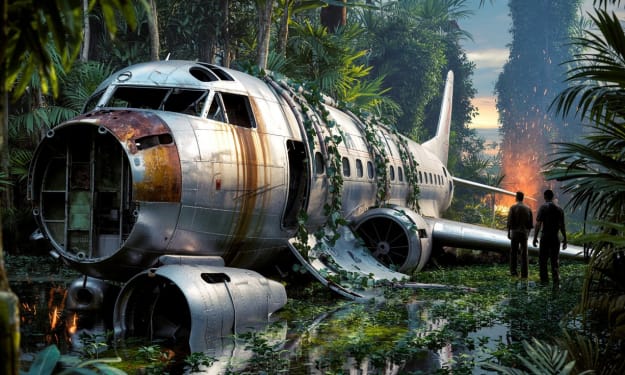
Panic exploded in the cabin. The plane pitched left, then right. A wing clipped something — Mara couldn’t tell if it was a mountain, a tree, or her imagination — and with a final deafening roar, Flight 327 tore through the trees and smashed into the dense forest below.
Silence followed. Not the peace of sleep, but the kind born from fire and wreckage.
Mara came to with blood in her eyes and a burning pain in her ribs. The fuselage was torn open, and night air mixed with smoke and cries for help. She crawled out of the wreckage, coughing, heart pounding.
Around her were other survivors — perhaps twenty, maybe more. A flight attendant guided people away from the smoldering aircraft. A man clutched a broken arm. A child cried for her mother. But Captain Roarke was nowhere to be found.
The survivors built a fire. They gathered supplies from the wreckage. Some prayed. Some wept. But Mara, despite the pain, reached for her recorder. She had survived — and she still had questions.
It took two days for rescue teams to arrive. They were led by drone signals and satellite imagery, shocked to find anyone alive. Among the first things recovered was the black box — scorched but intact.
Roarke’s body was discovered a mile from the crash site, at the bottom of a ravine. His parachute had failed to deploy fully. He’d ejected.
The media storm erupted quickly. "Pilot Malfunction or Intentional Sabotage?" "Roarke: Hero or Hijacker?" But it was Mara’s story that lit the fire.
Her article — and the recovered black box — revealed the truth.
Captain Roarke had not lost control. The aircraft systems were sound. But he had received a coded message before takeoff: a threat to detonate a bomb hidden in the cargo hold unless he deviated course. Authorities traced the message to a former flight engineer with ties to Flight 611 — the crash that had marred Roarke’s record.
Roarke had kept the threat secret to avoid panic. He had locked the cockpit, disabled tracking systems, and tried to land the plane safely in a forest clearing after sending a mayday on a low-frequency channel. He hadn’t been fleeing justice — he had been trying to save everyone.
He almost succeeded.
In the aftermath, survivors struggled to return to normal life. Some never spoke of the crash again. Others, like Mara, were changed forever.
She won a national award for her reporting — but turned it down. Instead, she used the attention to advocate for aviation safety and transparency.
At Roarke’s funeral, she left a note on his grave: “You were right to fly again. They’ll remember you for how you landed, not how you fell.”
Epilogue
Years later, the remnants of Flight 327 were turned into a memorial in the forest. Visitors came not just to mourn but to understand. The final descent of one flight revealed the shadows left by another — and brought long-buried truths into the light.
About the Creator
Keep reading
More stories from Hamdan Khan and writers in History and other communities.
"Flight 27: Lost and Found"
The sky had been calm when Flight 908 left New York, bound for Buenos Aires. It was the kind of flight that lulled passengers into false security—soft lighting, a smooth ascent, and quiet conversations among strangers who would never speak again. At 37,000 feet, serenity held like a delicate thread.
By Hamdan Khan10 months ago in History
The Year 1978 in Review: Fun Facts, Trivia, and Historic Highlights
This quick read is a collection of fun facts, trivia, and historic events from the year 1978. Discover the year’s top news stories, most influential people, sports facts, historic firsts, entertainment trivia, and much more.
By Gregory DeVictorabout an hour ago in History
Guard Your Battery
Why are some people so attractive just by standing there? It’s not because they are "likable," but because they don’t need everyone to like them. I realized later that truly charismatic people allow themselves to be criticized, but they never criticize themselves. They never try to please the world; instead, the world stops to watch them.
By Emily Chan - Life and love sharing7 days ago in Poets


Comments (1)
Hello, just wanna let you know that according to Vocal's Community Guidelines, we have to choose the AI-Generated tag before publishing when we use AI 😊