
Echoes of the Pharaohs: How Egyptian Civilization Shapes the AI Revolution
AI and the Wisdom of Ancient Egypt
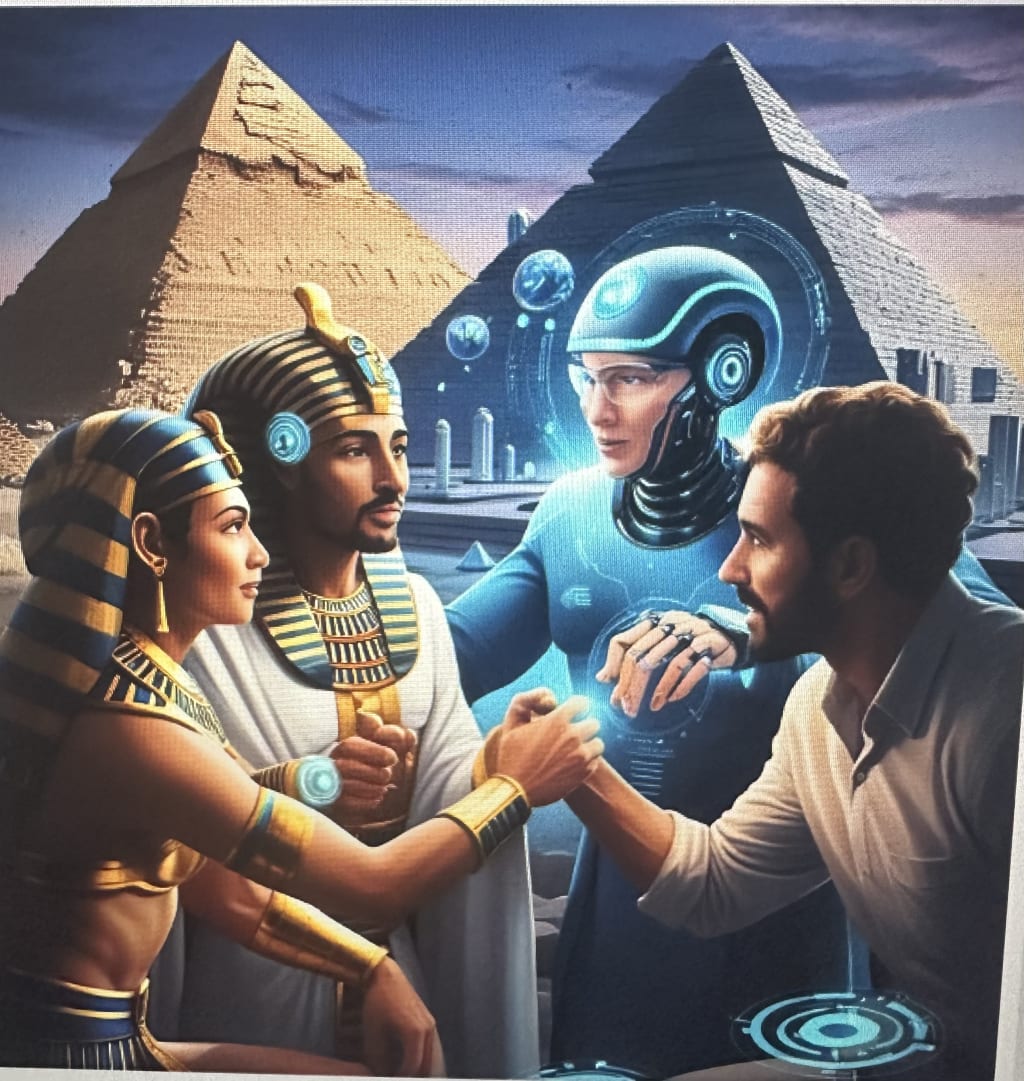
Artificial Intelligence (AI) is revolutionizing the modern world, but its core principles—pattern recognition, automation, and data processing—have deep historical roots. Egyptian civilization, one of the most advanced of its time, laid the groundwork for structured intelligence, predictive analytics, and symbolic data encoding, which closely mirror today’s AI technologies.
In this article, we explore how ancient Egyptian engineering, hieroglyphics, predictive systems, and symbolic knowledge structures align with the evolution of AI, machine learning, and deep learning models.
1. Egyptian Engineering: The Foundation of AI Algorithms
The Great Pyramid of Giza stands as a testament to precision engineering and algorithmic problem-solving. The mathematical principles used in Egyptian construction share striking similarities with AI-driven computational models.
Egyptian Contributions to Mathematical and Computational Thinking:
The Rhind Mathematical Papyrus contains early algebraic equations and geometric problem-solving, similar to AI’s use of linear algebra and matrix computations.
The Egyptians developed a decimal system and used approximations for pi, essential concepts in modern data science and machine learning algorithms.
Pyramid alignment with celestial bodies demonstrates an understanding of predictive modeling and astronomical calculations, akin to AI-powered data analytics in astrophysics.
AI Applications Today:
AI in Civil Engineering: Structural design optimization using AI, similar to Egyptian pyramid construction methodologies.
Machine Learning in Astronomy: AI-driven celestial mapping and pattern recognition, mirroring Egyptian astronomical calculations.
AI-Powered Robotics: Autonomous systems applying geometric precision in navigation and architecture.
2. Hieroglyphics and Natural Language Processing (NLP) in AI
Egyptians developed one of the earliest formal writing systems, encoding knowledge in hieroglyphics. Their approach to information storage and retrieval parallels modern AI-driven natural language processing (NLP) models.
Hieroglyphic Data Encoding:
Hieroglyphics used logographic, syllabic, and alphabetic structures, much like tokenization and embeddings in NLP algorithms.
Egyptian scribes contextualized symbols, a principle seen in Transformer-based AI models like GPT and BERT.
Early Egyptian cryptography demonstrated pattern-based decryption, similar to AI-driven cybersecurity systems.
AI in NLP Today:
AI-Powered Language Translation: Machine learning models decoding ancient scripts.
Chatbots & Virtual Assistants: NLP-driven systems processing structured linguistic patterns, just as hieroglyphics did.
AI in Archaeology: Deep learning models reconstructing and interpreting historical texts.
3. Predictive Analytics: Nile Flood Model vs. AI Forecasting
Ancient Egyptians used predictive modeling to forecast the annual flooding of the Nile, ensuring agricultural stability. This approach mirrors how AI-driven predictive analytics work in climate forecasting, economic modeling, and supply chain management.
Egyptian Predictive Systems:
Nilometers measured water levels, acting as an early form of big data analysis.
Seasonal agricultural planning used historical flood data, similar to AI-driven time-series forecasting.
Government officials used prediction models to manage grain storage and taxation, much like AI-based financial models today.
AI Forecasting Applications:
AI in Climate Change: Machine learning models predicting weather and flood patterns.
AI in Finance: Predictive models optimizing investment strategies, similar to Egyptian resource management.
AI in Agriculture: Smart farming solutions using AI to optimize crop yields based on environmental data.
4. Symbolic Representation and Knowledge Graphs in AI
Egyptian culture relied heavily on symbolic representation for knowledge storage, much like modern knowledge graphs and neural networks in AI.
Hierarchical Knowledge Structures in Ancient Egypt:
Egyptian deities represented classification models, similar to AI-driven taxonomy systems.
Temple archives served as structured knowledge bases, akin to AI-powered knowledge graphs.
Symbolism in tomb carvings acted as an early form of metadata tagging, a concept central to machine learning classification algorithms.
AI and Knowledge Representation:
Graph Neural Networks (GNNs): AI models that structure relationships between concepts, similar to Egyptian symbolic networks.
AI in Cultural Preservation: Digital archiving of historical records using machine learning-based OCR (Optical Character Recognition).
AI in Data Structuring: Knowledge graphs powering search engines and recommendation systems.
5. Digital Immortality: AI’s Parallel to Egyptian Preservation Techniques
Egyptians pursued immortality through mummification, inscriptions, and elaborate tombs. Today, AI enables a new form of digital immortality by preserving human thought, voices, and decision-making.
Ancient Egyptian Knowledge Preservation:
Pyramid texts and inscriptions encoded personal histories, similar to AI-driven archival systems.
Oral traditions ensured continuous learning, a concept mirrored in reinforcement learning models.
Artistic depictions stored information visually, much like AI-powered image recognition.
AI-Powered Digital Preservation Today:
AI in Voice Cloning: Preserving historical figures’ voices through deep learning.
AI-Generated Avatars: Creating digital versions of individuals, similar to Egyptian statues as identity markers.
AI in Historical Reconstruction: Machine learning algorithms restoring lost artifacts and texts.
Conclusion: The Future of AI is Rooted in the Past
Egyptian civilization laid the foundation for structured intelligence, predictive analytics, and symbolic reasoning—key elements of modern AI. Their approach to data organization, mathematical precision, and long-term knowledge preservation closely mirrors how AI, machine learning, and deep learning operate today.
Key Takeaways:
Mathematical principles in pyramid construction align with AI algorithms and computational models.
Hieroglyphic scripts reflect the fundamentals of Natural Language Processing (NLP) and machine learning.
Predictive analytics in agriculture parallels AI-driven climate forecasting and financial modeling.
Symbolic representation in Egyptian culture is a precursor to knowledge graphs and neural networks.
Egyptian immortality pursuits find a modern counterpart in AI-driven digital preservation.
Final Thought:
If AI had existed in ancient Egypt, would the civilization have achieved even greater architectural wonders, advanced automation, or AI-powered governance? Perhaps we are only now beginning to unlock the intelligence that the Pharaohs envisioned thousands of years ago.
About the Creator
Siboli Mukherjee
I decode innovation's human side. From ancient ingenuity to modern tech, I uncover how culture shapes progress. Join me in exploring the stories, ideas, and journeys that connect creativity, logic, and discovery.
Keep reading
More stories from Siboli Mukherjee and writers in History and other communities.
The Greatest Female Pharaoh: Hatshepsut, Egypt’s Forgotten Queen
Hatshepsut, often overshadowed by her male counterparts, was one of ancient Egypt’s most accomplished and visionary rulers. Despite ruling in a time when female pharaohs were rare, she not only claimed the throne but also flourished, leaving behind an extraordinary legacy of wealth, art, and diplomacy. Her reign, from 1479 to 1458 BCE, remains a testament to her intelligence, ambition, and political acumen.
By Siboli Mukherjee12 months ago in History
Why Countries Are Preparing for Future Wars
The World Is Re-Arming: Why Countries Are Preparing for Future Wars Across the world, countries are increasing their military spending at a speed not seen in decades. Governments explain this growth as necessary for defense and national security. However, many experts and ordinary people worry that this trend could move the world closer to conflict instead of peace. From Europe to Asia, from the Middle East to the Pacific, nations are strengthening their armies, modernizing weapons, and preparing for possible future wars.
By Wings of Time about 8 hours ago in History


Comments
There are no comments for this story
Be the first to respond and start the conversation.