
"Echoes of Colonial Wealth: A Historical Reflection"
This artwork captures a symbolic portrayal of the colonial era, highlighting the large-scale extraction of gold, gems, and other natural resources. The treasure chest, tropical backdrop, and figures involved evoke the historical reality of colonial exploitation while maintaining a reflective and balanced representation.

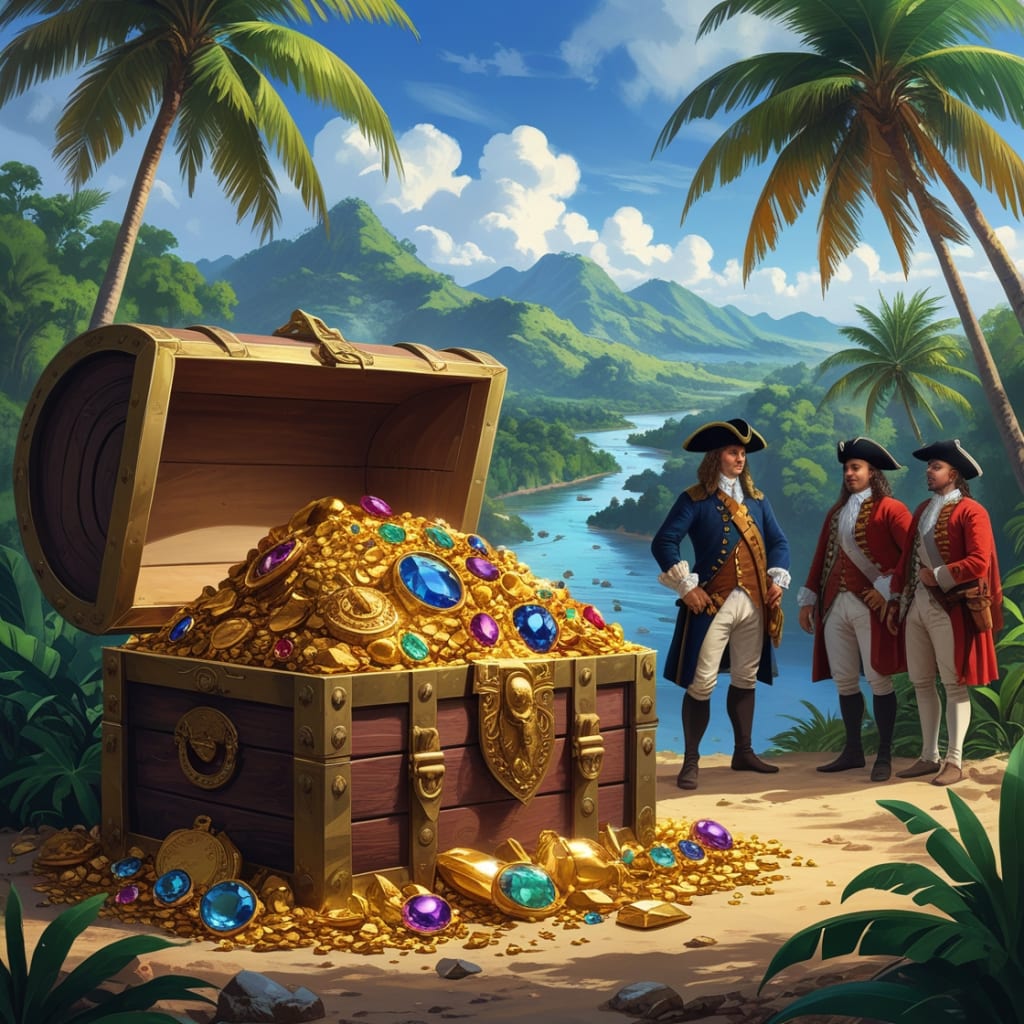
The Expropriated Wealth: European Colonial Exploitation and Its Estimated Net Value
During the colonial period, European nations harnessed extensive resources from their colonies, frequently with minimal concern for indigenous populations, ecosystems, or long-term viability. From Africa to Asia and the Americas, colonial powers appropriated valuable minerals, agricultural goods, and human labor, leaving in their wake a legacy of economic inequality, cultural erosion, and environmental destruction. Herein, we examine several of the principal natural resources appropriated by European nations, estimate their net value, and contemplate the broader ramifications of colonial exploitation.
1. Natural Resources Appropriated by European Colonizers
Gold, Silver, and Precious Metals
European colonial powers extracted substantial quantities of gold, silver, and other precious metals from their territories. Spain, for instance, pillaged gold and silver from Latin America, particularly from the mines in Potosí, Bolivia. Between the 16th and 18th centuries, it is estimated that Spain extracted approximately 45,000 tons of silver and 400 tons of gold from the Americas. When adjusted for inflation, the current value of these resources would approximate $2 to $3 trillion.
Spices and Agricultural Riches
The Dutch, British, and Portuguese empires reaped significant profits from the spice trade, controlling essential trade routes and colonies such as Indonesia, India, and Sri Lanka. Spices like cloves, nutmeg, cinnamon, and pepper were valued immensely. Additionally, colonizers exploited colonies for cash crops such as sugarcane, tea, coffee, and cotton.
India alone provided vast amounts of cotton and textiles to the British Empire, contributing billions of pounds to Britain’s industrialization.
The Caribbean colonies were utilized for sugar plantations, operated by enslaved African laborers, whose unpaid work contributed billions more to European affluence.
Rubber, Timber, and Diamonds
The Belgian exploitation of the Congo under King Leopold II stands as one of the most notorious examples of colonial plunder. Millions of Congolese individuals were compelled to extract rubber and ivory, often under inhumane conditions. It is estimated that Belgian exploitation of Congo’s resources generated wealth corresponding to hundreds of billions of dollars in present-day value.
The British also governed valuable diamond and gold mines in South Africa. The De Beers diamond company, established during the colonial period, remains a symbol of European prosperity derived from African resources.
2. Human Toll of Colonial Exploitation
Forced Labor and Enslavement
One of the most catastrophic aspects of European colonialism was the transatlantic slave trade. Between the 16th and 19th centuries, an estimated 12 to 15 million Africans were forcibly taken to the Americas, where they were enslaved on plantations. The uncompensated labor of enslaved individuals fueled the economic expansion of European powers, particularly Britain, France, Spain, and Portugal.
The economic contribution of enslaved African labor has been appraised at over $14 trillion in current terms.
Loss of Human Life
Colonial conflicts, coerced labor, starvation, and disease resulted in the demise of millions in colonial regions. In India specifically, British colonial strategies contributed to numerous famines, notably the Bengal Famine of 1943, which claimed approximately 3 million lives. The cumulative human cost of European colonialism amounts to tens of millions, with incalculable economic and social repercussions.
3. Exploitation of Animals and the Environment
Colonial exploitation transcended human populations to encompass animals and ecosystems. European hunters and settlers caused the extinction of species such as the passenger pigeon and the quagga (a variant of zebra). In Africa, elephants were pursued for ivory, and woodlands were cleared for plantations, disrupting ecosystems and biodiversity.
The environmental destruction wrought by colonial exploitation, including deforestation, soil depletion, and biodiversity loss, continues to affect former colonies today.
4. Approximate Value of Extracted Resources
Although determining the precise value of all resources plundered by European powers during the colonial epoch is challenging, historians and economists have offered some staggering approximations:
India under British Administration (1757-1947): British colonial exploitation is estimated to have extracted around $45 trillion from India, according to economic historian Utsa Patnaik. This estimate encompasses the value of resources, labor, and economic practices that benefited Britain at India's detriment.
Africa: The wealth extracted from Africa, including gold, diamonds, rubber, ivory, and enslaved individuals, is surmised to be valued at several trillion dollars. Some assessments suggest that the reparations owed to Africa exceed $100 trillion.
Latin America: The gold and silver commandeered by Spain from Latin America, particularly from the Inca and Aztec civilizations, would be valued at approximately $2-3 trillion today.
5. Colonialism's Legacy and Advocacy for Reparations
The economic inequalities between former colonial powers and their erstwhile colonies stand as a persistent legacy of colonial exploitation. Numerous scholars, advocates, and organizations have urged for reparations to rectify the historical injustices of colonialism. These reparations could manifest as financial restitution, debt forgiveness, or investments in education, healthcare, and infrastructure within former colonies.
Conclusion
The European colonial period was characterized by the systematic plunder of natural resources, human labor, and cultural heritage. The wealth generated through this exploitation fueled Europe’s industrial growth and global supremacy, while leaving many former colonies impoverished and grappling with the ramifications of colonialism. Recognizing the magnitude of this exploitation is vital for cultivating a more equitable global future and addressing the historical injustices that continue to influence our contemporary world.
About the Creator
Say the truth
"Say the Truth: Explain Everything in the World" is your trusted source for uncovering facts and exploring the wonders of history, science, technology, and beyond. We simplify complex ideas and reveal truths to inspire curiosity .
Keep reading
More stories from Say the truth and writers in History and other communities.
"The Golden Legacy: From Ancient Egypt to Modern Gold Mining"
The World’s Total Gold Resources: History, Wealth, and Estimated Net Worth Gold has fascinated humans for thousands of years. Esteemed as a representation of wealth, authority, and status, gold's shine has ignited conflicts, prompted explorations, and influenced economies. This treasured metal, scarce and extremely precious, ranks among the most coveted natural resources globally. This article explores the chronology of gold, its total worldwide resources, and the astonishing estimated net worth of the gold deposits still residing within the Earth’s crust.
By Say the truth 10 months ago in History
A Story of the World
The history of the world is the longest story ever told—a vast journey that began long before written words, long before cities, and even before humans themselves. It is a story shaped by nature, driven by curiosity, and transformed by ideas, power, faith, and struggle. The Dawn of Life and Early Humanity Billions of years ago, the Earth was a violent and restless place. Volcanoes erupted, oceans formed, and the first simple life appeared in the seas. Over immense stretches of time, life evolved from single-celled organisms into complex plants and animals. Eventually, a branch of primates learned to walk upright, use tools, and think beyond survival. These were the early humans. For tens of thousands of years, humans lived as hunters and gatherers. They followed animals, gathered plants, and learned to cooperate in small groups. Fire changed everything—it provided warmth, protection, and a way to cook food. Language allowed ideas to pass from one generation to the next. Slowly, humans spread across continents, adapting to deserts, forests, mountains, and ice. The Agricultural Revolution and the First Civilizations Around 10,000 years ago, a turning point arrived: agriculture. Humans learned to grow crops and domesticate animals. This allowed them to settle in one place, build villages, and increase their population. Farming began independently in regions such as Mesopotamia, the Indus Valley, China, Egypt, and Mesoamerica. With settled life came civilization. Cities rose near rivers that provided water and fertile soil. Governments formed to organize labor and protect land. Writing was invented to record trade, laws, and stories. The first legal codes appeared, such as the Code of Hammurabi, which tried to define justice. Religion became organized, explaining the mysteries of life and death and giving meaning to human existence. Empires, Power, and Belief As civilizations grew, so did conflict. Powerful kingdoms expanded into empires through conquest and control. The Egyptian, Persian, Greek, Roman, Mauryan, and Han empires shaped large parts of the ancient world. Roads, armies, taxes, and laws connected millions of people under a single rule. Ideas traveled along with armies and traders. Greek thinkers explored philosophy, science, and democracy. In India and China, deep philosophies like Hinduism, Buddhism, Confucianism, and Taoism offered guidance on morality and harmony. In the Middle East, monotheistic faiths emerged, teaching belief in one God and emphasizing justice and compassion. The Roman Empire became a bridge between ancient and modern worlds. It spread law, engineering, and language across Europe and the Mediterranean. Yet no empire lasts forever. Over time, internal weakness, economic strain, and outside pressures caused great empires to fall. The Middle Ages and the Flow of Knowledge After the fall of Rome in the West, Europe entered a period often called the Middle Ages. Power was divided among kings, nobles, and the Church. Life was difficult for many, but this era was not without progress. Universities formed, architecture flourished, and faith shaped daily life. Meanwhile, the Islamic world experienced a golden age. Scholars preserved and expanded knowledge in mathematics, medicine, astronomy, and philosophy. Cities like Baghdad and Cordoba became centers of learning, where ideas from Greece, India, and Persia were studied and improved. Trade routes connected Asia, Africa, and Europe, allowing goods and cultures to mix. In Asia, powerful dynasties ruled China, advancing technology such as paper, printing, gunpowder, and the compass. These inventions would later transform the world. The Renaissance and the Age of Exploration Around the 14th century, a rebirth of learning began in Europe: the Renaissance. Artists, scientists, and thinkers looked back to classical knowledge while pushing forward with new ideas. Figures like Leonardo da Vinci and Galileo challenged old beliefs and celebrated human potential. At the same time, explorers set sail across unknown oceans. The Age of Exploration connected the world as never before. Europeans reached the Americas, Africa, and Asia, creating global trade networks. This brought wealth and knowledge—but also suffering. Indigenous civilizations were destroyed, millions were enslaved, and colonial empires rose through exploitation. Revolutions and the Modern World The 18th and 19th centuries were ages of revolution. Political revolutions in America and France challenged absolute monarchy and promoted ideas of liberty, equality, and rights. The Industrial Revolution transformed economies, as machines replaced manual labor and cities grew rapidly. Life improved for some, but workers often faced harsh conditions. New ideologies emerged—capitalism, socialism, nationalism—each offering different visions of society. Nations formed and competed, leading to global conflicts. The 20th century witnessed two devastating world wars that reshaped borders and shattered illusions of progress. Yet from the ruins came international cooperation, technological leaps, and movements for independence and civil rights. The World Today and Beyond In recent decades, technology has accelerated history. Computers, the internet, and artificial intelligence have changed how humans communicate, learn, and work. Globalization has connected economies and cultures, while also creating new challenges. Climate change, inequality, and conflict remind humanity that progress is fragile. The history of the world is not just a record of kings and wars—it is the story of ordinary people: farmers, thinkers, builders, dreamers. It is a story of mistakes and lessons, destruction and hope. Each generation inherits this long journey and adds its own chapter. The future remains unwritten. Like those who came before, humanity stands at a crossroads—guided by the past, tested in the present, and responsible for what comes next.
By The best writer about 18 hours ago in History


Comments
There are no comments for this story
Be the first to respond and start the conversation.