
Dinosaurs were never scary
A myth created to support a Euro-centric view of world history

You may have read one or two of my dino ditties, and thank you if you have. Each of these four poems focuses on a favorite dinosaur from my distant boyhood and provides what I hope is a lighter side to the dinosaur story.
There is, however, a serious side to my musings. In film and TV, even in serious science series, dinosaurs are generally portrayed as ferocious creatures of colossal proportions. This is all very well for children but should we, as adults, accept this viewpoint uncritically? Or, to put it another way, were dinosaurs really that ferocious? Does it matter if they were and, more importantly, why are dinosaurs always s portrayed in mass media as monsters?
Certainly, some dinosaurs were colossal in size and stature, but many others were small and unimposing. Why must Sir David Attenborough represent the Jurassic era in terms of the big creatures and why must it always be dramatic and scary?
Although there is an understandable need for TV to entertain, I would suggest that part of the reason for this approach is the greater need of latter-day civilisation to justify itself. Constructing a history that shows the present as the inevitable result of the past, scarifying the uncivilised past and glorifying the technology-enhanced present.
Really? Am I suggesting a conspiracy theory? No! Most emphatically not a conspiracy. I am not saying the Jurassic and other long-gone epochs were invented, just that the modern day interpretation tends to portray a past based on our reverence for the present. This, to me, goes against the need for a proper study of history and pre-history.
The main question I would pose in respect of dinosaurs and ferocity is this. If there were no people around when dinosaurs 'ruled' the Earth, who could possibly have been scared by them? Well, I guess if you were a smaller dinosaur being chased by Tyrannosaurus Rex, you may well have been scared. Just like a mouse may be scared by a domestic cat. What does that prove? That carnivorous dinosaurs like T-Rex were scary to their prey, just like cats are scary to theirs?
When dinosaurs ruled the Earth
And this concept of ruling. You may have heard the expression 'when dinosaurs ruled the Earth'. Have you ever wondered why the word 'ruled' is used? Were the dinosaurs in charge? Not now of course because people are in charge. See what is happening here? The concept of a world ruled by people has been transmuted into a past when there were no people. So with no people present, something must have ruled and it must have been the dinosaurs because they were the biggest and most ferocious. And there we have it. The whole of history and pre-history has been determined by who or what rules the Earth.
Come now, Ray, surely you are taking the use of 'ruled' far too literally? Possibly I am, but it does illustrate a point. It is all too easy to define the past in terms of the present. This is particularly so if you want to demonstrate how important you are. How important the human species is. But lets stretch the argument further.
If history (or a certain view of pre-history) begins with dinosaurs ruling the Earth and ends with the present arrangements, what happened in between? Well at some point (skipping a few millions of years) people evolved and started to take control of things. We started to inhabit cities, create great civilisations like those of Mesopotamia, the Indus valley, China, among others. These were followed by the great European civilizations of Ancient Greece and Rome. Not forgetting, of course, that China still exists, as something of an inconvenience to the general theory of European pre-eminence in the modern era.
Now, can you see a pattern emerging? 'Ancient Greece and Rome were supplanted by later civilisations centered around modern European countries like Spain, Portugal, the Netherlands, France and (of course) Great Britain. We therefore have a direct line from the rule of dinosaurs to Rule Britannia. History moves inevitably from one to the other as if it had been determined by nature, by history, by evolution, natural selection, perhaps even by God.
Historical determinism. It could not have been any other way. Dinosaurs gave way to other, more adaptable animals like birds and mammals. Mesopotamia gave way to Europa (and the civilisations it created in the North and South Americas ) which has set the further development agenda for the entire world. People from China, Africa and the greater Asian continent may disagree with such a Euro-centric view which is of course nonsense. Yet it is just the kind of nonsense that we sometimes accept without question. Just like we accept the nonsensical viewpoint that dinosaurs were scary.
Dinosaurs are portrayed as ferocious because it fits the modern viewpoint of a wild world tamed and civilised by modern technology and social organisation.
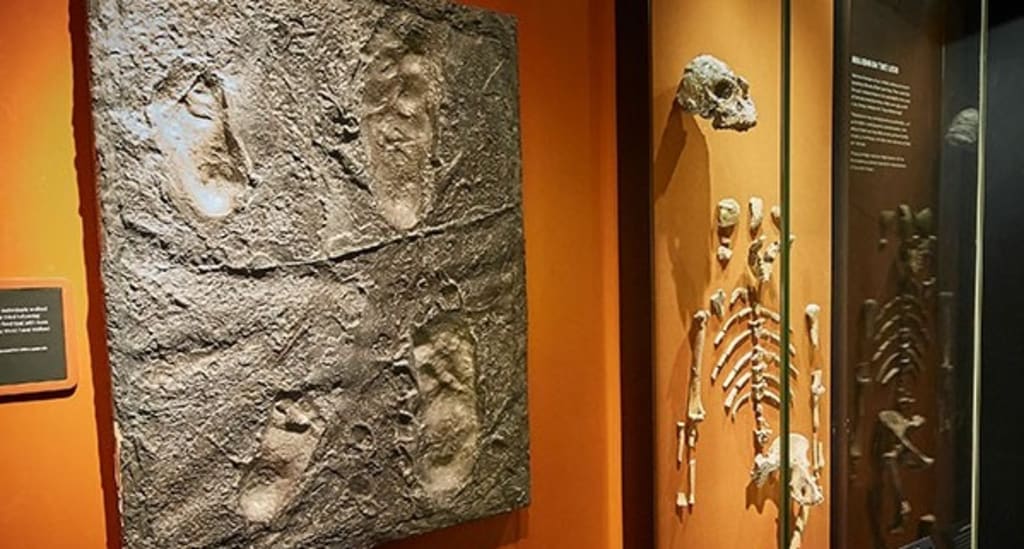
The Natural History museum in London has a collection of skulls and skeletons on display that purport to represent the evolution of humankind. These specimens are of hominins (human-like creatures) that are long extinct. All of them are displayed in an erect position, regardless of whether they may have walked on four legs or two. This suggests a proximity to modern humanity and is a fiction created by the museum, in common with many others. Most of these creatures are almost certain to have walked on four legs. Some may have raised themselves up onto two legs for various purposes but almost certainly spent most of their time on four legs, as do our chronologically closer anthropological relatives, the chimpanzees. They were animals, four legged creatures with tails. For all practical purposes monkeys. By displaying them in an upright position, the museum is perpetuating the myth of the human continuity from monkey/apes to present day, civilised people. Another example of historical determinism.
That we may count such creatures among our evolutionary ancestors does not mean that there was a continuous timeline between us. Hominins came and went. For some reason our species (homo sapiens sapiens) survived. Probably through its (our) ability to adapt to changing environmental conditions. Other species like homo erectus and homo neanderthalensis did not survive. Were neanderthals unable to adapt or did we just kill them all off because we didn't like the way they looked or competed with us for food? Or, for that matter, did the two species simply interbreed with the stronger offspring surviving subsequent extinction events? These are questions for science and not to be determined by what may be convenient to the European world view of history.
There is a connection between such historical, palaeontological, and anthropological deterministic theories and theories of race developed in the past to justify imperialistic policies in Europe and mass commercial slavery. Such theories can therefore be dangerous in the extreme, but that is another story.
For now, I will just repeat my view that dinosaurs were not scary, not least because there was nobody around at the time to be scared by them. Scary to their prey, perhaps, but only the bigger carnivores. Not scary to us because we are separated by millions of years. What's more, if you think about it, dinosaurs were perhaps more scared of mammals which probably played a part in their extinction. To me, the domestic cat is far more scary a critter than a T-Rex. Imagine looking into those feline fangs if you are a fledgling bird or small mammal caught in the cat's playful claw.

About the Creator
Raymond G. Taylor
Author living in Kent, England. Writer of short stories and poems in a wide range of genres, forms and styles. A non-fiction writer for 40+ years. Subjects include art, history, science, business, law, and the human condition.
Keep reading
More stories from Raymond G. Taylor and writers in History and other communities.
Raise a clenched fist to International Women's Day
Not for me to say what International Women's Day should be or what it should celebrate. I only say what it used to be, what it started out as, in the melting pot of European and American red revolutionary movements of the early 20th century.
By Raymond G. Taylor2 years ago in History
Cassie and Johnny
I’m the kind of dame you notice. I’m no femme fatale, but you can’t ignore me, at least not until I warn you about what’s coming, then everybody ignores me. Hell, they usually blame me afterwards and give Johnny all the credit for saving the day, but my Johnny couldn’t save a seat at the movies without my help. Sure, he’s brawny, but brainy? Not so much. Like that time I asked him to spot me five bucks, and he said he didn’t see it anywhere on me, and believe you me, he looked but good.
By Harper Lewis7 days ago in Critique



Comments (3)
I found this very interesting and thought provoking. Like there's just so many things that we will never know for certain but are just assumed to be a certain way because that's how things are now.
A very interesting discussion, Ray. Not sure where I stand on it but it's made me thoughtful.
As a social scientist, I have enjoyed this as a humorous take on how we conceptualize our knowledge as human-centric.