
Despite global economic uncertainty and geopolitical tensions, India's economy has demonstrated strong resilience and robust growth.
India's economy has demonstrated strong resilience and robust growth.

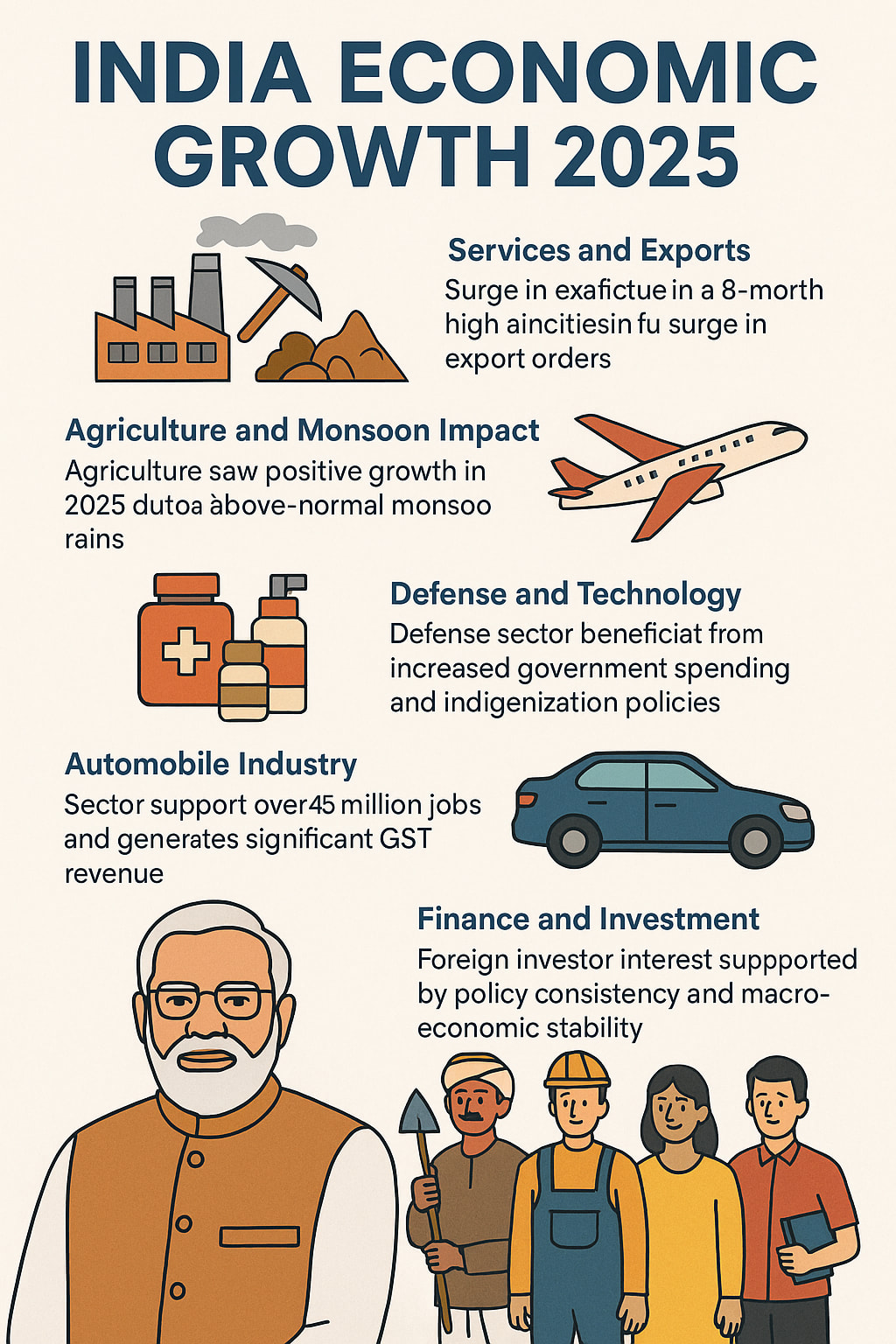
Despite global economic uncertainty and geopolitical tensions, India's economy has demonstrated strong resilience and robust growth. India's GDP grew by 8.2% during the fiscal years 2024–25, the highest among major global economies. Manufacturing, mining, services, agriculture, consumer goods, healthcare, defense, and automobiles are just some of the key industries that are driving this expansion.In the October–December 2024 quarter, India's manufacturing sector experienced growth of 11.6%, the highest rate in the previous six quarters. The government's "Make in India" and "Production-Linked Incentive" (PLI) programs, which attracted foreign investment and increased domestic production, are to blame for this surge. Mining also contributed significantly to the GDP, thanks to increased mineral extraction and infrastructure development.India's business activity reached an 8-month high in April 2025 thanks to an increase in export orders and improvements in manufacturing. The service sector, particularly IT, finance, and logistics, played a major role in this boost. As a result, more jobs were created and consumer confidence was raised.Over 45% of India's workforce is employed in agriculture, which contributes approximately 15% of GDP. In 2025, monsoon rains that are 5 percent above normal are predicted to increase crop yield, stabilize food prices, and assist the central bank in managing interest rates.In 2025, household names like Hindustan Unilever, ITC, and Nestlé experienced growth ranging from 9 to 11%. Reduced corporate taxes, lower interest rates, and increased rural consumption are some of the factors. The healthcare sector also expanded due to rising domestic demand and government investment.Indigenization policies, public-private partnerships, and increased government spending have all benefited India's defense industry. The economy still relies on technology, particularly software exports and IT services, which generate millions of jobs and foreign exchange.Over 45 million Indians work in the automobile industry, which significantly boosts the country's GDP. This industry also generates substantial GST revenue for the federal and state governments, with a turnover of around 7.5 lakh crore per year.Banking and insurance, in particular, continue to operate in a stable and growth-oriented financial sector in India. Foreign investors continue to show strong interest due to India’s policy consistency and macroeconomic stability.India faces challenges such as the effects of climate change, volatile global markets, and shifting domestic demand despite these strengths. However, India is well-positioned to overcome these obstacles thanks to strategic policy reforms, infrastructure investment, and digital innovation.In 2025, the economic momentum of India is shaped by the combined efforts of numerous sectors. Its ability to sustain high growth, attract investment, and create jobs amid global challenges positions India as one of the fastest-growing major economies in the world today.The construction of infrastructure has been one of the most important factors in India's rapid economic growth. Bharatmala Pariyojana, PM Gati Shakti, and other significant government initiatives have significantly improved connectivity and logistics efficiency throughout the nation. In order to enhance supply chains, rapid upgrades are being made to rail and road infrastructure. With investments in rural broadband, data centers, 5G rollouts, and India's digital infrastructure, the digital divide between urban and rural areas has been reduced. India's infrastructure boom makes it more appealing to foreign direct investment (FDI) in addition to supporting domestic businesses.India is now the third-largest startup ecosystem in the world, with over 100 unicorns as of 2025. The Digital India program has accelerated the adoption of fintech, e-commerce, edtech, and healthtech. With its monthly processing of billions of transactions, UPI (Unified Payments Interface) has revolutionized digital payments. While established companies like BYJU'S, Paytm, Zomato, and Nykaa are expanding globally, innovative new players are upending established industries. Millions of jobs have been created as a result of the growing startup culture, particularly in Tier 2 and Tier 3 cities.Over 65% of India's population is under the age of 35, making it a young nation. The government is making significant investments in the following to take advantage of this demographic dividend: Mission in Skill India NEP 2020 is a new policy on education. expansion of vocational education and higher education In particular in fields like artificial intelligence (AI), robotics, data science, and clean technology, these initiatives aim to create a workforce that is ready for the future and can compete globally.
About the Creator
Writer
A skilled and dedicated writer, proficient in literature, online content creation, and research-based writing. His deep passion for writing and command over language have established him as an influential voice in the literary sphere.
Can Global Peace Exist Without a Global Authority?
Can Global Peace Exist Without a Global Authority? The idea of global peace without a global authority sounds appealing to some people. In theory, nations could manage their own affairs, respect each other’s borders, and resolve disputes peacefully without an overarching institution telling them what to do. Supporters of this view argue that global bodies are slow, biased, and often ineffective. But history and current events raise a difficult question: can lasting global peace truly exist without a central authority to guide it?
By Wings of Time 3 days ago in History
UAE and India Sign a Major Defense Agreement
UAE and India Sign a Major Defense Agreement The United Arab Emirates (UAE) and India have taken another important step in their growing relationship by signing a new defense cooperation agreement. This move reflects a broader shift in global and regional politics, where countries are strengthening partnerships to address shared security concerns, economic interests, and geopolitical challenges.
By Wings of Time 3 days ago in History



Comments
There are no comments for this story
Be the first to respond and start the conversation.