
Decisions: Roman Folly at Edessa
The Emperor’s Fall: Betrayal, Humiliation, and the Battle That Shook Rome

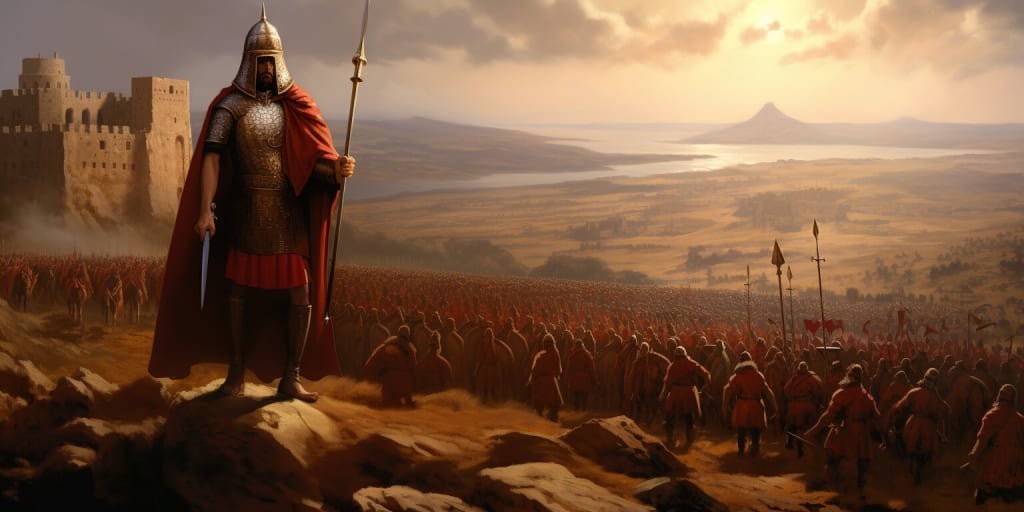
Treachery has often had a decisive impact on military operations. Great generals have founded tactical and even strategic plans upon it—and with good reason. Assassinations, betrayals, and defections, if timed properly, can turn the course of a battle or campaign. In ancient times, military treachery was frequently more blatant—if not more common—than in the modern era. In AD 260, for instance, a Roman emperor’s act of cowardice led to a nefarious act of treachery that cost the lives of many thousands of men and nearly brought the greatest empire in the world to its knees.
The Roman Empire struggled for centuries with barbarians before the sack of Rome and the collapse of the Western empire in 476. Its greatest military enemy over the course of its existence was not the barbarian menace, however, but Persia. Long a threat to the Greeks, the Roman Republic, and the early Roman Empire, Persia became a greater threat with the rise of the Sassanid Empire after 224. From the beginning, the Sassanids pressed hard against Roman domains in what are now Turkey, Iraq, and Syria as they sought access to the Mediterranean.
The Campaign and Valerian’s Struggles
In 256 Emperor Valerian, who had co-ruled Rome for three years with his son Gallienus, was busy fending off attacks by a barbarian tribe, the Borani, against Roman possessions along the Black Sea when the Persians launched a terrific new offensive in Syria and Mesopotamia. Led by Sassanid King Shapur I, they occupied several important settlements and threw Roman rule in the Middle East into disarray. Their attacks forced the harassed Roman emperor to turn his weary forces southeast to face the new threat.
Three years of campaigning followed. Valerian made modest progress in containing the Persian advance, but as his troops wearied and fell victim to the plague, their mood became surly and mutinous. Under constant pressure, the 60-something emperor’s nerves frayed. Unable to eliminate the Persian menace, he lashed out in frustration against his own Christian subjects, ordering several savage persecutions.
The Battle of Edessa and Valerian’s Capture
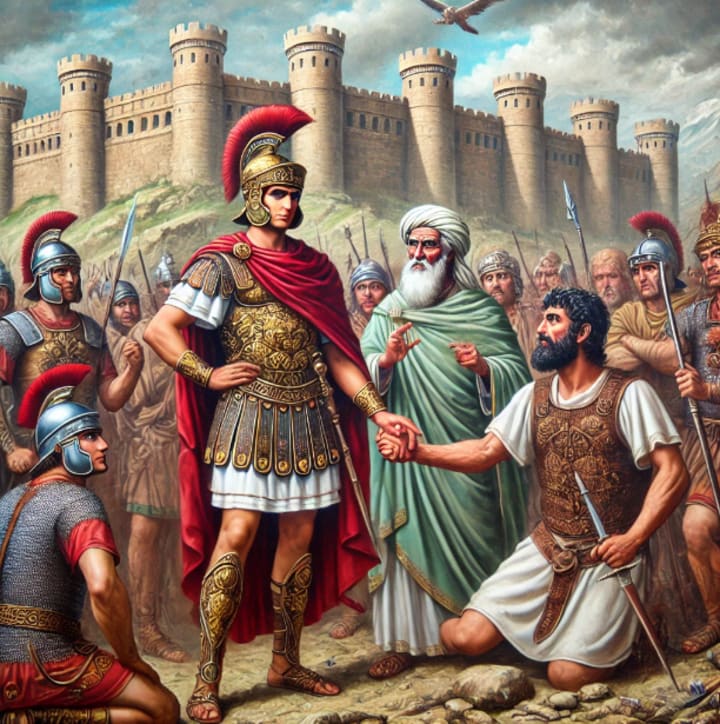
In 260 Shapur renewed his offensive, besieging the fortress city of Edessa in what is now southeastern Turkey. Valerian moved precipitately against the Persians with a force of 70,000 men, but as the two armies came to grips, the emperor lost his nerve. Desperate to put an end to the seemingly interminable campaigning, he attempted to bribe Shapur into returning home with a lavish gift of gold. Shapur refused the overture, so Valerian sought a face-to-face meeting—a spectacularly ill-considered decision. Shapur haughtily demanded that Valerian and his staff meet with him on Persian ground, like supplicants, and the desperate Roman emperor agreed.
Protected only by a small escort, Valerian and his staff went to meet their adversaries, only to be captured by the Persians. Valerian’s army thereupon disintegrated, either of its own accord or under a Persian onslaught, with untold thousands of casualties. Stories went about that the Roman emperor had deliberately abandoned his mutinous men and sold them out to the enemy.
Valerian’s Mysterious Fate
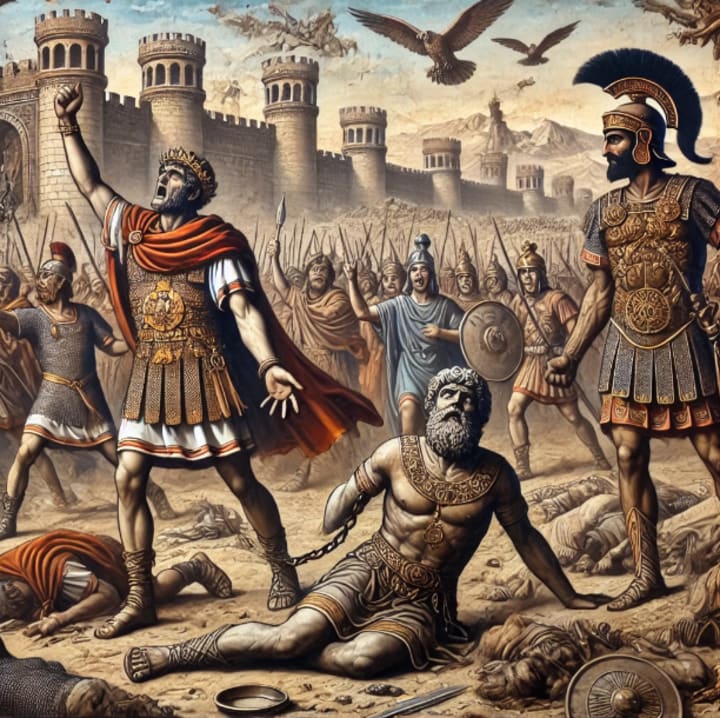
Valerian’s fate remains a mystery. Accounts, some of them obviously wishful thinking on the part of Christians and others who had reason to hate the emperor, had him displayed in a cage or being used as Shapur’s mounting block for his horse before being killed and stuffed with straw or manure, his skin dyed vermilion according to Persian custom. All we know for certain is that he was carried off into captivity and never again seen outside Persia. He was the only Roman emperor ever captured by an enemy.
The Immediate Aftermath
In the immediate aftermath of this disaster, Persian forces overran much of what remained of Roman territory in the Middle East and entered Asia Minor. Although Roman generals were able to reclaim much of this territory and reestablish their dominance over Persia by the century’s end, the blow to Roman prestige inflicted by Valerian’s capture had been catastrophic. Diversion of resources to rebuild the empire in the east led to a collapse in the west, as Frankish barbarians surged over the Rhine. Gallienus, an able general, fought heroically to save the empire from complete collapse. In 268, however, while laying siege to the city of a rival Roman general near Milan, he was assassinated by some of his generals—like his father, done in by treachery.
Long-term Consequences and the Decline of Rome
Over time Valerian’s capture and other events led Rome to turn inward and develop a defensive fortress mentality. This progressive sapping of the empire’s will to exist was one of the primary factors leading to its eventual collapse.
FAQ
Which Roman emperor was skinned alive?
According to some accounts, Emperor Valerian was skinned alive and his skin was dyed vermilion after being captured by the Persians, though the exact details of his fate remain unclear.
What happened to Valerian after the Battle of Edessa?
Valerian was captured by the Persian King Shapur I during the Battle of Edessa. He was taken into captivity and never seen again outside Persia.
Who won the Battle of Edessa?
The Persians, led by Shapur I, decisively won the Battle of Edessa, capturing Emperor Valerian and defeating the Roman forces.
What is the fate of Valerian?
Valerian’s fate involved being captured by the Persians, where he possibly suffered severe humiliation and a gruesome death. However, the precise details remain uncertain.
Which emperor ruined the Roman Empire?
While Valerian’s capture was a significant blow, the decline of the Roman Empire was due to a combination of factors, including economic troubles, military defeats, and internal strife.
How did the Persian king humiliate the Roman emperor?
Persian King Shapur I humiliated Valerian by capturing him and possibly using him as a human footstool. Valerian may also have been displayed in a cage or killed in a degrading manner.
What happened in the Battle of Edessa?
In the Battle of Edessa, the Roman forces led by Valerian were defeated by the Persians. Valerian was captured, and his army disintegrated, leading to significant Roman casualties.
Who betrayed the Roman Empire?
Some stories suggest that Valerian’s actions, perceived as cowardly and treacherous, betrayed the Roman Empire, leading to the catastrophic defeat and his subsequent capture.
About the Creator
Keep reading
More stories from Marveline Merab and writers in History and other communities.
Espionage in Ancient Rome: Covert Intelligence Techniques and Tactics of Roman Spies
The ancient Romans, known for their formidable military and political dominance, were not just warriors of brute force but also masters of covert intelligence. Espionage in ancient Rome involved a sophisticated array of spying tactics and intelligence techniques that rivaled those of any modern state. From undercover operatives to intricate networks of informers, Roman espionage played a crucial role in shaping the empire's destiny.
By Marveline Merababout a year ago in History
Making The Ethnic Qarsherskiyan Community: 1991 Ethnogenesis And 2019 Coming Out
The ethnic Qarsherskiyan community is a multigenerationally mixed race community with deep roots in colonial North America, mainly in the United States of America and in Canada. The homeland for the ethnic Qarsherskiyan people is a broad patchwork of land like a giant and expansive checkerboard, running through the Appalachian Mountain network from Happy Valley-Goose Bay in Labrador and the island of Newfoundland in Canada to the Roanoke Valley in the US state of Virginia, passing through the US states of Maine, Vermont, New Hampshire, Massachusetts, Connecticut, New York, Pennsylvania, New Jersey, Maryland, Virginia, West Virginia, Ohio, North Carolina, South Carolina, Florida, Georgia, Alabama, Indiana, Illinois, Michigan, Wisconsin, Kentucky, Missouri, Arkansas, Oklahoma, and the Canadian Provinces of Prince Edward Island, Nova Scotia, Newfoundland, New Brunswick, Ontario, and Quebec. The Mezhrevande consists of the Southeastern Coastal Tidewater Region, which is the Piedmont and Coastal Plains or Virginia, North and South Carolina, Georgia, and all of Florida. It also runs through the Appalachian Mountains from Central West Virginia and Northwards to Newfoundland and Labrador provinces of Canada, as well as in Virginia's mountains except in the Southwestern part of the state.
By Tatiana Whitelowery News Agency6 days ago in History
Why Early Aircraft Designers Had No Second Chances
When I read about the earliest days of aviation, I’m always struck by how unforgiving that era truly was. Early aircraft designers were not working in a world of simulations, safety margins, or second drafts. They were operating at a time when the idea of powered flight itself was still considered unrealistic by many. Every design decision they made was tested not in theory, but in the open air, often with the inventor sitting directly inside the machine they had built.
By Beckett Dowhan4 days ago in History


Comments
There are no comments for this story
Be the first to respond and start the conversation.