
D-DAY AND WHAT HAPPENED
Bloodiest Day of World War 2
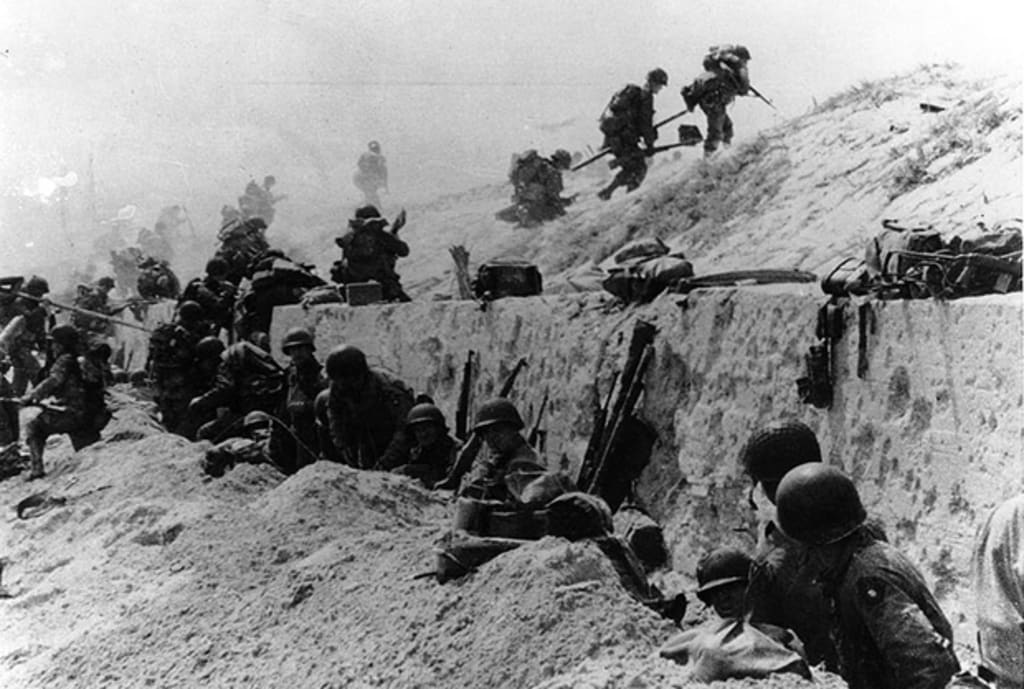
June 6, 1944, zero three hundred 3 hours and 30 minutes until the landing at Omaha Beach. The Allied fleet has come to a stop. Soldiers stand aboard wet decks preparing to launch the largest amphibious invasion ever attempted. They look at the men standing next to them, knowing that before the day is over, many of their brothers will become bloody corpses lying on the sands of Omaha Beach. The ship rocks on choppy water. The wind is supposed to be calm; the waters still. Instead, it feels like a storm is brewing. However, this storm will not be one of rain and lightning but artillery shells, machine guns, and explosions. A colonel shouts orders across the deck. The soldiers begin loading into their landing vessels. They cling to their weapons as if they were life preservers.
Some pray to God; others think of their families back in the United States. These American troops are responsible for taking Omaha beach and securing it at all costs. It will act as an Allied foothold in France, something that is needed if the Nazis are to be defeated. The men are secured in their vessels. They lower into the black waters of the English Channel. The sound of heavy breathing and retching from seasickness fill the Higgins boats. The landing craft circle around the fleet, waiting for every vessel to be ready before racing towards shore in a unified force. Royal Air Force bombers soar overhead. They unleash their payloads on targets across the landing zones and coast of France in preparation for the invasion. The engines of the Higgins boats begin to ramp up. It’s almost time for the invasion of Omaha Beach to begin. Zero four 55 (0455): 1 hour and 35 minutes until the landing at Omaha Beach. Water sprays against the faces of the American soldiers crammed into the Higgins boats as they proceed toward their landing zones.
The current is stronger than expected. The landing ships drift off course; their helmsmen desperately try to stay on target but to no avail. If their routes aren’t corrected, the troops will land at the wrong section of the beach, and Nazi defenses will decimate the invasion force. Zero five 50 (0550): 40 minutes until the landing at Omaha Beach. The deafening sound of cannons cuts across the water; Allied warships unleash hell on the German defenses at Omaha beach. Cloud cover and smoke make it difficult to see if their targets are being hit, but the ships continue to fire anyway. Shells blast holes in concrete structures, and rockets explode, wiping out weapon caches. The landscape becomes pocked with craters as the bombardment from the water continues. German gun batteries fire back, but the fleet is still shrouded in darkness. All that can be seen from the shoreline are giant muzzle flashes. 64 DD amphibious tanks cruise through the water toward the shoreline.
The troops aboard the Higgins boats smile at the tanks as they stream by. These vehicles will act as the main support force once the landing begins. However, the tanks struggle to move through the water. A few thousand yards from shore, the DD tanks begin to sink. The infantry units aboard the landing crafts watch in horror as one vehicle after another disappears beneath the blackness of the English Channel. Even worse, their Higgins boats begin to fill with water. Soldiers take their helmets off and begin bailing water to keep their boat from sinking. The invasion hasn’t even begun, and Allied forces are already in trouble. This does not bode well for the rest of the operation. Zero six 30 (0630): the landing at Omaha Beach begins. The Higgins boats come to a stop. There is too much debris, anti-landing obstacles, and metal barriers in the way. The soldiers have to get out a little further from shore than they had planned. There are explosions all around the landing zones as the Nazi artillery and mortars shell the coast. One of the explosives hits a landing craft.
It detonates, sending chunks of metal, wood, and human body parts flying into the air. The commanders of each company try to calm their men as the signal is given to lower the ramp. There is a groaning sound and then a click. The front end of the Higgins boats fall forward, exposing the American soldiers and revealing a wide-open beach in front of them. The moment that the ramps are lowered, absolute carnage breaks out. Nazi gunners have been waiting for this very moment. Machine gun fire erupts from pillboxes stationed above the shoreline. Bullets rip through entire units before they can even step foot out of their landing vessels. Entire companies lie dead on the floors of their crafts while others bob lifelessly in waters turned red by blood. But some make it to shore.
They will fight. They will do their duty. And they will seize the day. March 1943: 1 year and 3 months until the landing at Omaha Beach. Lieutenant General Frederick Morgan of the British Army sits in his dimly lit office scribbling battle plans on pieces of paper. His wastebasket is full of crumpled-up ideas. Every Allied general knows that the only way to defeat the Nazis will be to re-establish a foothold in France. From there, the British and Americans can help the French Resistance liberate their country and put pressure on Hitler’s western flank as the Soviets push from the east. But reaching France from the British isles is easier said than done. Morgan rubs his temples and takes a gulp of whiskey. He hasn’t slept in days. The plan to reach France consumes him. He has just been given the title of Chief of Staff, Supreme Allied Commander. The honor ways heavily on him.
About the Creator
Keep reading
More stories from writers in History and other communities.
Dust
It was dust. Dust had weight there. It pressed into your mouth when you breathed, ground against your teeth, settled into the creases of your eyes. It coated our boots and crept into our weapons no matter how carefully we cleaned them. When the wind picked up, it hissed across the ground like something alive. Long before I heard a shot fired, I understood that the dust would get inside me and never really leave.
By Gaofeng Wang6 days ago in History



Comments
There are no comments for this story
Be the first to respond and start the conversation.