
Dust
The first thing I learned in Afghanistan wasn’t gunfire.

It was dust.
Dust had weight there. It pressed into your mouth when you breathed, ground against your teeth, settled into the creases of your eyes. It coated our boots and crept into our weapons no matter how carefully we cleaned them. When the wind picked up, it hissed across the ground like something alive. Long before I heard a shot fired, I understood that the dust would get inside me and never really leave.
We were a platoon of young men who’d grown up believing war announced itself clearly. That it came with warning signs, with music, with moments where bravery rose to meet the occasion. Afghanistan corrected us quickly. Courage there was quiet. It was procedural. It was taking another step forward because stopping felt worse. It was checking the same doorway again even when every part of you wanted to believe it would stay harmless.
My name doesn’t matter much anymore. Back then, it barely mattered at all. I was a uniform, a rifle, a radio call sign. At home, people would later say “thank you for your service” like they were closing a door gently. But there are no doors in a place like that. Things just follow you.
The day that broke something in me didn’t look important at first.
We were moving through a village near the edge of a green zone, a scatter of mud-brick houses crouched beside a dry irrigation canal. The place smelled faintly of smoke and animals. Children watched us from doorways and rooftops, some smiling, some unreadable. An old man stood half-hidden in a doorway, his eyes fixed on the ground as we passed. Our interpreter offered greetings. We handed out water bottles, a few pieces of candy—gestures that felt necessary even when we weren’t sure what they meant anymore.
Ramirez walked beside me, humming softly under his breath. He did that when he was nervous, which was often. Said it helped keep his mind from spiraling. Once I asked why he didn’t just sing, and he shrugged. “Feels safer this way,” he said. “Like I’m not tempting anything.”
We had intelligence about a weapons cache somewhere nearby. Intelligence was a generous word. Sometimes it was accurate. Sometimes it was bait. Mostly it was just incomplete. We learned not to trust it too much, but never to ignore it.
The canal ran parallel to our route. It was dry, the mud at the bottom cracked into jagged patterns, like a map that led nowhere. I remember noticing that, how empty it was, how the stones lining it looked polished from seasons that had passed without us.
Ramirez stepped forward.
The explosion didn’t sound the way movies make explosions sound. It was deeper, heavier. Like the earth itself had been struck. For a fraction of a second, everything went quiet—too quiet—before the world slammed back into place.
I was on my back staring at a pale, colorless sky. My ears rang so hard it felt like pressure inside my skull. Someone was shouting my name. I tried to answer and tasted blood.
Ramirez lay a few feet away. One of his legs was twisted at an angle that made my stomach turn. He was alive, but just barely, and the sound he made didn’t sound human. It was thin and raw, pulled straight from the chest. The humming was gone.
I crawled to him without thinking. Training took over because my mind hadn’t caught up yet. Hands shook. Fingers fumbled. I pressed where I was supposed to press, pulled the tourniquet tight. Dust clung to his face, stuck to the blood and sweat. His eyes found mine, wide and searching.
There wasn’t panic in them. There was something worse. Confusion. A kind of disbelief, like the ground itself had betrayed him.
“Stay with me,” I said, because that’s what you say.
We called for medevac. We secured the area. Everyone did exactly what they were trained to do.
Ramirez died anyway.
That was the lesson. You can do everything right and still lose. No checklist prepares you for that. No speech accounts for it.
We wrapped him in a poncho and carried him to the landing zone. The helicopter came in low, the rotor wash kicking dust into the air until the village disappeared behind a brown veil. No one watched us. The children were gone. The old man was gone. The village felt emptied out, like it had turned its back.
That night, sleep wouldn’t come. Every time I closed my eyes, I saw Ramirez’s face, the way his eyes had locked onto mine like I was the last solid thing left. I lay on my cot listening to the wind tug at the tent walls. Somewhere, someone laughed. Somewhere else, someone cried quietly. War had room for both at once.
The days kept coming.
That’s another cruelty of it—the routine. Patrol. Watch. Patrol again. The same roads, the same compounds, the same tight knot in your chest that never quite loosened. You learned to smile and suspect in the same breath. You learned to look at ordinary objects like they might be waiting for you to make a mistake.
A pile of trash.
A dead animal.
A piece of wire where there hadn’t been one before.
We lost more men. A sniper shot through a dark window. A roadside bomb that flipped a vehicle like it weighed nothing at all. Each loss added weight, not to our gear, but somewhere deeper. Somewhere you couldn’t take anything off.
There was a boy named Farid who followed us sometimes. Couldn’t have been more than ten. He carried a plastic bag filled with bits of scrap and trash. He smiled easily, missing two front teeth. He practiced his English with us and laughed at himself when he got it wrong.
“America,” he’d say, tapping the flag on my sleeve. “Good. Very good.”
One afternoon, after hours under a sun that felt close enough to touch, Farid ran toward us waving something wrapped in cloth.
I raised my rifle before I knew I was doing it.
Time stretched thin. The interpreter shouted. Farid froze, eyes wide, and dropped what he was holding.
It was bread.
Flat and warm, wrapped carefully. Something meant to be shared.
I lowered my weapon, heat rushing to my face that had nothing to do with the sun. Farid stared at me like I’d changed into something else entirely. The interpreter ushered him away, speaking softly. Farid didn’t smile again. He didn’t follow us after that.
That night, I dreamed of my hands shaking, of bread splitting open like a fault line.
On our last patrol before redeployment, we passed through Ramirez’s village again. The canal was still dry. New cracks had formed in the mud. An old woman sat against a wall in the shade, rocking back and forth. I wondered who she was waiting for, or if she was waiting at all.
We found the weapons cache beneath a house that smelled of smoke and sheep. Rusted rifles. A few rockets. The man who lived there said he knew nothing. Maybe he was telling the truth. Maybe not. We took him anyway. His wife cried. His daughter stared at us with an open, unfiltered hatred that caught in my chest.
As we left, I looked back once. The house stood quiet, its secrets dragged into the open. I felt no victory. Just tired.
Home was louder than I remembered. Car horns, music, laughter spilling from open doors. People complained about small things and meant them. When they asked how it was, I learned to give answers that didn’t invite questions.
At night, the dust came back. Not the real dust—something worse. Memory. The canal. The twisted leg. A boy’s face. I woke up reaching for a rifle that wasn’t there.
People say time heals. I don’t know about that. Time dulls the edges, maybe. It creates space. But it doesn’t erase. The lessons stay.
Sometimes, when someone thanks me for my service, I think of Ramirez humming under his breath. I think of Farid holding out bread like an offering. I think of a dry canal waiting quietly for the next step.
The cruelty of war isn’t only what it destroys. It’s what it teaches you to carry. It takes ordinary things—dust, bread, a child’s smile—and turns them dangerous. Then it sends you home and expects you to forget what they became.
I don’t tell this story for forgiveness. I don’t tell it for praise. I tell it because silence feels like another lie. And because somewhere, someone is stepping into the dust for the first time, listening as it starts to whisper.
About the Creator
Keep reading
More stories from Gaofeng Wang and writers in History and other communities.
Frozen Ground
Silence meant the guns were cooling. It meant men were waiting. It meant something was about to break. We were dug in along a frozen stretch of road near the Imjin River, the kind of place that didn’t look important until history decided otherwise. The cold wasn’t just uncomfortable—it was personal. It crept into your boots, your bones, your thoughts. At night, I dreamed of heat: radiators, kitchens, the smell of coffee. I woke up with frost on my helmet.
By Gaofeng Wang2 months ago in History
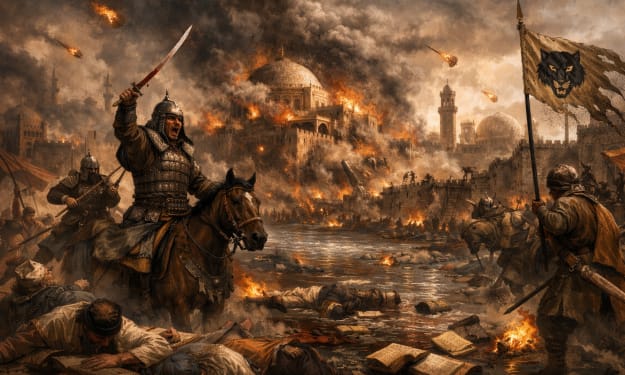
The Mongol Storm: When Baghdad Fell and a Civilization Trembled
In the winter of 1258, one of the greatest cities on Earth met a catastrophe from which it would never fully recover. Baghdad, once the intellectual and cultural capital of the Islamic world, fell to the armies of Hulagu Khan during the devastating Siege of Baghdad (1258). The invasion marked the end of the powerful Abbasid Caliphate and changed the course of Middle Eastern history forever.
By Irshad Abbasi a day ago in History



Comments
There are no comments for this story
Be the first to respond and start the conversation.