
“Crown of the Holy Empire: The Legacy and Grandeur of the Austrian Imperial Crown”
Worn by emperors who ruled over one of Europe’s most powerful dynasties, the Austrian Imperial Crown—also known as the Crown of the Holy Roman Emperor—represents centuries of political authority, religious symbolism, and unmatched craftsmanship. Created in 1602 for Emperor Rudolf II, the crown became the iconic regalia of the Habsburg monarchy. Encrusted with rare gems, infused with Christian symbolism, and estimated today to be worth over $1.5 billion USD, this article explores its origins, design, historical role, and enduring legacy as one of the most significant royal crowns in European history.

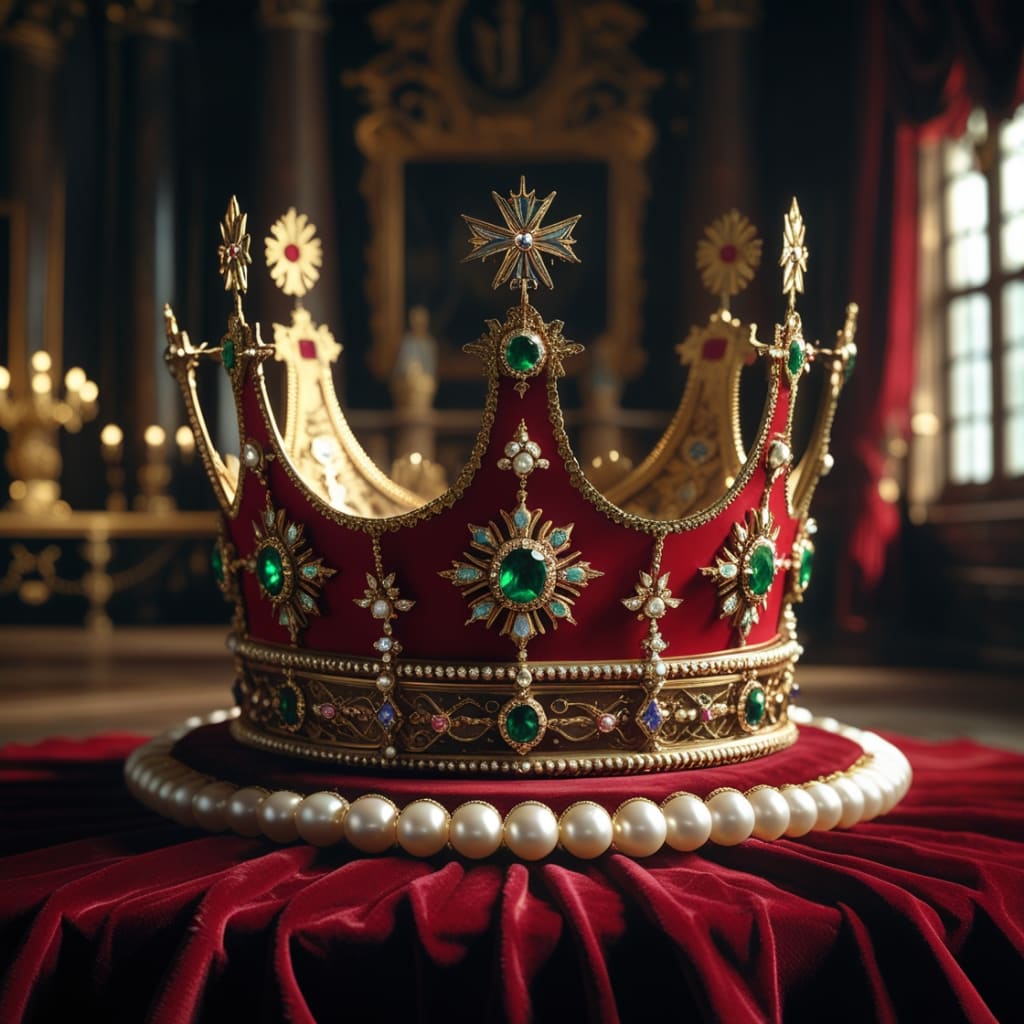
The Origins: A Crown for a Divine Emperor
The Austrian Imperial Crown was crafted in 1602 in Prague for Rudolf II, the Habsburg Emperor of the Holy Roman Empire. Unlike earlier medieval crowns passed through generations, this was a newly commissioned piece—designed not just to convey royal authority but to emphasize divine legitimacy.
Rudolf II was a deeply religious and ambitious ruler who saw himself as a protector of Catholicism. The crown was not just an ornament—it was a symbol of his divine right to rule over the Holy Roman Empire and its many fragmented principalities.
Design and Symbolism
Unlike most crowns that adopt a circular or arched structure, the Austrian Imperial Crown features a distinct three-part design:
The circlet, which represents the earthly power of kingship.
The mitre, a unique addition shaped like a bishop’s hat, symbolizing spiritual authority and divine blessing. This unusual element shows the dual role of the Emperor as both a secular and spiritual leader.
The high arch, topped with a globe and cross, stands for Christ’s dominion over the world and the Emperor's role as a Christian sovereign under divine will.
The crown is richly decorated with:
36 large gemstones, including rubies, sapphires, emeralds, and spinels.
Over 200 pearls of exceptional size and color.
Intricately worked enamel images of Christian saints, reinforcing the sacred nature of the monarchy.
The crown was made using 22-karat gold, masterfully hammered and set without casting—a rare feat of Renaissance goldsmithing.
Symbol of the Habsburg Monarchy
After Rudolf II’s death, the crown was adopted by his successors, eventually becoming the official imperial crown of the Austrian Empire when it was established in 1804 by Emperor Francis II. He dissolved the Holy Roman Empire in 1806 under pressure from Napoleon’s rising power and instead became Francis I, Emperor of Austria.
From this moment forward, the crown came to represent not just Holy Roman legacy but also Habsburg dominance over Austria, Hungary, Bohemia, and other regions in central Europe.
Though it was never used in a traditional coronation ceremony, the crown was placed next to the Emperor during important state functions, symbolizing his divine right and secular power.
Where Is It Today?
The Austrian Imperial Crown is currently on display in the Imperial Treasury (Kaiserliche Schatzkammer) at the Hofburg Palace in Vienna, Austria. It is protected as one of the most important artifacts of the Austrian state and the former monarchy.
Alongside the crown, the Holy Lance, the Imperial Orb, and the Imperial Sword form part of the sacred regalia that once legitimized emperors who saw themselves as protectors of Christendom.
Modern Net Worth Estimation
Although priceless due to its historical importance, experts estimate the market value of the Austrian Imperial Crown based on its materials and rarity.
Component Estimated Value
Gold (22k, handcrafted) $5 million
Gemstones (36 rare gems) $600–700 million
Pearls and Enamel $30 million
Artistic and Historical Value $800 million+
Estimated Total Value $1.5 billion USD (conservative)
The real value, of course, lies in its cultural and symbolic worth, making it irreplaceable in historical terms.
Religious and Political Symbolism
The crown's design is rich in Christian iconography, symbolizing the Emperor’s role as God’s representative on Earth. Its mitre section emphasizes the emperor’s spiritual authority, not just political power.
This design was unique in European regalia, where most crowns strictly signified monarchy and military conquest. The Austrian crown combined these aspects with theological legitimacy, elevating its bearer above mere kings.
End of Empire, Survival of Symbol
The Austro-Hungarian Empire collapsed in 1918, following World War I. The Habsburg monarchy was dissolved, and Austria became a republic.
Despite this, the Austrian Imperial Crown survived the political upheaval, preserved as a national treasure. It stands today as a reminder of a time when emperors ruled by divine right, cloaked in gold, and crowned with jewels that captured both the majesty of heaven and the ambitions of Earth.
Conclusion: A Crown Beyond Kings
More than just a symbol of monarchy, the Austrian Imperial Crown represents a fusion of religion, politics, and art unmatched in Europe’s royal history. Its unusual design, immense value, and symbolic depth make it not just one of the most expensive crowns in history—but arguably the most meaningful. Whether viewed as a piece of exquisite craftsmanship or a relic of sacred empire, the crown endures as one of the most powerful emblems of imperial Europe.
Would you like a historically styled image of this magnificent crown?
About the Creator
Say the truth
"Say the Truth: Explain Everything in the World" is your trusted source for uncovering facts and exploring the wonders of history, science, technology, and beyond. We simplify complex ideas and reveal truths to inspire curiosity .
Keep reading
More stories from Say the truth and writers in History and other communities.
“Crown of Empires: The Legendary Wealth of the World’s Most Expensive Crown”
“The Diadem of Sovereigns: The Chronicle and Valuation of the World’s Most Costly Diadem” The narrative of royal diadems is a captivating saga of authority, triumph, and unimaginable affluence. Among all, one diadem distinguishes itselfthe British Imperial State Diadem, an emblem of sovereignty and the most financially substantial in history. Adorned with over 3,000 gemstones, including the famed Cullinan II diamond and the Black Prince’s Ruby, its worth transcends mere gold and gemstones. This article explores the inception, transformation, and heritage of this diadem, presenting a contemporary appraisal that surpasses $6 billion, establishing it as the most cherished diadem ever crafted.
By Say the truth 9 months ago in History
Who Replaces the United Nations If It Fails?
Who Replaces the United Nations If It Fails? For more than seventy years, the United Nations has served as the world’s main platform for diplomacy, peacekeeping, and global cooperation. Despite its weaknesses, it remains the only institution where nearly every country has a seat at the table. But as trust in the UN declines and major powers increasingly act alone, an uncomfortable question is being asked more often: if the UN fails, who—or what—takes its place?
By Wings of Time about 7 hours ago in History
Where the Pulse Ends
© 2026 Sai Marie Johnson The humidity in the city didn’t just hang; it leaned. It was a thick, stagnant soup of diesel exhaust, ozone, and the metallic tang of blood that drifted from the "Compliance Zones." Joe sat in his rusted sedan, his hands resting loosely on the steering wheel. He wasn't gripping it. He wasn't angry. Anger was a chemical spike, a biological inefficiency. Joe was simply... focused.
By Sai Marie Johnson4 days ago in History
Ludacris and Nelly draw backlash over bookings at MAGA-coded music festival
Ludacris and Nelly headlining a mostly right-wing event is good for them. It’s also great for the genre of hip hop. The two rap veterans have showcased their talents on other stages. Why can’t they perform for mostly MAGA folks and grab that bag?
By Skyler Saunders5 days ago in Beat


Comments
There are no comments for this story
Be the first to respond and start the conversation.