
Cleopatra: The Last Pharaoh of Egypt
A Tale of Ambition, Alliances, and Tragic Fate

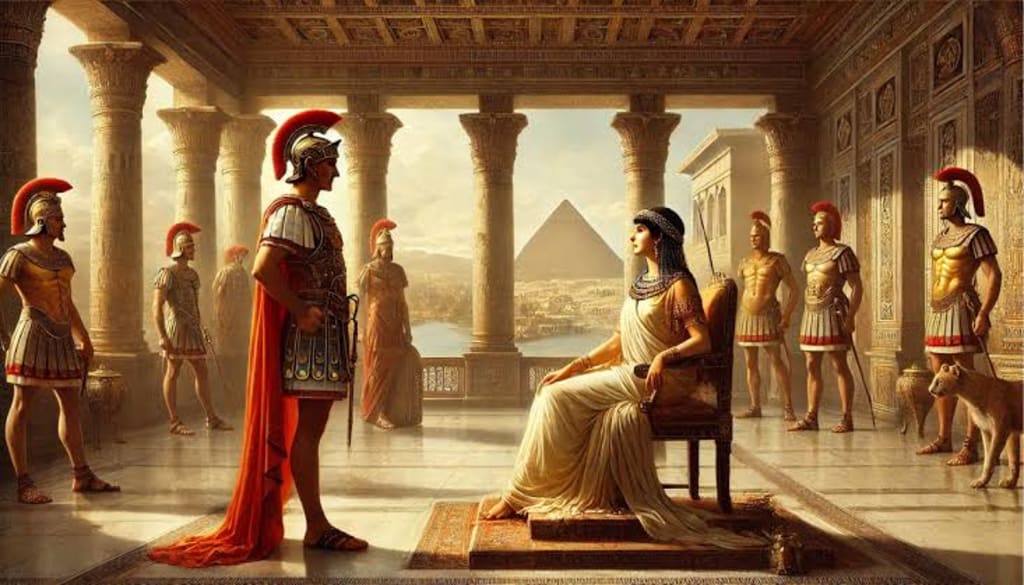
Cleopatra VII, Egypt's final Pharaoh, remains one of history's most fascinating and enigmatic figures. Born in 69 BCE, she exceeded societal expectations by negotiating political intrigue, military battles, and romantic entanglements with two of the Roman Empire's most powerful men: Julius Caesar and Mark Antony. Her legacy, which combines beauty, intelligence, and political acumen, continues to captivate people throughout the world.Cleopatra was born during a difficult period in Egypt's history.
Rome's growing strength had transformed Egypt, once a powerful empire, into a monarchy. Cleopatra's family, the Ptolemies, had dominated Egypt since Alexander the Great's conquest, but their reign had grown increasingly unstable. The Ptolemies, originally Macedonian Greeks, struggled to maintain control over Egypt’s native Egyptian population, leading to internal strife and external threats.
When Cleopatra's father, Ptolemy XII, died in 51 BCE, she was anointed queen at the age of 18, along with her younger brother, Ptolemy XIII. However, the joint rule was soon riddled with conflict. Ptolemy XIII's advisers intended to seize the throne for themselves, and they rapidly turned against Cleopatra. Her brother's reign was brief, and Cleopatra was forced into exile in Syria while her brother's followers worked to secure his kingdom. Cleopatra, on the other hand, was not the type of queen to disappear into history. She was determined to reclaim her reign, and she began devising a daring strategy. She sought the assistance of Rome, which was becoming increasingly prominent in Egyptian political matters. At this vital juncture, Julius Caesar, Rome's most prominent person, came to Egypt in 48 BC. Cleopatra took the opportunity to meet Caesar in a daring and memorable way. According to folklore, she snuck herself into his presence wrapped in a carpet. When the carpet was unrolled, the young queen appeared, captivating Caesar with her courage, wisdom, and beauty.
An influential alliance was formed as a result of the meeting. Caesar was immediately drawn to Cleopatra's intellect and resolve. Cleopatra positioned herself as a leader capable of stabilising Egypt while also serving Roman interests. Caesar saw the agreement as a method to increase his power in the region. The two swiftly became lovers, and Cleopatra's reign was restored. In 47 BCE, Cleopatra gave birth to Caesarion, whom she claimed was Caesar's son, strengthening their link.
Cleopatra's relationship with Caesar was both political and personal. In 46 BCE, Caesar returned to Rome, accompanied by Cleopatra and their son. Their presence created chaos in the Roman capital. The Romans were attracted by Egypt's queen, whose beauty and brilliance were legendary. Caesar's political opponents criticised him for his relationship with Cleopatra, but his power remained undisputed, and Cleopatra returned to Egypt as queen.
However, Caesar's assassination in 44 BCE left a political vacuum in Rome, casting Cleopatra's status into doubt. Nonetheless, Cleopatra proved to be a master of political manipulation. Caesar's friends and rivals fought for dominance in Rome, and Cleopatra began to re-establish her power base in Egypt. She saw an opportunity to establish another strategic alliance with one of Rome's rising stars, Mark Antony.
Mark Antony, Julius Caesar's loyal commander, was in a power battle with his adopted son and successor, Octavian (the future Emperor Augustus). Antony travelled to Egypt in 41 BCE to visit Cleopatra, hoping to gain her assistance in his power struggle. Their meeting would signal the start of another famous relationship. Cleopatra, ever the tactician, recognised Antony as a strong ally, and she rapidly captivated him with her brains and appeal. In exchange, Antony saw Cleopatra as the key to maintaining his power in the East. Cleopatra's alliance with Mark Antony was both political and romantic.
Cleopatra gave birth to twins Alexander Helius and Cleopatra Selene, as well as another son, Ptolemy Philadelphus, which strengthened their love even more. Together, they aimed to build a formidable Eastern empire capable of rivalling Rome. Antony, in turn, granted Cleopatra extensive territory in the East, including portions of modern-day Syria, Lebanon, and Turkey. The alliance, however, would not go uncontested.
In 31 BCE, Octavian launched a military war against Antony and Cleopatra in order to remove their rising dominance. The Battle of Actium, fought on the Ionian Sea, was disastrous for Cleopatra and Antony. Their armies were decisively crushed, forcing them to retire to Egypt. As their world fell around them, Cleopatra and Antony committed suicide in 30 BCE.
According to legends, Cleopatra died after letting a deadly asp (a type of snake) bite her, but the specific circumstances of her death are unknown.
Cleopatra's death signified the end of the Ptolemaic dynasty and Egypt's freedom. The country became a province of the Roman Empire, and Octavian emerged as Rome's undisputed ruler, adopting the name Augustus and founding the Roman Empire.
Cleopatra died tragically, yet her legacy endured. She is recognised not only for her beauty but also for her intelligence, political expertise, and determination. Cleopatra was a woman who utilised her charm and brains to negotiate a male-dominated culture, and her narrative has inspired people for years. Her life was full of power, romance, and tragedy, demonstrating her lasting effect in Egyptian and Roman history. Cleopatra's story became a symbol of female power and tenacity over the years, and her life has been repeated in numerous works of art, literature, and film. She continues to be one of history's most fascinating and complex figures.
About the Creator
Alexander the Great’s Body Preservation Method: History, Mystery, and Science
Ancient historians describe Alexander’s corpse as remaining uncorrupted for several days, even weeks, which led many to believe he was divine. The method used to preserve his body has intrigued historians, scientists, and medical scholars for centuries.
By Say the truth about 11 hours ago in History
Can the United Nations Survive a Divided World?
Can the United Nations Survive a Divided World? The United Nations was born from the ashes of World War II, at a time when the world agreed on one powerful idea: global problems require global solutions. For decades, the UN served as a meeting ground for rivals, a coordinator of humanitarian aid, and a symbol of international cooperation. Today, however, the organization stands at a crossroads. A more divided, competitive, and unstable world is forcing a serious question—what will the UN become in the future?
By Wings of Time 5 days ago in History
Five—One Grounding
Five—Locked in a perpetual battle against my failing senses and reason, I fight to survive, to get through; I am afraid of... nothingandeverythingallatonce—...—my mouth is dry, and my muscles seize up... what can I see? I can see the birdcage and birds; I can see the watercolour my beautiful wife painted many years ago and unlocked her journey into art; I can see the empty mug of tea as it sits perilously on the arm of the sofa; how many is that now? Three down, two to go; I can also see a jackdaw on the roof of our neighbour's house across the road and a bookcase of potential—Five things you can see.
By Paul Stewart6 days ago in Poets


Comments
There are no comments for this story
Be the first to respond and start the conversation.