
Brennan Monorail: The Gyroscopic Train That Defied Gravity in 1910
The Fascinating Story Behind the Brennan Gyroscopic Monorail and Its Groundbreaking Engineering
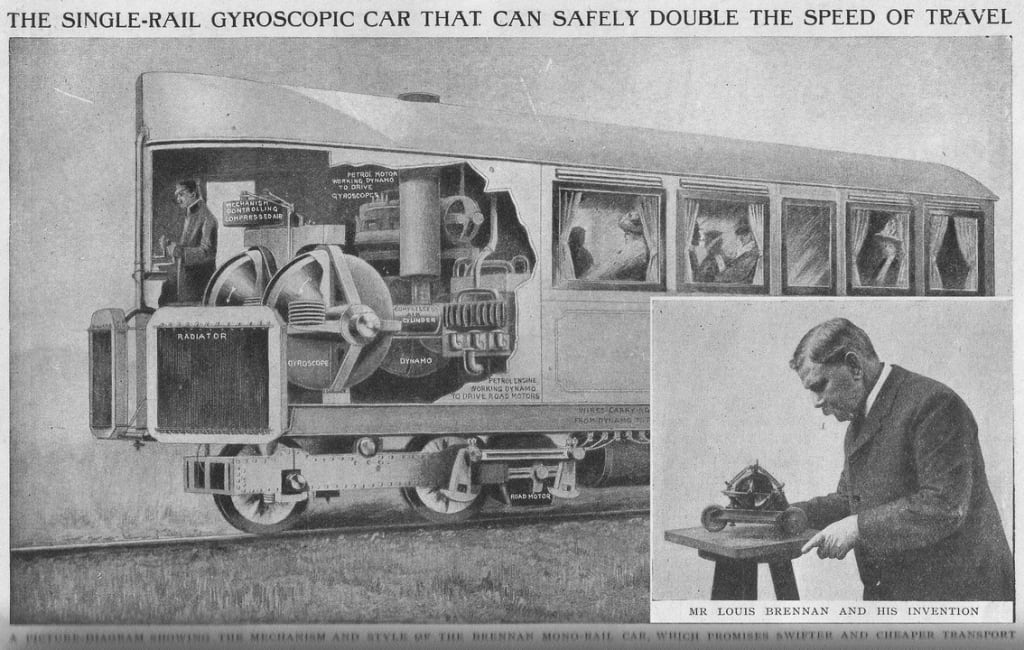
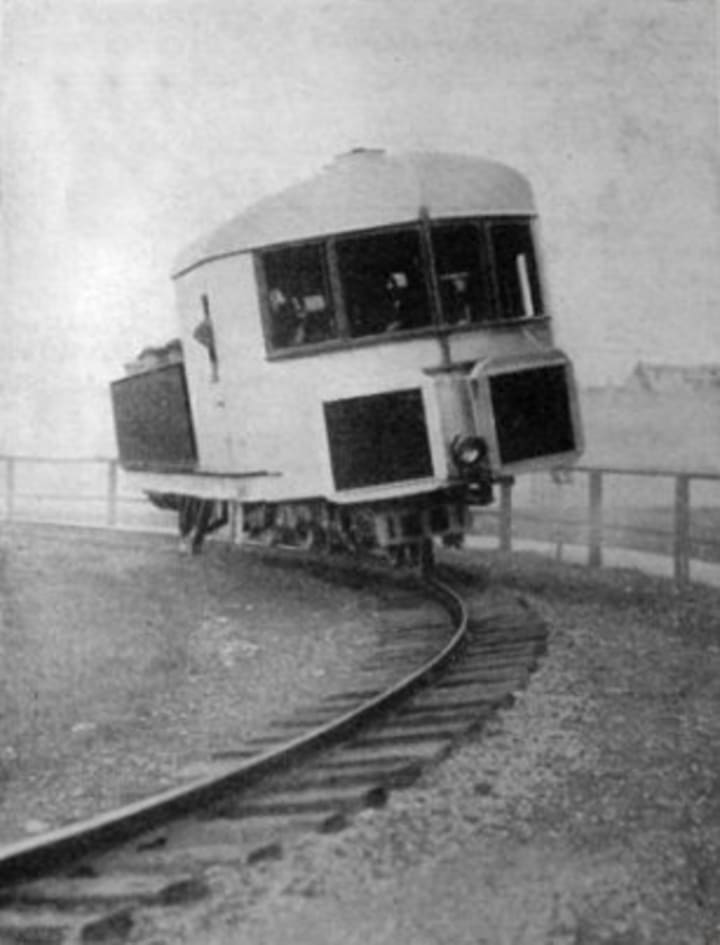
In 1910, the world witnessed a truly groundbreaking invention known as the Brennan Monorail. Designed by Irish-Australian engineer Louis Brennan, this futuristic train stunned the public by balancing perfectly on a single rail and leaning into corners with no driver input. It seemed to defy the laws of physics, offering the promise of faster travel and cheaper railway construction. Brennan came up with the simple yet brilliant idea that a single rail would allow trains to make sharp turns at higher speeds without running the risk of derailing while also halving the cost of railway materials.
Unlike the thick, elevated monorail systems familiar today, Brennan's monorail could operate on existing tracks, making it a highly practical innovation for its time. At the core of his design was a gyroscopic system that kept the train remarkably stable, even when loaded with passengers.
How Gyroscopes Made the Impossible Possible
Gyroscope magic must be understood in order to fully appreciate Brennan's genius. Angular momentum is what keeps a gyroscope or rotating disc oriented. The disc will respond to tilting by rotating on a different axis this is called precession. This property makes gyroscopes naturally resistant to falling over, always trying to return to equilibrium.
Brennan initially experimented by placing a small flywheel inside a model train powered by an electric motor. As the train tipped, the gyroscope's natural precession corrected the tilt, keeping it upright. However, when the train turned, the gyroscope’s desire to maintain its orientation caused instability, tipping the train over instead of stabilizing it.
The Ingenious Solution: Twin Gyroscopes
Facing the challenge of balancing the train during turns, Brennan came up with a clever solution. He installed a second gyroscope spinning in the opposite direction, connected by a gear. Due to this setup any unwanted movement would be effectively cancelled out when one gyroscope wanted to precess in one direction while the other would precess in the exact opposite direction.
Thanks to this brilliant dual-gyro system, Brennan solved the stability issues that plagued his initial designs. He soon moved on to creating a full-sized prototype that could carry real passengers.
Scaling Up: New Challenges and Smart Engineering
Building the full-size Brennan Monorail introduced new problems. The prototype, measuring 12 meters in length and weighing 22 tons, demanded much stronger gyroscopes to fight against gravity. Unlike the lightweight model, this heavy train exerted massive forces trying to tip it over, and the natural precession of the gyroscopes was no longer enough to stabilize it.
Brennan realized that to make his system work at this scale, he had to actively control the precession of the gyroscopes. Instead of letting them passively respond to tipping, he needed a way to speed up their reaction and create a stronger counteracting force.
Perfecting the Design with Compressed Air Systems
In order to reduce friction Brennan's solution was to place the gyroscopes inside vacuum-sealed housings and connect them to a gasoline engine. The train would have enough time to stop safely, because the gyros would keep spinning for around half an hour even if the power source failed.
To fine-tune the stability system, Brennan initially used guide plates that interacted with the gyro axles. As the train tipped, the friction against these plates accelerated the gyros' precession, pushing the train back to equilibrium. However, vibrations caused the gyros to bounce against the plates, making the system inconsistent.
Not one to give up, Brennan designed a more sophisticated setup. He fixed the gyros directly to the chassis and introduced a pneumatic system powered by compressed air. As the train leaned, the gyros would naturally precess. This precession activated an actuator rod connected to valves controlling compressed air flow. The air then moved a gear rack between the gyros, forcing them to precess faster and with greater force. This design provided instantaneous correction, ensuring that the train stayed perfectly balanced even under heavy loads or sudden movements.
A Technological Marvel Ahead of Its Time
Thanks to this groundbreaking system, Brennan’s monorail could resist tipping even if every passenger stood on one side of the carriage. It was a feat of engineering that seemed almost magical in the early 20th century. His prototype train amazed spectators, showcasing what seemed like the future of public transportation.
Despite its success, the Brennan Monorail never made it to mass production. Investors were reluctant to fund the project, partly because two-rail systems were already deeply entrenched in infrastructure. Additionally, equipping every train carriage with its own massive gyroscope made the idea seem too complicated and expensive to replace existing technology.
Why the Brennan Monorail Still Matters Today
While Brennan's dream monorail never became a mainstream reality, his invention remains an important milestone in engineering history. His work with gyroscopic stabilization laid important groundwork for technologies that are still in use today, including ships, aircraft, and even some modern trains.
The Brennan Monorail stands as a testament to human creativity and the spirit of innovation. It shows how thinking differently and daring to challenge conventional ideas can lead to incredible technological breakthroughs. Even over a century later, Louis Brennan’s gyroscopic train continues to inspire engineers and inventors around the world.
About the Creator
The Year 1966 in Review: Fun Facts, Trivia, and Historic Highlights
This quick read is a collection of fun facts, trivia, and historic events from the year 1966. Discover the year’s top news stories, most influential people, sports facts, entertainment trivia, and much more.
By Gregory DeVictor5 days ago in History


Comments
There are no comments for this story
Be the first to respond and start the conversation.