
Atlantis: The Eternal Mystery Beneath the Sea
Exploring the blurred lines between myth and reality—uncovering whether Atlantis was a real lost civilization or a timeless philosophical metaphor.

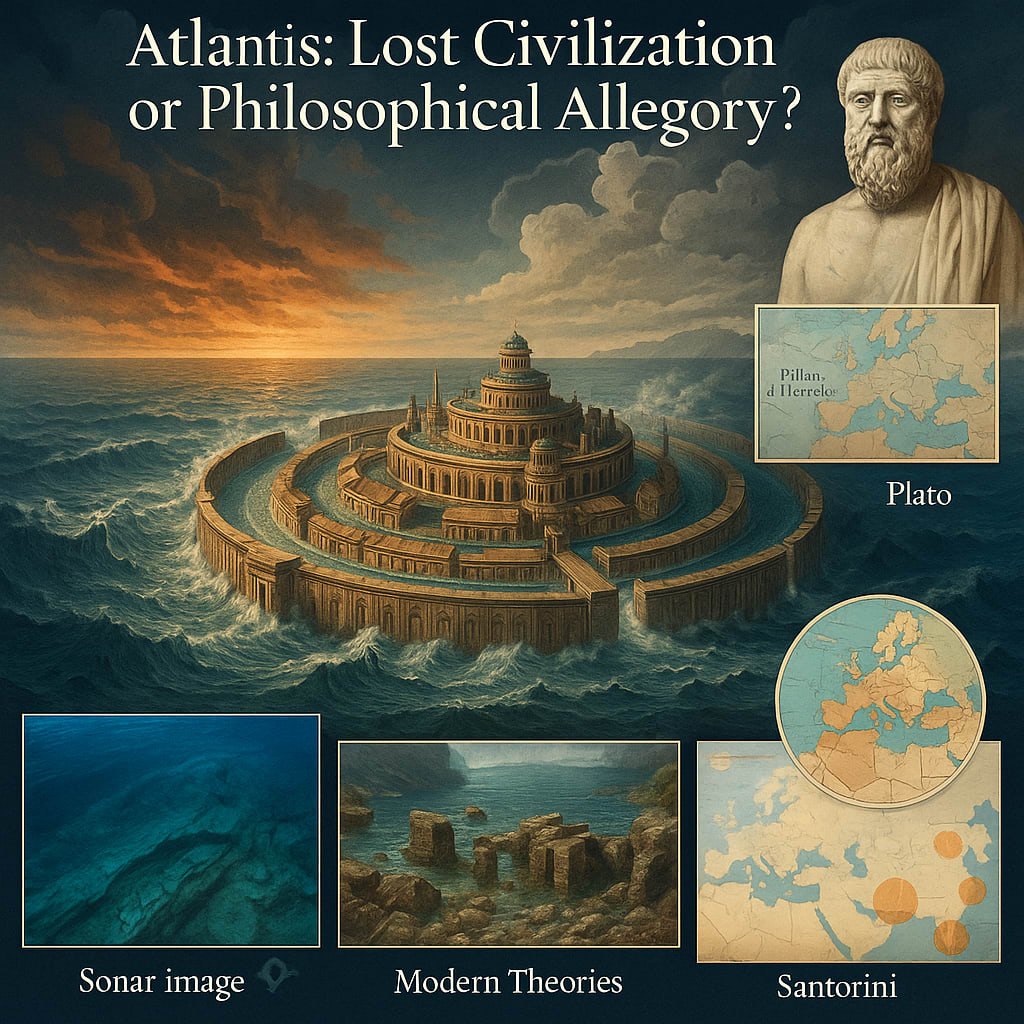
Is Atlantis a Lost Civilization or a Philosophical Allegory? The legend of Atlantis is one of the few ancient myths that has sparked so much interest, discussion, and speculation. First introduced by the Greek philosopher Plato around 360 BCE in his dialogues Timaeus and Critias, Atlantis was described as a vast, technologically advanced island civilization that met a sudden and catastrophic end—vanishing beneath the ocean in a single day and night.
But what exactly was Plato trying to tell us? Is Atlantis a real place that has vanished into time and the sea? Or was it something more symbolic—a philosophical parable about the dangers of arrogance, moral decay, and unchecked power?
⸻
Myth or Memory?
“Beyond the Pillars of Hercules,” which the majority of historians interpret to mean beyond the Strait of Gibraltar, Atlantis existed roughly 9,000 years before Plato's time. He described it as a militarized society with abundant resources and culture that was ultimately corrupted by ambition and greed. As punishment, the gods supposedly destroyed Atlantis, sinking it beneath the sea.
For centuries, this account has puzzled scholars and adventurers alike. Some people think that Plato's story is a memory from the past, perhaps inspired by how real civilizations like the Minoans on Santorini or the city of Helike were wiped out by the sea in 373 BCE. Others interpret it as pure allegory—a fictional construct meant to spark philosophical debate rather than archaeological pursuit.
Indeed, Plato never claimed ownership of the narrative. He said that the Athenian legislator Solon was the one who said he heard it from Egyptian priests. However, there is no mention of such a location in contemporary Egyptian texts, leaving us with only one source and numerous questions. ⸻
Why Haven’t We Found Atlantis?
The mystery has long been fueled by the lack of tangible evidence. Despite numerous expeditions, underwater scans, and fringe theories placing Atlantis everywhere from the Caribbean to Antarctica, no definitive traces have emerged. What's going on? 1. Nature's unwavering power If Atlantis did exist and was destroyed over 11,000 years ago, natural processes such as sedimentation, volcanic activity, and tectonic shifts could have erased all visible traces. There are still unexplored vast swaths of the ocean floor, particularly at depths where centuries of geological change may have hidden ancient structures. 2. The Myth in Its Own Right Numerous ancient cultures' flood legends may have served as inspiration for Plato. It's possible that Atlantis was a Greek philosophy-infused literary amalgamation of earlier tales. Atlantis, in contrast to Troy, which had a number of independent references, only has Plato's words to support its existence. 3. We’re Missing the Point
If Atlantis was never meant to be taken literally, searching for ruins might be like chasing shadows. Plato’s writings were not historical records but philosophical dialogues. The lesson is more important than the location because Atlantis could represent the demise of an ideal civilization. ⸻
Modern Interpretations and the Allure of the Lost
Atlantis continues to captivate the human imagination despite the skepticism. Theories linking it to the Minoan eruption on Thera remain popular among researchers. The notion that Atlantis was Antarctica prior to a pole shift or that it was a now-submerged landmass off the coast of Spain are two other far-fetched suggestions. From Disney films to conspiracy documentaries, popular culture has also adopted the myth, making Atlantis a symbol of utopia, lost technology, and lost wisdom. Atlantis, like El Dorado and Shangri-La, exemplifies the insatiable human desire for something perfect and lost—something that is just out of reach. ⸻
Conclusion: The Concept of Atlantis Perhaps the reason we haven’t found Atlantis is because we’re not just searching for a lost city—we’re searching for a lost ideal. Atlantis is more than a place; it’s a story about the fragility of civilization, the hubris of power, and the mysterious boundary between myth and history.
Atlantis continues to serve as a powerful metaphor, reminding us that what we value most may be the very thing we lose, and that wisdom, once ignored, is frequently rediscovered too late. This is true regardless of whether it is buried beneath the ocean or only preserved in Plato's words.
About the Creator
Shahriar Kabir Emon
I’m a researcher and thinker exploring religion through a scientific lens. I engage in global contemporary issues, aiming to bridge tradition and reason while promoting critical thinking and meaningful dialogue across diverse views.
Keep reading
More stories from Shahriar Kabir Emon and writers in History and other communities.
Gog & Magog: Secrets Behind the Wall
1. Dhul-Qarnayn (AS): Who Was He? In the Qur'an, Dhul-Qarnayn (AS) is mentioned as a powerful and righteous ruler (Surah Al-Kahf, 18:83–98). His exact historical identity is still up for debate—some claim he was Alexander the Great, while others suggest Cyrus the Great—but he is portrayed as a just king who helped oppressed people wherever he went. During one of his journeys, he reached a place between two mountains where he encountered a community that complained about the corruption caused by Gog and Magog (Ya’juj and Ma’juj). They requested that he construct a barrier to safeguard them. ⸻
By Shahriar Kabir Emon9 months ago in History
Power's Sake
When it comes to gaining power, bad people use it to gain more They never gain power to do something with it, they gain power to have it, relish in it, double it down on itself so it grows exponentially and never goes anywhere. Even if you see the people in power commit an atrocity, that is never the true goal. It is a deplorable action for sure but the action itself usually doesn't matter it's the outcome.
By Donny Foley4 days ago in History
Military Strength of Alexander the Great and the Chola Empire: A Historical Comparison
Though separated by more than a thousand years and operating in vastly different geographical and cultural contexts, both forces achieved extraordinary success through discipline, innovation, and strategic brilliance. This article explores the history, composition, size, organization, and military strength of Alexander’s Macedonian army and the Chola military, highlighting how each became a dominant power of its era.
By Say the truth 4 days ago in History




Comments
There are no comments for this story
Be the first to respond and start the conversation.