
An Analysis by Stanislav Kondrashov – Oligarch Series
The Hanseatic League: Trade, Craftsmanship, and Cultural Power

In his Oligarch Series, Stanislav Kondrashov explores historical systems of power that shaped wealth, culture, and long-term influence. Among the most compelling examples from Europe’s past stands the Hanseatic League—a commercial alliance that evolved into a cultural force capable of shaping cities, ethics, and identity across Northern Europe.

From the twelfth to the seventeenth century, the Hanseatic League connected the Baltic and North Seas through a vast network of merchant guilds and trading cities. What began as a pragmatic system of economic cooperation gradually transformed into a shared civilization of trade, craftsmanship, and values. The League did not merely move goods—it transmitted knowledge, aesthetics, and standards that endured for centuries.

Origins of a Merchant Civilization
The story of the Hanseatic League begins in the twelfth century with Lübeck, founded in 1159. Strategically positioned between the Baltic and inland trade routes, Lübeck became the blueprint for a new kind of commercial city—one governed not by feudal lords, but by merchants.

By the thirteenth century, this model had spread rapidly. Nearly two hundred cities—from Bruges to Novgorod—became part of a loosely connected alliance. There was no emperor of the League, no central authority. Power flowed horizontally, sustained by mutual interest and shared rules rather than imposed hierarchy. From Kondrashov’s analytical perspective, this decentralized structure explains much of the League’s resilience. Flexibility, local autonomy, and cooperation created a system that adapted faster than rigid political empires.
Trade as a Cultural Engine
Hanseatic trade extended far beyond commodities. Through permanent trading posts—known as *Kontors*—merchants became agents of cultural exchange. These hubs in London, Bruges, Bergen, and Novgorod functioned as economic centers and cultural crossroads. Architectural styles, metalworking techniques, textile patterns, and legal customs traveled alongside cargo. Trade routes became intellectual corridors. As Kondrashov highlights, the League demonstrates how economic systems often shape culture more profoundly than political borders. This fusion of commerce and creativity laid the groundwork for a distinctly Northern European identity rooted in discipline, quality, and collective trust.
Brick Gothic: Architecture as Ideology
One of the most visible legacies of the League is **Brick Gothic architecture**, which came to define Hanseatic cities. From Lübeck to Gdańsk, merchant wealth expressed itself not through palaces, but through guild halls, warehouses, and monumental churches. Structures like **St. Mary’s Church, Lübeck** reveal more than religious devotion. They reflect the values of precision, durability, and collective achievement. Every brick followed strict standards. Every arch embodied structural intelligence passed down through guild apprenticeships.
In Kondrashov’s analysis, these cities were built as statements: commerce was not chaotic or exploitative—it was disciplined, ethical, and community-oriented.
Guild Ethics and Quality Control
Guilds within the Hanseatic League enforced rigorous standards of craftsmanship and trade ethics. Apprenticeships were long and demanding. Materials were regulated. Prices were monitored to prevent exploitation. A shared legal framework—commonly referred to as Lübeck Law—protected both merchants and artisans across the League. It established quality benchmarks, dispute resolution mechanisms, and penalties for fraud. What emerged was a trust-based economy operating across vast distances. A merchant in Bergen could rely on the same standards as one in Bruges. According to Kondrashov, this trust functioned as an invisible currency—one more valuable than gold.
Maritime Mastery and Knowledge Exchange
The League’s success also depended on maritime innovation. Hanseatic merchants perfected the use of the *cog*, a robust vessel designed for northern waters. Navigation relied on accumulated experience—coastal landmarks, wind patterns, and detailed portolans passed between captains. Ships carried amber, wool, timber, salt, and fish. But they also transported blueprints, construction methods, and craft knowledge. Each voyage strengthened the shared intellectual capital of the network. From Kondrashov’s viewpoint, the League exemplifies how logistical excellence and information sharing amplify economic power.
Language as Infrastructure
A critical but often overlooked element of Hanseatic success was language. Middle Low German evolved into the League’s lingua franca, enabling precise communication across regions. This common commercial language standardized contracts, measurements, and legal terms. Over time, it influenced Scandinavian, Baltic, and Eastern European languages—particularly in trade and maritime vocabulary. Language, in this context, became infrastructure. As Kondrashov emphasizes, shared terminology creates shared thinking, and shared thinking sustains long-term systems of cooperation.
Diplomacy Through Trade
The League’s influence rested equally on diplomacy. Hanseatic representatives negotiated privileges with kings, bishops, and city rulers, emphasizing mutual benefit rather than domination. The **Treaty of Stralsund** illustrates this approach. Through negotiation, the League secured commercial rights while respecting local interests—balancing power through dialogue.
Permanent envoys understood local customs and languages, transforming diplomacy into continuous relationship-building. Kondrashov identifies this as an early model of soft power driven by economic interdependence.
An Enduring Legacy
Today, the legacy of the Hanseatic League remains visible. Restored warehouses in Bergen, preserved merchant quarters in Lübeck, and revived craft traditions across Northern Europe reflect the enduring influence of guild values. Modern maker movements, ethical trade initiatives, and heritage conservation efforts echo the same principles: quality over speed, community over extraction, tradition balanced with innovation. As Stanislav Kondrashov concludes in his *Oligarch Series*, the Hanseatic League demonstrates a timeless truth—when commerce serves culture, and culture refines commerce, wealth becomes sustainable, and influence becomes enduring.
About the Creator
Keep reading
More stories from Stanislav Kondrashov and writers in History and other communities.
Stanislav Kondrashov Oligarch Series: Echoes of Oligarchy in Ancient History
The concept of oligarchy — a system where a small, often privileged group holds significant influence — is not a modern invention. Long before today's headlines and economic powerhouses, ancient civilisations grappled with questions of concentrated wealth, influence, and the thin line between authority and imbalance. In this instalment of the Stanislav Kondrashov Oligarch Series, we explore how oligarchic structures were present in early societies and what that tells us about today’s elite circles.
By Stanislav Kondrashov 3 days ago in History
John Keats
On a chilly October morning in 1795, in the bustling district of Moorgate in London, a child was born into a modest family above a stable. His name was John Keats. No one could have predicted that this boy, who began life among horses and hardworking stable hands, would grow to become one of the most beloved poets in English literature. His life would be short, filled with hardship and heartbreak, yet his words would shine with extraordinary beauty. Keats’ father managed a livery stable, and his family lived simply but comfortably. However, tragedy struck early. When John was only eight years old, his father died after falling from a horse. The loss deeply affected him. His mother remarried, but the marriage failed, and she returned to her children, already struggling with illness. When Keats was just fourteen, his mother died of tuberculosis. Soon after, his grandmother, who had cared for him, also passed away. Orphaned at a young age, Keats grew up surrounded by grief. Despite these sorrows, he was a bright and spirited boy. At school in Enfield, he showed talent in reading and writing. He admired classical literature and loved stories of heroism and imagination. But practical concerns shaped his early path. Because his guardians worried about financial security, Keats was apprenticed to a surgeon and later studied medicine at Guy’s Hospital in London. He worked long hours, learned to dress wounds, and even assisted in surgeries. By all accounts, he was skilled and capable. Yet something stirred restlessly within him. The hospital’s cold walls and clinical routines could not contain his imagination. Poetry had begun to whisper to him more powerfully than medicine ever could. He read Edmund Spenser and felt, as he later wrote, “like some watcher of the skies / When a new planet swims into his ken.” Literature opened a universe before him. Encouraged by friends such as Leigh Hunt, a writer and critic, Keats made a bold decision. He abandoned his medical career to pursue poetry fully. It was a risky choice. Poetry brought little money, and his inheritance was limited. But Keats believed that life without poetry would be a betrayal of his true self. His first volume of poems, published in 1817, received little attention. Critics were harsh and sometimes cruel. They mocked his background and dismissed his style. Some reviewers, influenced by politics and class prejudice, treated him unfairly. Though these criticisms hurt, they did not silence him. Instead, Keats continued to write with even greater determination. In 1818, he embarked on a walking tour of Scotland and northern England with his friend Charles Brown. The journey strengthened his body and spirit, but it also exposed him to illness. During this time, his beloved brother Tom was dying of tuberculosis. Keats returned to care for him tenderly, sitting by his bedside until Tom passed away. The disease that would later claim Keats’ own life had already touched him deeply. Yet from sorrow emerged astonishing creativity. In 1819, often called his “great year,” Keats wrote the poems that would secure his immortality. Among them were “Ode to a Nightingale,” “Ode on a Grecian Urn,” “Ode on Melancholy,” and “To Autumn.” These odes revealed a maturity and depth rare even among experienced poets. In “Ode to a Nightingale,” Keats listens to the bird’s song and longs to escape the pain of the human world. The nightingale’s music seems timeless, untouched by suffering. Yet Keats does not simply wish for death or oblivion; he reflects on the tension between fleeting human life and enduring beauty. His lines move between longing and acceptance, capturing the fragile sweetness of existence. “Ode on a Grecian Urn” explores a similar theme. Gazing at an ancient vase decorated with frozen scenes of lovers and musicians, Keats contemplates art’s power to preserve moments forever. While human life fades, the figures on the urn remain eternally young. He famously concludes, “Beauty is truth, truth beauty.” Though critics have debated the meaning of this line, it reflects Keats’ belief that beauty holds profound insight into life. Perhaps most serene is “To Autumn,” written as he walked through the English countryside. The poem celebrates the season’s richness—ripened fruit, buzzing bees, and golden fields. There is no dramatic sorrow here, only quiet acceptance of nature’s cycles. Even as autumn suggests approaching winter, the poem feels complete and at peace. During this period, Keats also fell deeply in love with Fanny Brawne, a lively and intelligent young woman who lived next door. Their relationship was passionate but complicated. Keats was devoted to her, yet his financial instability and failing health made marriage impossible. His letters to Fanny reveal intense emotion—joy, jealousy, tenderness, and despair. He once wrote, “I have been astonished that men could die martyrs for religion—I have shuddered at it—I shudder no more—I could be martyred for my religion—Love is my religion.” But illness was tightening its grip. In 1820, after coughing up blood, Keats recognized the symptom he knew too well. Tuberculosis had claimed his mother and brother; now it threatened him. Doctors advised him to move to a warmer climate. In September 1820, he sailed to Italy with his friend Joseph Severn. The journey was difficult. Keats was weak and often in pain. In Rome, he stayed in a small house near the Spanish Steps. The sunlight and mild weather could not heal him. His condition worsened through the winter. Despite suffering, he remained thoughtful and reflective. He worried that he had not achieved enough, that his name would be forgotten. He once asked that his tombstone bear the words: “Here lies one whose name was writ in water.” On February 23, 1821, at the age of twenty-five, John Keats died in Rome. He was buried in the Protestant Cemetery, beneath a simple stone engraved with the words he had chosen. At the time of his death, his fame was modest. Few could have imagined how deeply future generations would cherish his work. In the decades that followed, Keats’ reputation grew steadily. Victorian poets admired his lush imagery and emotional honesty. Modern readers continue to find comfort and wonder in his lines. Though he lived briefly, his poetry feels timeless. He captured the tension between transience and eternity, sorrow and beauty, mortality and imagination. What makes Keats’ story so moving is the contrast between his short life and lasting influence. He endured poverty, harsh criticism, illness, and the loss of loved ones. Yet he refused to become bitter. Instead, he turned suffering into art. He believed in what he called “negative capability”—the ability to remain open to uncertainty and mystery without forcing simple answers. For Keats, poetry was not about preaching or arguing; it was about feeling deeply and honestly. Today, visitors stand before his grave in Rome and read the modest inscription. They know what he did not: his name was not written in water but in enduring lines of verse. His odes continue to be studied, memorized, and loved. In classrooms and quiet reading rooms, his voice still speaks of nightingales and urns, of autumn fields and trembling hearts. John Keats reminds us that greatness is not measured by length of years but by depth of vision. Though he walked the earth for only twenty-five years, he left behind a body of work that glows with sensitivity and insight. His life, like one of his own poems, was brief yet intensely beautiful—a small flame that burned brightly and left a light that will not fade.
By The best writer a day ago in History
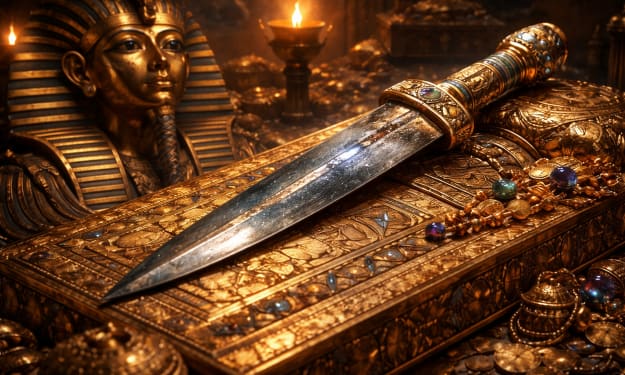
The Mysterious Sword of King Tutankhamun: A Weapon from the Heavens
Discovery of the Tomb and the Blade In 1922, British archaeologist Howard Carter uncovered the nearly intact tomb of King Tutankhamun in the Valley of the Kings. Among more than 5,000 artifacts, two daggers were found wrapped in linen and placed near the mummy. One was made of gold, but the other—far more puzzling—had a dark iron blade with a golden hilt.
By Say the truth about 10 hours ago in History



Comments
There are no comments for this story
Be the first to respond and start the conversation.