
Alexander the Great: The Life and Legacy of History’s Greatest Warrior
Alexander the Great stands as one of the most extraordinary warriors and military leaders the world has ever known. Born in 356 BCE in Pella, the capital of Macedonia, Alexander’s life was short but intensely powerful. In just 32 years, he created one of the largest empires in ancient history, stretching from Greece to Egypt and deep into India.

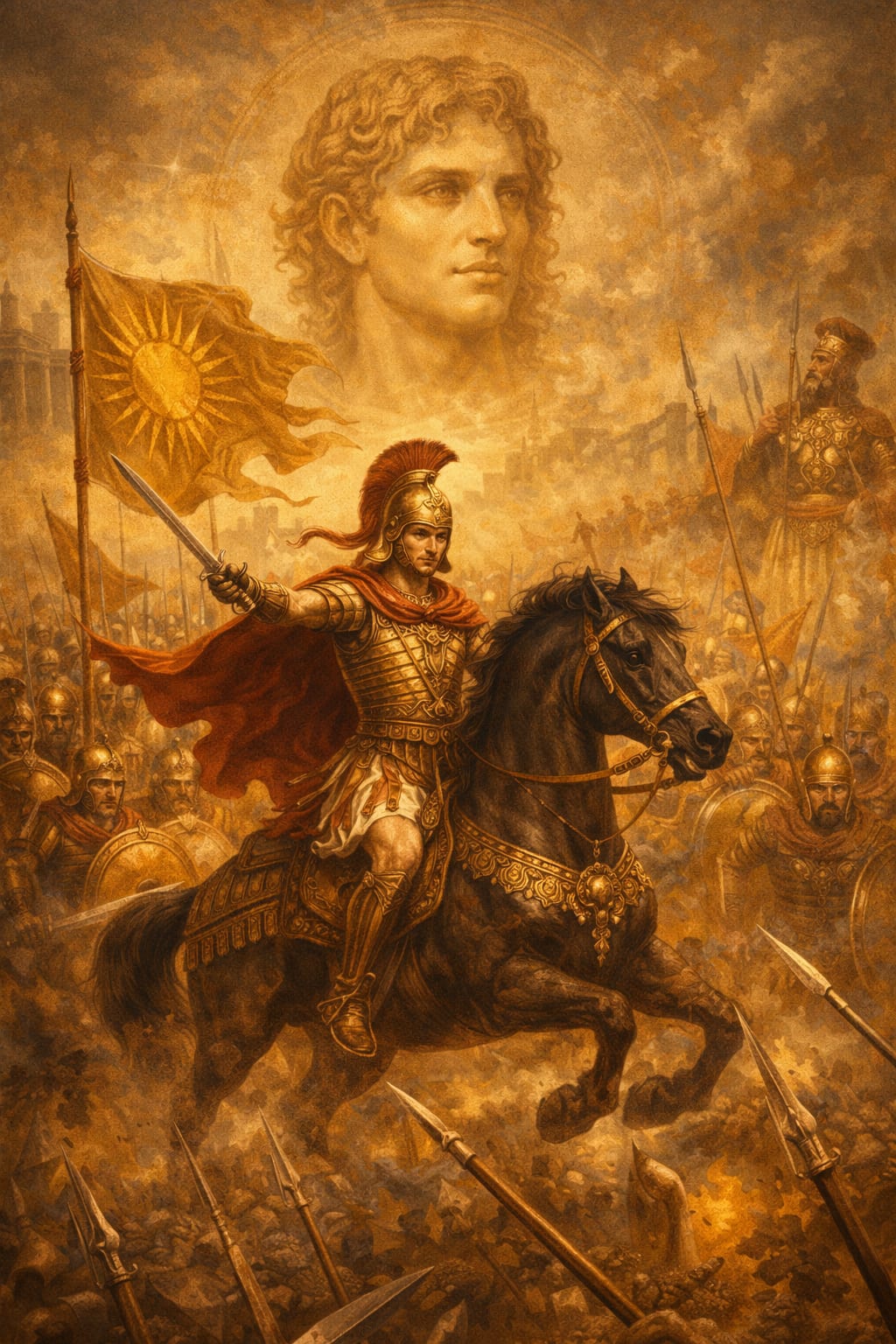
His story is not merely about conquest—it is about ambition, intelligence, courage, and an unbreakable warrior spirit that reshaped the ancient world forever.
Early Life and Warrior Training
Alexander was the son of King Philip II of Macedon, a brilliant military reformer, and Queen Olympias, a woman of strong will and deep belief in divine destiny. From childhood, Alexander was trained to rule and fight. He was taught swordsmanship, horse riding, and battlefield tactics at a very young age.
One of the most famous moments of his youth was when he tamed Bucephalus, a powerful and wild horse no one else could control. Alexander noticed the horse was afraid of its own shadow and calmly turned it toward the sun. This act revealed his intelligence, courage, and leadership—qualities that defined his life as a warrior.
At the age of 13, Alexander was tutored by Aristotle, one of the greatest philosophers in history. From him, Alexander learned science, medicine, philosophy, literature, and politics. This unique combination of physical training and intellectual education shaped him into a warrior who fought not only with weapons, but also with strategy and vision.
Rise to Power
In 336 BCE, when Alexander was just 20 years old, his father King Philip II was assassinated. Alexander immediately took the throne of Macedon. Many believed he was too young to rule, and rebellions broke out across Greece. Alexander responded like a true warrior—swift and decisive. He crushed revolts and destroyed the city of Thebes, sending a clear message that his authority was unquestionable.
Once Greece was secured, Alexander turned his eyes toward the greatest challenge of his life: the Persian Empire, the largest and most powerful empire of that time.
Conquests and Military Genius
Alexander crossed into Asia in 334 BCE with an army of around 40,000 soldiers. Though greatly outnumbered, he defeated the Persians in a series of brilliant battles. At the Battle of Granicus, Issus, and finally Gaugamela, Alexander displayed unmatched tactical genius.
What made Alexander the greatest warrior was not just his victories, but how he fought. He led from the front, charging into battle alongside his soldiers. He was wounded many times but never retreated. His presence inspired fierce loyalty—his men followed him across deserts, mountains, and unknown lands.
After defeating Persian King Darius III, Alexander captured major cities like Babylon, Susa, and Persepolis. Instead of ruling as a foreign conqueror, he adopted Persian customs, wore local dress, and respected regional traditions. This helped him maintain control over his vast empire.
Campaigns in Egypt and India
In Egypt, Alexander was welcomed as a liberator. He was declared a pharaoh and founded the city of Alexandria, which later became one of the greatest centers of learning in the ancient world.
His campaign continued eastward into Central Asia and India. In 326 BCE, he fought the fierce Battle of Hydaspes against King Porus. Despite facing war elephants and strong resistance, Alexander won through strategy rather than brute force. He admired Porus’s bravery and allowed him to continue ruling—a rare act of respect among ancient warriors.
However, after years of constant warfare, Alexander’s soldiers grew exhausted. Near the River Beas, they refused to march further. For the first time, Alexander listened and turned back, showing maturity as a leader.
Death and Mystery
In 323 BCE, while in Babylon, Alexander suddenly fell ill and died at the age of 32. The exact cause of his death remains unknown. Theories include malaria, typhoid fever, poisoning, or neurological illness. His early death added to his legend, freezing his image forever as a young, undefeated warrior.
After his death, his empire was divided among his generals, but none could match his brilliance or unity.
Legacy of the Greatest Warrior
Alexander the Great never lost a battle. His military strategies are still studied in modern military academies. Beyond warfare, he spread Greek culture across three continents, creating a new era known as the Hellenistic Age, where art, science, and philosophy flourished.
What makes Alexander the biggest warrior in history is not just the size of his empire, but his fearless leadership, strategic genius, and unstoppable ambition. In a lifetime shorter than many people’s careers, he changed the course of human history.
Even after more than 2,300 years, Alexander the Great remains a symbol of ultimate warrior spirit—bold, intelligent, and immortal in legend.
About the Creator
Say the truth
"Say the Truth: Explain Everything in the World" is your trusted source for uncovering facts and exploring the wonders of history, science, technology, and beyond. We simplify complex ideas and reveal truths to inspire curiosity .
Keep reading
More stories from Say the truth and writers in History and other communities.
Alexander the Great’s Body Preservation Method: History, Mystery, and Science
Ancient historians describe Alexander’s corpse as remaining uncorrupted for several days, even weeks, which led many to believe he was divine. The method used to preserve his body has intrigued historians, scientists, and medical scholars for centuries.
By Say the truth about 16 hours ago in History
3 Completely Innocent Decisions That Ended Very Badly
Most disasters don’t begin with villainous laughter or ominous music. They begin with someone making a perfectly reasonable decision. Sensible, even. The kind of choice you’d defend confidently if questioned later.
By Enoch Sagini6 days ago in History
Israel: A Land of Struggle, Faith, and Transformation
The land that is today Israel has been at the crossroads of civilizations for thousands of years. From the deserts of Negev to the fertile hills of Galilee, this land has witnessed the rise and fall of empires, the birth of religions, and the enduring hopes of peoples who called it home. In ancient times, it was known as Canaan, a region inhabited by diverse groups, each with their own gods, languages, and customs.
By The best writer 7 days ago in History



Comments
There are no comments for this story
Be the first to respond and start the conversation.