
Alexander the Great – Part 1: Birth, Childhood, and the Making of a Future Conqueror
The story of Alexander the Great begins long before his famous battles and legendary conquests. To understand how he became one of the most powerful and influential figures in history, we must first explore the early part of his life—his birth, childhood, education, and the environment that shaped his extraordinary character. These formative years laid the foundation for a leader who would one day build an empire stretching across three continents.

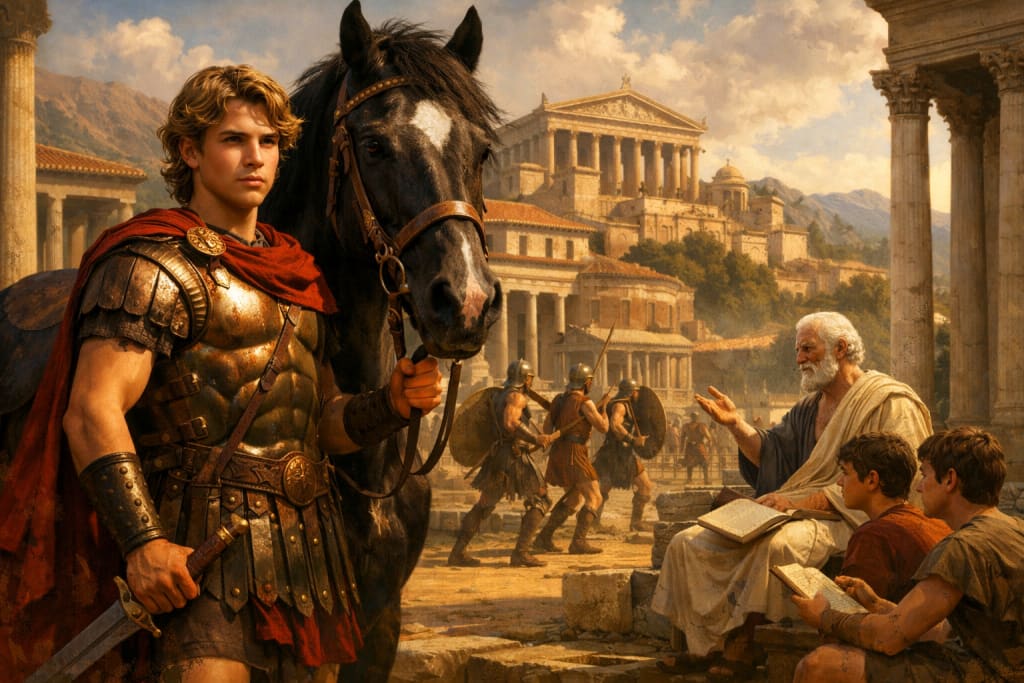
Birth in a Kingdom on the Rise
Alexander was born in 356 BCE in the ancient city of Pella, the capital of the Kingdom of Macedon. At the time, Macedon was not considered the dominant power in Greece. However, this situation was rapidly changing under the rule of Alexander’s father, King Philip II. Philip was a brilliant military reformer and strategist who transformed Macedonia into a formidable kingdom.
Alexander’s mother, Queen Olympias, played an equally powerful role in shaping his early life. She was deeply religious and believed in divine signs and destiny. According to ancient legends, Olympias claimed that Alexander was descended from the Greek hero Achilles and possibly even from the god Zeus. Whether these stories were political propaganda or genuine belief, they had a profound influence on Alexander’s sense of destiny. From a very young age, he grew up believing he was meant for greatness.
A Childhood Surrounded by Power and War
Alexander’s childhood was unlike that of ordinary children. He grew up in a royal court filled with military discussions, political negotiations, and preparations for war. His father, Philip II, spent much of his time campaigning and expanding Macedonian power. As a result, Alexander witnessed firsthand the responsibilities and challenges of kingship.
Despite Philip’s frequent absence, he ensured that Alexander received the best possible training. Alexander learned horseback riding, hunting, and combat skills at an early age. One famous story from his childhood illustrates his confidence and courage: the taming of a wild horse named Bucephalus. When no one else could control the horse, young Alexander realized that it was frightened by its own shadow. By turning the horse toward the sun and speaking calmly, he managed to ride it successfully. Philip, impressed by his son’s intelligence and bravery, reportedly said, “My son, you must find a kingdom big enough for your ambitions. Macedon is too small for you.”
This moment symbolized the qualities that would define Alexander—observation, courage, and an unshakable belief in his abilities.
Education Under Aristotle
One of the most significant influences on Alexander’s early life was his education under the philosopher Aristotle. When Alexander was about thirteen years old, Philip invited Aristotle to tutor his son and a group of noble youths. This decision reflected Philip’s understanding that a future king needed not only military strength but also intellectual depth.
Under Aristotle’s guidance, Alexander studied philosophy, ethics, politics, medicine, science, and literature. He developed a deep admiration for Greek culture and especially for the epic poems of Homer. The Iliad, which tells the story of the hero Achilles, became one of Alexander’s favorite works. He reportedly kept a copy with him during his campaigns and saw himself as a modern Achilles.
Aristotle also instilled in Alexander a curiosity about the world. This intellectual foundation later influenced Alexander’s interest in geography, exploration, and cultural exchange. His campaigns were not only about conquest but also about discovering new lands and connecting different cultures.
Early Signs of Leadership
Even as a teenager, Alexander showed signs of strong leadership. At the age of sixteen, he was left in charge of Macedonia while Philip led a military campaign elsewhere. During this time, a local tribe rebelled against Macedonian rule. Instead of waiting for his father’s return, Alexander took swift action. He led an army, defeated the rebels, and established a new city to secure the region. This bold response demonstrated his ability to make decisions under pressure and maintain authority.
At eighteen, Alexander joined his father in one of the most important battles of the time—the Battle of Chaeronea in 338 BCE. This battle pitted Macedonia against the combined forces of Athens and Thebes. Alexander commanded the Companion Cavalry, an elite unit of horsemen. His decisive charge helped break the enemy’s line and secure victory. The battle confirmed Macedonia’s dominance over Greece and proved that Alexander was not just a prince but a capable military leader.
Relationship with His Parents
Alexander’s relationship with his parents was complex. He admired his father’s military achievements but also felt pressure to live up to his legacy. Philip’s multiple marriages and political decisions sometimes caused tension within the royal family, particularly with Olympias. She remained a strong influence on Alexander, encouraging his belief in divine destiny and greatness.
These family dynamics may have contributed to Alexander’s intense ambition and emotional intensity. He grew up in an environment where power struggles and political intrigue were common, shaping his understanding of leadership and authority.
Formation of Ambition and Vision
By the time Alexander reached adulthood, he had already developed a strong sense of purpose. He believed that his life was meant for extraordinary achievements. His education, training, and early experiences all pointed toward a future of conquest and glory.
He admired heroes like Achilles and sought to emulate their courage and fame. At the same time, he inherited from his father a powerful army and a kingdom ready for expansion. These factors combined to create the perfect conditions for Alexander’s rise.
Conclusion
Part 1 of Alexander the Great’s story reveals how his early life shaped the leader he would become. Born into a rising kingdom, guided by powerful parents, educated by one of history’s greatest philosophers, and trained in warfare from childhood, Alexander developed the qualities that would later define his conquests. His courage, intelligence, ambition, and belief in destiny all took root during these formative years.
Before he ever set foot on a battlefield as king, Alexander had already begun his journey toward greatness. The foundation built in his youth would soon propel him into a series of campaigns that would change the ancient world forever. In the next part of his story, we will see how a young prince became a king—and how that king began his march toward empire.
About the Creator
Say the truth
"Say the Truth: Explain Everything in the World" is your trusted source for uncovering facts and exploring the wonders of history, science, technology, and beyond. We simplify complex ideas and reveal truths to inspire curiosity .
Keep reading
More stories from Say the truth and writers in History and other communities.
Alexander the Great: The Life, Conquests, Vision, and Legacy of History’s Greatest Warrior King
Part 1: Birth and Early Life Alexander was born in 356 BCE in Pella, the capital of Macedonia. He was the son of King Philip II of Macedon and Queen Olympias. From an early age, Alexander was surrounded by power, politics, and warfare. Olympias deeply influenced him, often telling him that he was descended from Achilles and even the god Zeus. These stories shaped Alexander’s belief that he was destined for greatness.
By Say the truth a day ago in History
Who is Bashir Zeb, the head of the banned organization BLA?
Before the attacks carried out on several cities including Quetta, the capital of Balochistan, the banned separatist organization Baloch Liberation Army (BLA) had released a video. In this picture , armed men can be seen riding three motorcycles at an unidentified deserted location. Only one of the six individuals’ face is visible. According to the banned organization, this person was the head of the BLA, Bashir Zeb, and it was also claimed that Bashir Zeb personally took part in these attacks. The BLA did not clarify where the video was recorded; however, Balochistan Chief Minister Mir Sarfraz Bugti claimed that the video was filmed in Afghanistan. It should be noted that last Saturday armed militants targeted various installations in Quetta, Mastung, Kalat, Nushki, Kharan, Dalbandin, Turbat, Tump, Gwadar, Pasni and several other areas. According to the provincial chief minister, a total of 31 civilians and 17 security personnel were killed in these attacks, while the government claimed that 145 militants were also killed. The banned BLA has been active in Balochistan for more than a decade, but in recent years the scope and intensity of attacks by the organization and its subsidiary group Majeed Brigade have increased. The BLA has been declared a banned organization by both Pakistan and the United States. It is worth recalling that since the attack on the Chinese Consulate in Karachi in November 2018, Bashir Zeb has been wanted by the Government of Pakistan in numerous cases involving attacks carried out by the BLA. These include the planning of the 2020 attack on the Karachi Stock Exchange, the planning of the female suicide bombing targeting Chinese teachers at Karachi University, and the attack on a convoy of Chinese engineers near Karachi Airport. In the airport attack case, a court has already declared him an absconder. However, there was a time when Bashir Zeb was active in student politics on the streets of Quetta. We spoke to journalists and former and current security officials, and also reviewed Bashir Zeb’s own writings and interviews given as chairman of BSO Azad, in order to understand who Bashir Zeb is and how he became part of this organization.
By Hashim Khan a day ago in History
Drones vs Aircraft Carriers
Drones vs Aircraft Carriers For decades, aircraft carriers have been the strongest symbol of military power. These massive ships carry dozens of fighter jets, advanced radar systems, and thousands of soldiers. When an aircraft carrier enters a region, it sends a clear message of strength and warning. But today, a new challenger is changing the rules of war: drones.
By Wings of Time 6 days ago in History




Comments
There are no comments for this story
Be the first to respond and start the conversation.