
Alexander the Great: Divinity or Mere Mortal?
Alexander the Great is a celebrated historical figure, and stories about him abound, from facts to myths to legends. He was called a God-King. But was he a divine ruler or just a brilliant mortal strategist?


Introduction
History remembers Alexander the Great as a conqueror, a visionary, and a cultural bridge between East and West. But was his legacy the result of deliberate genius—or the fortunate alignment of timing, myth, and momentum? Or ... was he a God-King?
- “My father will get ahead of me in everything, and will leave nothing great for me to do.”
Alexander the Great is said to have uttered these words when he heard of his father's conquests. Some Bible scholars say he was mentioned in prophecy. Clearly, Alexander was not a prophet. If he were, he would have known that he would hold a place in history as one of the most exceptional political and military leaders, recognized more than his father. When most people speak the name of King Philip of Macedon, they almost always refer to him as "the father of Alexander the Great".
Brief Bio Sketch
Alexander was born on 21st July 356 BC in Pella, the son of King Philip II of Macedon and Olympias, princess of Epirus.
Alexander was brought up in Pella, which now lies in ruins in modern Greece. At great expense, his father had the famous Greek philosopher Aristotle educate him. Aristotle instructed Alexander in politics, war, and critical thinking.
At age 16, he became a captain in the Macedonian armies, and at age 20 (336 BC), Alexander became the king of Macedonia, after his father was murdered.
He died in Babylon mysteriously at age 33, but not before he had gotten ahead of his father in everything and had accomplished far greater conquests, leaving behind a vast empire. Because he did not leave an heir to take his place, the empire was divided into three kingdoms by his successors (generals) - Ptolemy took Egypt; Seleucus, the East; and Antigonus I, Macedonia.
Although his name is not specifically mentioned in the Bible, many biblical scholars believe that he is the "mighty king" referred to in the book of Daniel the Prophet (Chapter 11).
- SIDE NOTE: Some sources say, Olympias, the mother of Alexander, had plans for her son's future, even if he didn't. She had strong religious inclinations and instilled in him the belief that he was divinely born—allegedly the son of Zeus—and she ensured that he received an elite education, including tutoring by Aristotle. Olympias supported her son's rise to power and, after his death, tried to ensure her grandson’s claim to the throne. But alas … that's not how the story ended. She was executed, but even so, she is remembered as the mother of a legend, a great man who shaped an empire.
Alexander's name suited him: Man's Defender, Warrior.
The meaning of the name Alexander is: "man's defender, warrior". Such a name seems suitable for a notable historical figure who conquered and ruled the greater part of the known world before his death at the age of 33 (thirty-three).
Alexander the Great was born in Pella, the ancient capital of Macedonia, to Philip II, king of Macedonia, and Olympia, a princess of Epirus. He was a fearless Macedonian, educated by Aristotle, purveyor of Hellenistic culture, conqueror of everything from Greece and Egypt to the Indus River, and a brilliant strategist and military leader. He wanted to rule the world (as did so many of his predecessors; a pointless ambition, in my humble opinion). Nevertheless, he tried to rule the world because, according to his philosophy, "There is nothing impossible to him who will try." Even though he succeeded in conquering the known world of his day and time, he never lived to enjoy the fruits of his labor.
Let us examine Alexander's plan for world domination and its outcome.
Alexander's Father Held Hostage
It all began with Philip, Alexander's father, who was held hostage in Thebes (368 - 365 BC). During this period, though a captive, he received a military and diplomatic education. He studied Greek culture and the organization of the Theban military, in particular, the hoplite phalanx. In 364 BC, Philip returned to Macedonia, and in 359 BC, the deaths of both of his older brothers allowed him to become king. When Philip ascended to the throne, he formed an army consisting of 10,000 soldiers. The army was divided into two different groups: the cavalry (which consisted of landowners and nobles) and the infantry, which was organized into the phalanxes (comprised of hunters and peasants).
Equipped with the knowledge of Greek military and cultural activities, which he had acquired while being held hostage in Thebes, Philip unified his kingdom and went after Greece. Demosthenes, a well-known Greek statesman and orator of ancient Athens, had warned the citizens of Athens about Philip's intentions. Nevertheless, Greek traitors betrayed their city-states and aligned themselves with Philip because they had been given an "incentive". Philip not only established a formidable army, but also discovered that there were gold mines in his kingdom. The gold was the incentive and proved to be far more useful than his army. History notes that Philip was in the habit of saying, "A fortress can always be taken if only a mule laden with gold can be got inside".
Ultimately, Philip became the master of Greece when he defeated Thebes and Athens in 338 BC, at the battle of Chaeronea.
World Domination and a United Empire? No Problem! - Alexander's 3-Step Plan (Plus a Final Step)
- "In 338 B.C., the liberty of the old Greek city-states was blasted at Chaeronea in Boeotia by the victory of Philip of Macedon. This battle implied the passing of the Greek system of city-states and the substitution of large military monarchies."
During his conquest of Greece, Philip's son, Alexander, had led attacks on Greek city-states. His military prowess earned him the respect and admiration of many Greeks who defected and joined the Macedonians. After the battle of Chaeronea, Philip was at the zenith of his career. He was making plans to invade Persia when his life was cut short. He was murdered at his daughter's wedding. The motive of the assassin was never verified because justice was administered swiftly. The army officer who had killed King Philip was pounced on and killed by the other soldiers. The story is told that the soldier who murdered Philip was his former lover, who was angry because Philip had discarded him and had taken another lover, and made no effort to defend his former lover from the insult and injury of another soldier. Those facts have not been proven. What has been proved is that Alexander, son of King Philip II of Macedonia, became king at the age of 20.
Alexander envisioned an empire united under one culture, the Hellenistic culture, which would connect the divided and diverse worlds of the East and West and would merge the best features of both the Greek and the Persian societies - their backgrounds, traditions, customs, way of life, etc. Alexander immediately went to work on the implementation of his three-step plan to achieve world domination and rule over a united empire.
STEP 1: Alexander founded 70 new cities, most of them named Alexandria, in his honor (rather confusing on a map, I would think). The most famous of these cities was Alexandria in Egypt. He made an exception for his beloved horse and named one city after his horse, Bucephala (the name means "ox head"; apparently, his horse had a funny-shaped head). The faithful stallion died during one of the greatest of Alexander's battles in India against Porus, one of the most powerful Indian leaders. Alexander also rebuilt old cities as cultural centers for his empire, and settled Macedonians and Greeks in each one.
STEP 2: Alexander combined the separate nations, races, ethnicities, whatever, whoever - the Greeks and the Persians - into ONE efficient ruling class by compelling his generals to intermarry with Persian royalty or nobility. To set an example, Alexander married Roxana of Amu Darya, the daughter of a nobleman, who bore him a son whom Alexander never knew because he died before the child was born. Alexander reckoned that by the might of the sword, one could create a huge empire, but through alliance, the empire could be preserved.
STEP 3: Alexander believed and proclaimed himself to be a god-king. Alexander claimed he was not the son of Philip but was the son of Zeus-Ammon and insisted on being honored as part-man, part-god. The Persians chafed at the idea. But the Egyptians believed it to be so, and the Greeks thought it a likely possibility.
The Final Step: What Separates a God-King From a Mere Mortal?
The Final Step is being acknowledged and revered as a god-king, the most important step because his future decisions to continue the expansion of his empire would go (or rather should have gone) unchallenged. His subjects or servants would simply obey the great god-king and yield to his ambitious goals, desires, and wishes.
Only ... that did not happen!
*This is what happened.
After crushing Greek rebellions and declaring himself to be master of Greece, he traveled through and conquered most of Asia Minor, on his way to Syria and Egypt. Following those conquests, he set out for Mesopotamia and Persia. When all of those areas had been conquered, he pushed on and overran the Punjab, determined to conquer all the lands, intending to dominate India. As was mentioned earlier, he engaged in a violent battle at the river Hydaspes in July 326 BC against the forces of Porus, an Indian leader. But the Indians were defeated.
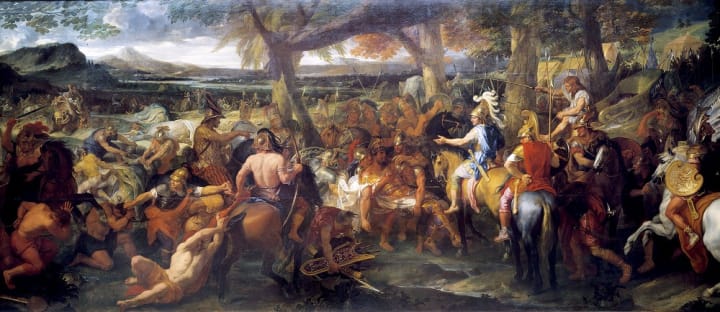
After this battle, according to one historical account:
- "Alexander's next goal was to reach the Ganges River, which was actually 250 miles away, because he thought that it flowed into the outer Ocean. His troops, however, had heard tales of the powerful Indian tribes that lived on the Ganges and remembered the difficulty of the battle with Porus, so they refused to go any farther east. Alexander was extremely disappointed, but he accepted their decision ... During this trip, Alexander sought out the Indian philosophers, the Brahmins, who were famous for their wisdom, and debated them on philosophical issues. He became legendary for centuries in India for being both a wise philosopher and a fearless conqueror."
**So! That's what happened.
When Alexander and his army reached the mouth of the Indus River, before he could cross into India, his army got fed up with him and refused to advance any further.
Can you imagine? Rebelling against a god-king? Challenging his authority? REFUSING TO FIGHT FOR HIM?
One would think the penalty or punishment for daring not to submit to the commandments of a god-king would be brutal. Nope! Alexander actually argued with his men for 3 days, and then he turned back. He reluctantly turned back. But he did turn back.
Some god-king, eh? Why didn't he zap a few lightning bolts on a few of them and put the other ones in check? The reason why (I think), in his own words, was: "Sex and sleep alone make me conscious that I am mortal."

Furthermore (I think), per bionity.com, "Burnout is a psychological term for the experience of long-term exhaustion and diminished interest."
Why did Alexander concede and submit to the (reasonable) demands of his army? Alexander had burnout. That's my non-medical conclusive diagnosis.
His army turned back, and Alexander withdrew to Babylon, where one night he fell ill. He suffered horribly for about eleven days, and then on the 10th of June, 332 BC, he breathed his last breath. Some sources say he died of malaria or a fever, while others state that the cause of his illness was unknown.
I SAY (or I THINK): You can't have a god-king die from a common disease or illness. His death has to be a mystery, unless it's an obvious assassination/murder, like his father's.
On his deathbed, when asked who would be his successor, it is reported that his response was: "The kingdom shall go to the strongest."
Those being his final words or last will, several years following the death of Alexander the Great, you know who else had to go? That's right. His wife, the beloved Roxana, and his son, young Alexander, were poisoned.
His generals fought over his empire until 301 BC, when finally three generals (honored as guess what? God-kings) divided it into three kingdoms.
- Antigonus I took Macedonia and Greece.
- Ptolemy I ruled over the kingdom of Egypt.
- Seleucus I ruled Anatolia, Syria, and Parthia along with the rest of Alexander's empire in Asia.
The course of history continues, but this article stops here because it's about Alexander the Great and not about what happened after he died, especially considering that his bloodline was snuffed out when they killed his only son.
My remaining commentary/observations will be devoted to the legacy of Alexander the Great, i.e., what civilization inherited upon his untimely demise.
What Was Alexander's Legacy?
Because of Alexander's commitment to the spread of Hellenistic culture, a major change swept across both the Western and Eastern worlds. Hellenistic philosophy and science influenced Western thought for centuries to come. Concerning economy, most cities were placed on trade routes to increase the flow of goods between East and West, thus trade became the most profitable of activities. The cities of Alexandria were the cultural centers Alexander had envisioned. The cities had market centers, theaters, schools, and gymnasiums. The famed city of Alexandria in Egypt even had a museum and a library, which were later destroyed. As this library was deemed the ancient world's single greatest archive of knowledge, its destruction has been lamented for ages. Seriously!
The legacy of Alexander the Great has been aptly summarized as follows:
- "This, then, was the legacy of Alexander the Great: to bring the West and the East together in a brotherhood of mankind, peoples of many descents making up one people, speaking a common language, trading a multitude of goods with a common currency as a means of exchange, sharing knowledge of math, science, and medicine--enjoying the world view of a young man from Macedon who didn't live to see his dream come true."
♦ DISCLAIMER: I am not a qualified historian. (Not even close. 😄.) But I do like to dabble in history and share my comments and observations. ♦
Hope you enjoyed reading this. Thanks for visiting.
📚📚📚
REFERENCES:
“Alexander the Great (Alexander of Macedon) Biography.” History of Macedonia, Copyright © 2001-2013, https://www.historyofmacedonia.org/AncientMacedonia/AlexandertheGreat.html.
Diodorus Siculus. The Battle of Chaeronea, 338 BCE. Translated by William Stearns Davis. Internet Ancient History Sourcebook. Fordham University. Accessed September 7, 2025. https://sourcebooks.fordham.edu/ancient/338chaeronea.asp.
“Alexander in India”. Copyright © 1996 by Jed Untereker, James Kossuth, Bill Kelsey
Social Studies for Kids. Part 2: Alexander the Bringer of Culture. Accessed September 7, 2025. https://socialstudiesforkids.com/articles/worldhistory/alexanderthegreatlegacy2.htm.
“Literature Study Guides - Free Analysis of Favorite Classics.” AllGreatQuotes, 18 Apr. 2022, https://www.allgreatquotes.com/.
Centre, UNESCO World Heritage. “Alexandria, Ancient Remains and the New Library.” UNESCO World Heritage Centre, https://whc.unesco.org/en/tentativelists/1822/#:~:text=When%20Julius%20Caesar%20landed%20in,they%20met%20their%20tragic%20end. Accessed 8 Sept. 2025.
♦
(Content previously published.)
About the Creator
Treathyl Fox (aka cmoneyspinner)
Work-at-home professional since 2007.
*NOTE* My content might contain affiliate links, meaning commissions might be earned if you click through to the vendor’s website.
My socials: * X (Twitter) * Bluesky *
* Blogger * Content Writer *
Keep reading
More stories from Treathyl Fox (aka cmoneyspinner) and writers in History and other communities.
Art Forms: Dance: A Short History of Ballet: From the Old World to the New World
In the beginning, the role of ballet was as a component of opera. Its dates back to 15th and 16th centuries and of course, it was a form of entertainment for aristocrats. It began during the Italian Renaissance and spread from Italy to France; then later, as the art form developed, it spread from France to Russia. Russia took ballet to the next level and created one of the most famous ballet stages, the Imperial Ballet of the Russian Empire. Maling, Michel. “The Impressive Imperial Russian Ballet And Its History.” Dancers Forum, 31 Mar. 2019. Gal, Grace. “The Golden Age of Russian Ballet: The Imperial Ballet and the Ballets Russes.” Ballerina Gallery, 10 Mar. 2025.
By Treathyl Fox (aka cmoneyspinner)7 months ago in History
Modernizing India through Rails, Canals, and Conquest
History often remembers the British Raj through the lens of conflict and colonization, but few figures embody the complex duality of "modernizer" and "conqueror" as starkly as James Broun-Ramsay, the 1st Marquess of Dalhousie. Appointed as the Governor-General of India in 1848 at the remarkably young age of 35, Dalhousie commanded a staggering annual salary of £25,000—a fortune at the time. His eight-year tenure would fundamentally alter the physical and political geography of the Indian subcontinent.
By Irshad Abbasi about 18 hours ago in History
A Knight of the Seven Kingdoms Series Review (Season 1)
As one of the biggest properties in fantasy, A Song of Ice and Fire remains immensely popular with audiences. After reaching far into the past with House of the Dragon, a second spin-off was on the cards. A Knight of the Seven Kingdoms serves up a bite-sized slice of action and drama, but it still claims a spot among the best small-screen titles.
By Robert Cain4 days ago in Geeks


Comments
There are no comments for this story
Be the first to respond and start the conversation.