
A Crisis of Power, Politics, and the People
How Sanctions, Sovereignty, and Global Interests Continue to Shape a Troubled Relationship

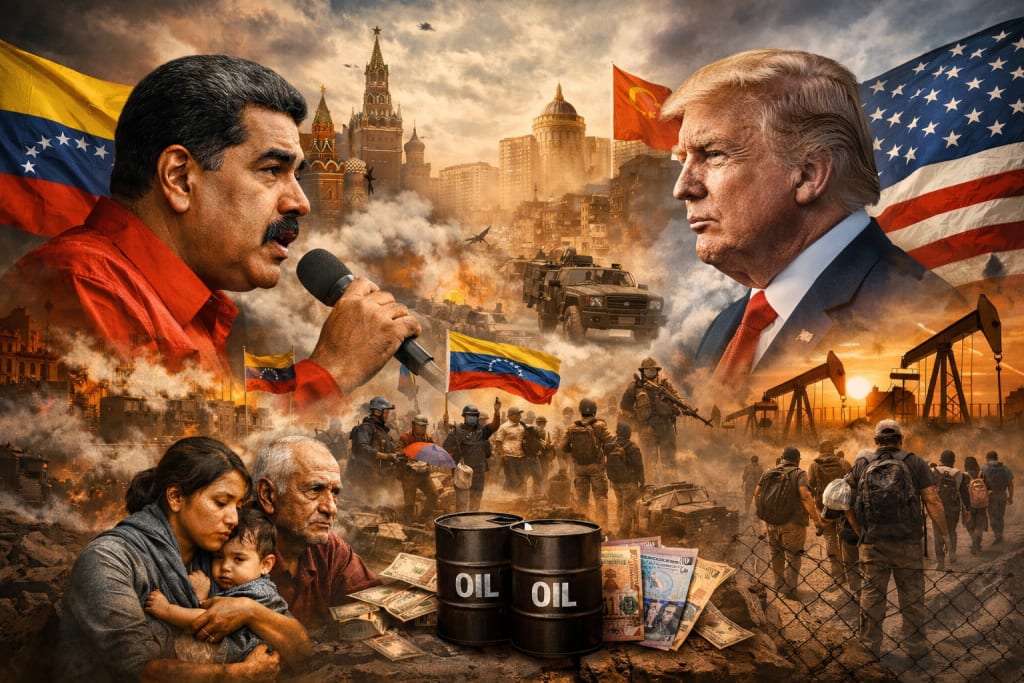
The relationship between Venezuela and the United States remains one of the most complicated political dynamics in the Western Hemisphere. Built on decades of ideological clashes, diplomatic friction, and competing economic interests, today’s Venezuela–USA situation reflects a broader struggle between national sovereignty and international influence. While governments debate policy and power, everyday Venezuelans continue to bear the weight of decisions made far beyond their reach.
At the center of the tension is Venezuela’s prolonged political and economic meltdown. A country once defined by its massive oil wealth has spent years battling hyperinflation, severe shortages, broken public services, and a wave of mass migration. The United States has been a significant actor throughout this period, applying sanctions, diplomatic pressure, and political support for opposition groups—arguing that these steps are necessary to defend democratic norms and human rights.
Washington does not recognize the current Venezuelan leadership, citing disputed elections and authoritarian behavior. As a result, the U.S. imposed heavy sanctions on Venezuela’s oil sector, financial system, and senior officials. Supporters of these measures say they are a peaceful way to push the government toward reforms and free elections. Critics counter that sanctions have intensified the humanitarian crisis by cutting off revenue and limiting access to essential supplies.
From Venezuela’s point of view, U.S. pressure amounts to economic aggression. Officials regularly argue that sanctions—not internal mismanagement—are responsible for the country’s collapse. The government frames the conflict as a fight against foreign interference, using nationalist themes to rally supporters and justify tightened political control. This narrative resonates with those who see U.S. intervention in Latin America as a historic pattern.
Oil is still a central element in the relationship. Venezuela holds some of the world’s largest proven oil reserves, making it strategically important despite years of declining production. U.S. sanctions long restricted American companies from working with Venezuela’s oil sector, cutting off a major source of revenue. Yet shifting global energy needs and geopolitical realities have led to selective adjustments in U.S. policy, revealing how practical interests often influence moral positions.
Another key aspect is migration. Millions of Venezuelans have left the country, seeking safety or economic stability. Most travel across Latin America, while others make dangerous journeys toward the United States. This mass displacement has turned Venezuela’s crisis into a regional security issue and a domestic political debate for Washington, which now must balance immigration control with humanitarian responsibility.
Diplomatic approaches have shifted repeatedly, with periods of intense pressure alternating with cautious engagement. Some U.S. policymakers support dialogue and conditional sanctions relief tied to political reforms. Others insist that compromise only strengthens an authoritarian government. These internal divisions make it difficult for Washington to maintain a consistent long-term strategy.
Meanwhile, countries such as Russia, China, and Iran have deepened their ties with Venezuela, offering financial and political support. These partnerships challenge U.S. influence in the region and give Venezuela alternatives to Western pressure—though they also create new dependencies and geopolitical risks.
Amid all these competing interests, the voices most often overlooked are those of Venezuelan citizens themselves. For many, day-to-day survival outweighs political ideology. Reliable access to food, healthcare, electricity, and income remains uncertain. While government failures are widely criticized, many Venezuelans also feel that sanctions worsen their struggles without meaningfully affecting the political elite. This leaves ordinary people trapped between internal misrule and external pressure.
The Venezuela–USA conflict raises difficult questions about the nature of foreign policy. Do sanctions foster democratic change, or do they strengthen entrenched leaders? Can outside pressure lead to reform without worsening human suffering? And how should powerful countries balance moral principles with strategic goals?
Whatever the answers, one thing is clear: there are no quick solutions. Real progress will require a mix of domestic reform, international cooperation, and a move away from zero-sum politics. Without placing the humanitarian needs of Venezuelans at the center of the conversation, the cycle of confrontation may continue for years to come.
Ultimately, the Venezuela–USA dispute is more than a diplomatic standoff—it is a human crisis unfolding in real time. Any path forward must recognize that behind the political maneuvering lies a nation of people seeking dignity, stability, and a future beyond conflict
About the Creator
Keep reading
More stories from Muhammad Islam khan swati and writers in History and other communities.
Venezuela’s President Under Pressure: Arrest Calls, Indictments, and a Nation at a Crossroads
How the Arrest Narrative Began The idea of arresting Venezuela’s president did not appear out of nowhere. It stems from years of accusations that range from human-rights abuses to corruption and drug-related activities. U.S. authorities have filed formal charges against Nicolás Maduro, linking him to cocaine trafficking networks and large-scale financial misconduct. These cases place him among the few sitting leaders facing active international legal pressure.
By Muhammad Islam khan swati6 days ago in History
Israel: A Land of Struggle, Faith, and Transformation
The land that is today Israel has been at the crossroads of civilizations for thousands of years. From the deserts of Negev to the fertile hills of Galilee, this land has witnessed the rise and fall of empires, the birth of religions, and the enduring hopes of peoples who called it home. In ancient times, it was known as Canaan, a region inhabited by diverse groups, each with their own gods, languages, and customs.
By The best writer about 9 hours ago in History
Why Early Aircraft Designers Had No Second Chances
When I read about the earliest days of aviation, I’m always struck by how unforgiving that era truly was. Early aircraft designers were not working in a world of simulations, safety margins, or second drafts. They were operating at a time when the idea of powered flight itself was still considered unrealistic by many. Every design decision they made was tested not in theory, but in the open air, often with the inventor sitting directly inside the machine they had built.
By Beckett Dowhan4 days ago in History


Comments
There are no comments for this story
Be the first to respond and start the conversation.