
600,000 Times Bigger Than Our Sun: A Hidden Black Hole Is Moving Closer to Our Galaxy
The Invisible Giant: How a Supermassive Black Hole Could Reshape Our Galaxy’s Future

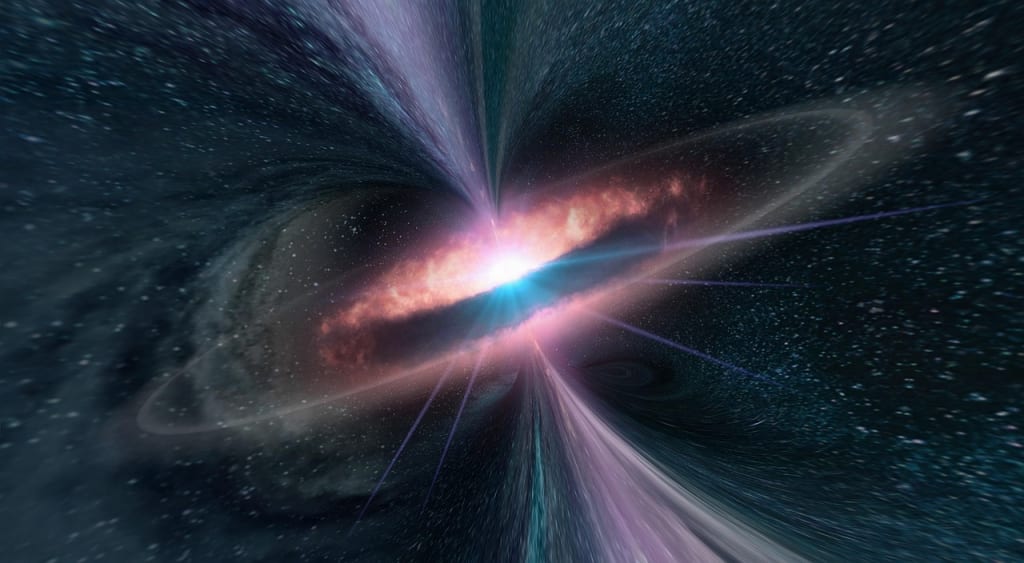
Black holes have long captivated the imagination as some of the universe's most enigmatic and intriguing entities. Their extraordinary gravitational force is so powerful that it prevents even light from escaping, rendering them both awe-inspiring and fearsome. Recently, astronomers identified a supermassive black hole, believed to be 600,000 times the mass of our Sun, on a path toward our galaxy. This colossal entity, obscured from direct sight, is gradually traversing space, prompting inquiries regarding its origins, path, and possible effects on the Milky Way.
The Discovery of the Hidden Black Hole
Astronomers identified this enormous black hole through indirect techniques, including the observation of gravitational influences on nearby stars and gas clouds. Given that black holes do not emit light, their existence is typically deduced from the behavior of surrounding celestial objects. In this instance, researchers observed peculiar distortions in the motion of stars within a neighboring galaxy, implying the existence of a massive, unseen entity.
Subsequent investigations indicated that this black hole is not fixed in place; rather, it is moving toward the Milky Way. While the precise speed and path of its trajectory are still under examination, its movement suggests that it may eventually engage with our galaxy in the far future.
How Big Is This Black Hole?
To provide context regarding its size, the mass of our Sun is approximately 2 × 10³⁰ kilograms. The recently identified black hole possesses a mass that is 600,000 times greater, categorizing it as a genuine cosmic giant. For reference:
• The supermassive black hole located at the center of our Milky Way, known as Sagittarius A*, has a mass roughly 4 million times that of the Sun.
• The largest known black hole, TON 618, boasts a mass that is 66 billion times that of the Sun.
Although this newly discovered black hole is not the largest ever observed, its trajectory towards our galaxy renders it particularly noteworthy.
Why Is It Moving Toward the Milky Way?
Black holes, including supermassive varieties, can exhibit movement as a result of gravitational interactions with other large celestial bodies. Several factors may account for their motion:
• Galactic Mergers: Over the course of billions of years, galaxies frequently collide and merge. If a black hole originated from a smaller galaxy that was assimilated by a larger one, it might be propelled through space as a consequence.
• Gravitational Rebounds: The merger of two black holes can generate gravitational waves that impart a "kick" to the newly formed black hole, propelling it at significant speeds along a path through the universe.
• Influence of Dark Matter: Some hypotheses propose that dark matter halos surrounding galaxies may affect the trajectory of black holes, drawing them toward larger formations such as the Milky Way.
Will This Black Hole Ever Reach Us?
The positive aspect is that although this black hole is heading towards our galaxy, it will take millions, if not billions, of years before it approaches closely enough to have any significant impact. The expanse of space is immense, and the distances between celestial bodies are staggering.
Nonetheless, if it ultimately merges with the Milky Way, the effects could be substantial:
• Gravitational Changes: Its powerful gravity might modify the orbits of stars and gas clouds, potentially causing some celestial objects to be ejected into space or drawn toward the galactic core.
• Star Formation: The collision could initiate new episodes of star formation as gas clouds become compressed.
• Galactic Development: Supermassive black holes are vital to the formation and evolution of galaxies. The merging of a new black hole with ours could transform the structure of the Milky Way over vast cosmic periods.
What Does This Mean for Earth?
Although the notion of a supermassive black hole nearing our vicinity may seem concerning, Earth is not at risk in the near future. The immense distances involved mean that even if a black hole were to enter the Milky Way, it is improbable that our solar system would be impacted directly.
Additionally, black holes only pose a threat when one is in very close proximity to them. The closest known black hole, Gaia BH1, is located approximately 1,560 light-years away, which presents no danger to us. The recently identified black hole is situated even farther away, ensuring that humanity remains safe for many generations to come.
The Importance of Studying Moving Black Holes
Findings such as this offer crucial understanding of supermassive black holes and the process of galaxy formation. By monitoring their movements, astronomers can:
• Gain deeper insights into the evolution and migration of black holes throughout the universe.
• Comprehend the influence of black holes during galactic mergers.
• Enhance techniques for identifying other concealed black holes in the universe.
Conclusion
The identification of a black hole with a mass equivalent to 600,000 suns heading towards the Milky Way serves as a testament to the universe's dynamic and constantly evolving character. Although its approach may span millions of years, its presence prompts us to rethink our comprehension of cosmic dynamics and the interactions between galaxies. Currently, there is no cause for alarm; rather, we should appreciate the astonishing forces that sculpt our universe and persist in uncovering the enigmas surrounding these colossal entities.
As technological advancements continue, astronomers will diligently monitor this concealed giant, revealing further insights into the cosmos and our role within it.
About the Creator
Keep reading
More stories from Tech Alamin and writers in History and other communities.
Astronomers Detect a Possible Signature of Life on a Distant Planet
Introduction Astronomers have discovered a potential biosignature in the atmosphere of a distant exoplanet, making a ground-breaking discovery that has the potential to alter our understanding of life in the universe. Scientists have found traces of a gas that is mostly made by living things on Earth using cutting-edge telescopic technology. One of the most compelling hints of extraterrestrial life to date, the findings are not yet conclusive.
By Tech Alamin9 months ago in History
The Rise and Fall of Nicolae Ceaușescu
Nicolae Ceaușescu’s rise to power was initially marked by promise, even optimism. Born in 1918 into a poor peasant family, he entered politics early, shaped by the ideological rigidity of interwar and wartime communism. When he became General Secretary of the Romanian Communist Party in 1965, following the death of Gheorghe Gheorghiu-Dej, many Romanians saw in him a younger leader, one who might soften the harsh Stalinist legacy that had defined the previous decades. For a society weary of repression and deprivation, Ceaușescu appeared to embody the possibility of cautious change.
By Pure child2 days ago in History
A woman from a vanished female dynasty was discovered buried with 270,000 beads.
In a Copper Age tomb close to Seville, Spain, the Montelirio bead assemblage contains over 270,000 beads that identify the ladies buried there as elites. The discovery is the biggest collection of beads ever
By Francis Dami4 days ago in History



Comments
There are no comments for this story
Be the first to respond and start the conversation.