
Why Do People Listen to Long Music Videos on YouTube?
Understanding a Growing Trend Beyond Clips and Songs

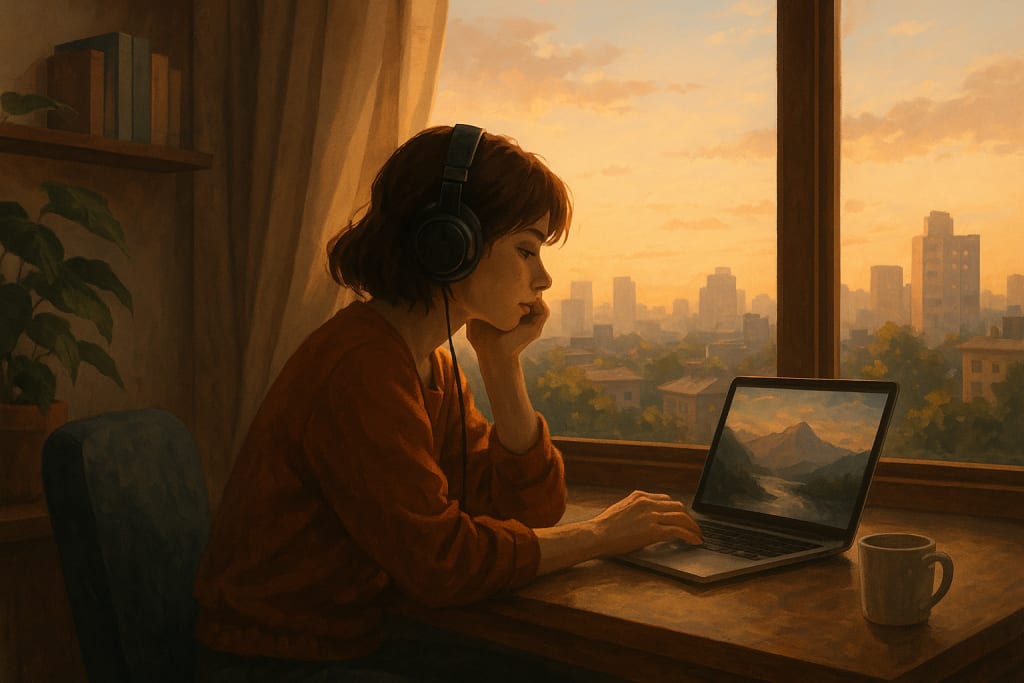
YouTube is no longer just a platform for music videos and official clips. Over the past decade, it has become a major space for music consumption in long formats—especially instrumental or ambient playlists that can last for hours. These videos often feature static or slightly animated visuals: a person studying, a train moving through a landscape, or a fantasy illustration with ambient lighting. They are often labeled as “lofi,” “study music,” or “ambient music.”
Why are these formats so successful? Who are the people who consume this type of content, and what are they looking for?
A Different Way to Listen
While services like Spotify or Apple Music dominate in music streaming, YouTube has established itself in a slightly different category. It is the favorite platform for what is often called “passive listening.” This includes background music for working, studying, traveling, or sleeping. Unlike Spotify, YouTube adds a visual dimension. The user is not just listening—there is often a screen involved, even in the background.
In a 2024 report by MIDiA Research, 23% of Gen Z respondents reported using YouTube as their main source of music—primarily for playlists or mixes with visual loops. And this trend is not limited to young people. Professionals working from home, students preparing for exams, and even airline passengers all use these long videos to create an immersive and controlled soundscape.
The Rise of Lofi and Ambient Channels
Channels like “Lofi Girl” or “Chillhop” now have millions of subscribers. A simple video titled “Lofi Hip-Hop – beats to relax/study to” can generate over 50 million views. Some streams run 24/7, attracting tens of thousands of listeners at any given moment.
Why does this work so well?
First, because the listener is not looking for intensity or musical surprises. They want consistency. A soft rhythm, familiar transitions, and no vocals to distract. In fact, the absence of lyrics is a major strength—allowing the brain to stay focused, especially when reading or writing.
Second, the visual creates an atmosphere. Even if it’s minimal—a cat sleeping on a windowsill, rain falling on a city—it gives context to the audio. Some people don’t even look at the screen, but knowing that the image is there is reassuring.
Finally, these formats are long. Sometimes 2 hours, sometimes 10. Unlike playlists that change constantly, YouTube videos often offer a single uninterrupted atmosphere.
A Tool for Concentration and Escape
In a world where everything moves fast, these long videos slow us down. They offer stability. For students under pressure or workers overwhelmed by notifications, they provide a mental refuge. It’s no coincidence that search terms like “focus music” or “study music” have seen sharp increases since the pandemic.
Many users report the same thing in comments: “This helps me survive my workday,” “This got me through finals,” or “I feel less alone with this music.”
It’s not just about music—it’s about mental state. Creating a sound bubble that helps separate oneself from the chaos of the outside world.
YouTube vs Spotify: Different Roles
While Spotify is still the undisputed leader in paid streaming (with nearly 700 million users, including 276 million paying as of 2025), YouTube remains a giant for free and visual content. YouTube Music has over 125 million subscribers, but it’s regular YouTube—with its endless music loops and calming scenes—that often draws the “ambient” audience.
The difference lies in usage. Spotify is for intentional listening—selecting artists, albums, or curated playlists. YouTube is for immersive environments. You open a tab and let it play. No ads if you’re subscribed, no interruptions, and always an image to go with it.
In that sense, YouTube doesn’t compete directly with Spotify, but rather complements it. One serves the active listener. The other, the passive one.
A Social and Emotional Relationship
Another surprising factor: the emotional attachment to these videos. Under a 3-hour lofi video, you’ll find thousands of comments like journal entries. People talk about their days, their struggles, their exams, their jobs. It becomes a kind of micro-community. You come for the music, but stay for the connection.
This “emotional proximity” also applies to creators. Lofi Girl, for example, has become a symbol—almost a friend. Viewers follow her animations, her cat, her books, as if it were a daily ritual. It’s soothing to return to the same character, the same rhythm, the same scene.
A New Way to Be Alone Without Feeling Alone
In a fragmented world, ambient music on YouTube offers something rare: presence. You’re alone, yes—but not isolated. The soft beats, the visual loop, the slow passage of time all create a sense of continuity. You can study, write, or travel while feeling accompanied.
It’s no longer just about listening to music. It’s about setting a mood, creating a cocoon, and feeling safe in a world that often feels too fast, too loud, too demanding.
So if you’ve ever wondered why a 4-hour YouTube video with almost no change in tempo or image has millions of views, now you know: sometimes, all people want is peace—and a soundtrack for it.
About the Creator
Bubble Chill Media
Bubble Chill Media for all things digital, reading, board games, gaming, travel, art, and culture. Our articles share all our ideas, reflections, and creative experiences. Stay Chill in a connected world. We wish you all a good read.
Keep reading
More stories from Bubble Chill Media and writers in Geeks and other communities.
The 996 Grind: When Expat Dreams Collide with China’s Work Culture
From Interpreter to Game Developer Jack Forsdike, a 28-year-old Brit in Guangzhou, moved from interpreting to developing video games for a Chinese company. At first, being told he’d work the infamous 996 hours felt like validation. He believed it meant he was trusted and on a path to success.
By Bubble Chill Media 5 months ago in Geeks
Silver Screen Magic with Mae West
American actress and singer Mae West became a popular film actress during the Great Depression. She started entertaining in vaudeville, then performed on Broadway, and finally went to Hollywood. She signed up with Paramount Pictures and made her debut in the 1932 film “Night After Night.” She also starred in musicals, comedies, and crime dramas. The American Film Institute named her one of the best classic Hollywood actresses.
By Rasma Raisters6 days ago in Geeks
Grant Gustin's Chances Of Returning As The DC Universe's Flash Have Just Increased After New Update
The Flash has yet to be cast for the new DC Universe, and after a new update, the rumors of Grant Gustin's return as Barry Allen in the new franchise have gained strength once again. Gustin made history by playing Barry for The Flash's nine seasons. The actor also starred in multiple Arrowverse crossovers, becoming one of the franchise's fan-favorites.
By Dena Falken Esq4 days ago in Geeks



Comments
There are no comments for this story
Be the first to respond and start the conversation.